

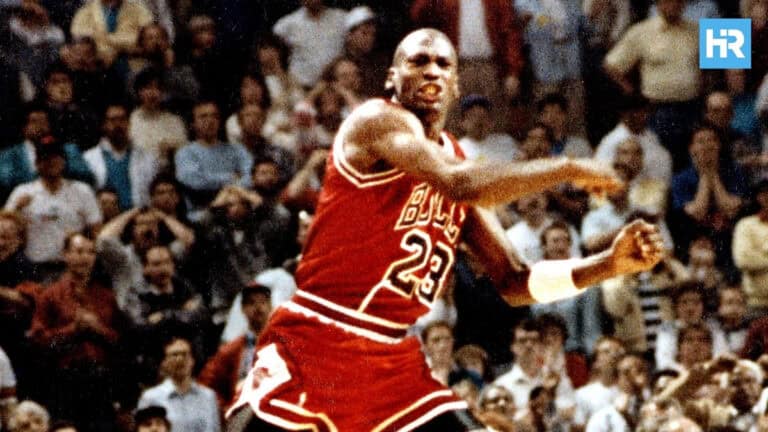
No sports documentary during the pandemic commanded attention the way The Last Dance did, drawing viewers back into the final chapter of Michael Jordan’s career with the Chicago Bulls. As the series approached its conclusion, the focus narrowed to Jordan’s final possession in Game 6 of the 1998 NBA Finals, the last shot he would take in a Bulls uniform and the play that secured the championship.
The jumper secured a title, became one of the most documented plays in basketball history, and produced an image later ranked number one on Sports Illustrated’s “100 Greatest Sports Photos of All Time.” The photograph was captured by Fernando Medina, positioned on the baseline while working for the NBA, at the instant Jordan released the shot that ended the Bulls’ dynasty.
- Michael Jordan scored 45 points and hit the game-winning 20-footer with 5.2 seconds left to secure an 87–86 Game 6 victory and the Bulls’ sixth NBA title in eight years.
- Fernando Medina captured the iconic photograph of the final shot, which was later ranked No. 1 on Sports Illustrated’s 100 Greatest Sports Photos of All Time.
- The photograph was created using the Flash Wizard system, linking multiple film cameras operated by NBA Photos during the 1998 NBA Finals.
Fernando Medina’s Early Life and Entry Into NBA Photography
Fernando Medina’s journey into professional sports photography began well before his presence on NBA baselines. At the age of 3, Medina and members of his family fled Cuba for the United States following Fidel Castro’s rise to power. His parents concluded that communist Cuba was “no place to raise a family or run a business.” Prior to leaving the country, the family had established itself as successful entrepreneurs. Medina’s father, Rosendo, operated a cardboard business, while his mother, Diolanda, worked with photographers producing wedding photo albums that included embedded music boxes.
After high school, Medina continued the family’s entrepreneurial tradition by starting an audio-visual company with friends. Connections formed through that business eventually led to an opportunity with the Orlando Magic. In 1989, he became part of the franchise’s inaugural photography team, working under Tony Smith. His initial responsibilities did not involve shooting games; instead, he was tasked with delivering slide photographs.
Medina developed his photographic skills through hands-on experience, learning alongside respected figures in the industry such as Barry Gossage, Andrew D. Bernstein, Nathaniel Butler, and Walter Iooss. His role expanded over time, and in 1996, he was appointed official team photographer for the Magic. The position allowed him to cover NBA games on a full-time basis and travel to document NBA Finals, All-Star Games, and additional league events for both the NBA and Getty Images.
Throughout his career, Medina’s photographs were distributed globally and appeared in publications including Sports Illustrated, ESPN, SLAM, Hoops, Beckett, Bravo Sport, Dunkshoot, and Forbes, in addition to various websites and hardcover books. His work was also featured by The New York Times, The Los Angeles Times, USA Today, The Sporting News, and NBA.com. While Medina never submitted his images to photography competitions, two of his photographs were selected as NBA Photo of the Year by Getty Images, and his work also received recognition from Sports Illustrated.
Game 6 of the 1998 NBA Finals
Game 6 of the 1998 NBA Finals was played on June 14, 1998, at the Delta Center in Salt Lake City, Utah, between the visiting Chicago Bulls and the Utah Jazz — the championship series for the 1997–98 NBA season and a rematch of the previous year’s Finals.
Both teams finished the regular season with identical 62–20 records. Utah defeated the Los Angeles Lakers in the Western Conference Finals, while Chicago beat the Indiana Pacers in the Eastern Conference Finals. The Jazz swept the Bulls 2–0 during the regular season, giving Utah home-court advantage.
The Jazz won Game 1, the Bulls won Games 2 through 4, and Utah extended the series by winning Game 5 at the United Center 83–81 after Michael Jordan missed a potential game-winning three-pointer at the buzzer. None of the Bulls’ previous five Finals appearances had gone to a Game 7.
In Game 6, the Jazz led 49–45 at halftime and 66–61 after the third quarter. Scottie Pippen aggravated a back injury on the opening basket and was limited to 8 points on 4–7 shooting in 26 minutes. Michael Jordan attempted 35 of the Bulls’ 67 shots, scoring 45 points in 44 minutes. Karl Malone led Utah with 31 points, 11 rebounds, and 7 assists.
With 41.9 seconds left, John Stockton hit a three-pointer to give Utah an 86–83 lead. Jordan responded with a layup, cutting the deficit to one. With 18.9 seconds remaining and Utah in possession, Jordan stole the ball from Karl Malone in the low post and dribbled down the court. Guarded by Bryon Russell, Jordan drove inside the three-point line, executed a quick crossover, and hit a 20-footer with 5.2 seconds left to give Chicago an 87–86 lead.
Stockton missed a final three-point attempt, and the Bulls won their sixth championship in eight years. It was the final shot Jordan would take as a member of the Chicago Bulls, his 25th game-winning shot for the team.
The Technology and Teamwork Behind “The Last Shot” Photograph
The photograph that captured Jordan’s jumper was not the result of chance alone. It was the culmination of more than five years of research and development by NBA Photos, which had been testing a system originally used by Sports Illustrated photographers known as the Black Box, later referred to as the Flash Wizard system.
At the time, photographers had to bring and install their own strobe lights in arenas. The Flash Wizard system allowed multiple cameras to fire simultaneously using a single burst of strobe lighting, accounting for lag times across different 35mm and 120mm film cameras. Development included hiring an engineer from MIT and testing shutter lag down to milliseconds, while working within the limits of 36 frames per roll, or 24 frames for Hasselblad cameras.
During Game 6, photographers Andrew D. Bernstein, Scott Cunningham, and Fernando Medina worked together. Bernstein was positioned in the lower corner, Cunningham in an elevated position near center-court TV cameras, and Medina on the opposite baseline. Bernstein controlled the remote trigger, while Medina and Cunningham acted as “human drones,” continuously composing and maintaining focus without pressing the shutter themselves.
NBA Photos credited images to the photographer who was holding and composing the camera, while stationary cameras were credited to the photographer who installed them. When Jordan rose for the shot, Bernstein’s view became obstructed, resulting in a blurred image, but Medina and Cunningham captured the moment cleanly.
The final image stood out because it included sideline-to-sideline framing, the shot clock, the scoreboard, and the fans. Among them was a young boy in a Bulls jersey surrounded by Jazz fans, holding up six fingers in anticipation of Chicago’s sixth championship.
Broadcast Records, Legacy, and Continued Discussion
NBC broadcast Game 6 live as part of NBA on NBC. The game earned a 22.3 Nielsen rating and a 38 share, averaging 35.9 million viewers. At least 72 million people in the United States watched some portion of the game, making it the most-watched NBA game in history.
The shot remains one of the most discussed plays in league history. In 2010, John Hollinger of ESPN ranked it fourth among the 50 best single-game performances. Officiating decisions involving Howard Eisley and Ron Harper continue to be debated decades later. Bryon Russell later stated, “Whether he pushed off or not, he was making that shot.”