


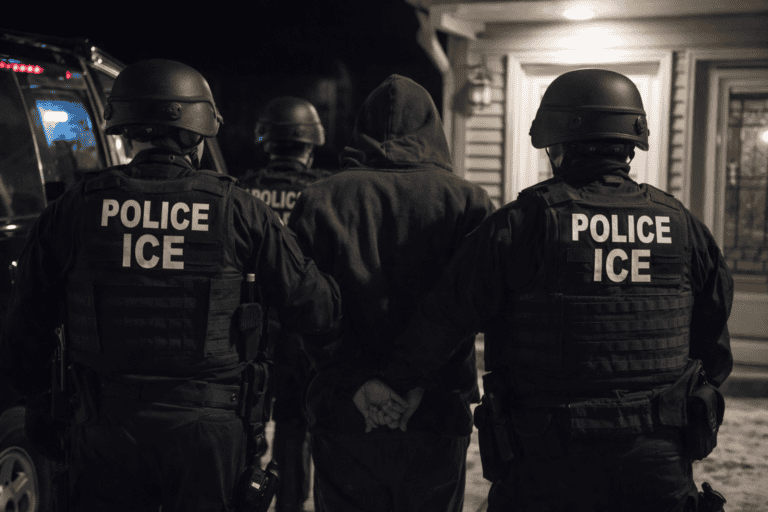
A legal dispute between the Trump administration and the State of New Jersey is now before a federal court in Trenton. On February 24, the U.S. Department of Justice filed a lawsuit against New Jersey and Governor Mikie Sherrill over Executive Order No. 12, which was signed and took effect on February 11, 2026.
- The U.S. Department of Justice sued New Jersey and Gov. Mikie Sherrill in federal court in Trenton over Executive Order 12, which took effect February 11, 2026.
- The order bars ICE, CBP, and other federal immigration agencies from conducting arrests or using nonpublic areas of state property, including correctional facilities and courthouses, without a judicial warrant.
- The case follows similar federal lawsuits against states and cities, including Minnesota, Colorado, New York, Chicago, Los Angeles, Denver, and four New Jersey cities — Newark, Jersey City, Paterson, and Hoboken, with that New Jersey case still pending.
What Executive Order 12 Does
Executive Order 12 restricts how federal immigration authorities can operate within nonpublic areas of state-owned property. The directive bars Immigration and Customs Enforcement (ICE), U.S. Customs and Border Protection (CBP), any similar or successor agency, and any other federal law enforcement agency assigned to civil immigration enforcement or working with ICE or CBP from entering, accessing, or using nonpublic areas of state property for enforcement actions unless they present a judicial warrant. It also prohibits the use of those areas as staging or processing sites for immigration enforcement.
The order applies to property owned, operated, leased, or controlled by New Jersey Executive Branch departments and agencies. According to the governor’s office, that includes state correctional facilities, residential medical facilities, child care centers, government offices, and state university dormitories. The Justice Department’s complaint specifically references arrests in nonpublic locations such as correctional facilities and courthouses.
Justice Department’s Legal Argument
In its filing, the Justice Department contends that New Jersey’s sanctuary policies violate federal law. The complaint states that the state’s refusal to cooperate with federal immigration authorities would lead to the release from police custody of individuals who would otherwise face removal. It cites illegal aliens convicted of aggravated assault, burglary, and drug and human trafficking as examples.
The lawsuit further asserts that Governor Sherrill, a Democrat who assumed office on January 20, “insists on harboring criminal offenders from federal law enforcement.” It accuses her of attempting to obstruct federal law enforcement and undermine President Donald Trump’s immigration crackdown. According to the complaint, the executive order “poses an intolerable obstacle” to immigration enforcement and “directly regulates and discriminates” against the federal government. The filing misspells the governor’s name as “Sherill.”
National Enforcement Effort
Attorney General Pamela Bondi initiated a review of state and local immigration-related policies on her first day in office, directing the Department’s Civil Division to identify laws and practices that facilitate violations of federal immigration laws or impede lawful federal immigration operations. The Department published a list of sanctuary jurisdictions on August 5, 2025, prior to the issuance of New Jersey’s Executive Order 12. The case filed on February 24 is described as part of a series of lawsuits brought by the Civil Division targeting sanctuary city policies nationwide, including actions in New York, Minnesota, and Los Angeles, California.
The Justice Department also sued Minnesota and Colorado last year, along with cities including New York, Chicago, Los Angeles, and Denver, over laws aimed at preventing police cooperation with immigration agents. In May 2025, the Trump administration filed suit against four New Jersey municipalities — Newark, Jersey City, Paterson, and Hoboken — over similar policies. That matter remains pending.
Response from State Officials
Governor Sherrill addressed the new lawsuit during an unrelated press conference on Tuesday, February 24. She said, “What I think the federal government needs to be focused on right now, instead of attacking states like New Jersey working to keep people safe, is actually training their ICE agents with some modicum of training, like any law enforcement officer in the state of New Jersey would have, so they can operate better and more safely.”
New Jersey’s acting attorney general, Jennifer Davenport, described the federal action as “wasting its resources on a pointless legal challenge.” She told NBC News that the state intends to contest the lawsuit and “continue to ensure the safety of our state’s immigrant communities.”
Prior Enforcement Activity and Federal Response
Executive Order 12 was issued after several high-profile ICE operations took place across New Jersey in recent weeks, prompting protests and calls for local protections. A spokesperson for the Department of Homeland Security previously criticized the directive. DHS spokeswoman Tricia McLaughlin told POLITICO that the order was “legally illiterate” and questioned its benefit to residents, asking, “How does this serve the people of New Jersey? The biggest losers are the people these politicians were elected to serve.”
It is unclear how often federal immigration agents previously relied on nonpublic state property in New Jersey for enforcement activities. Legal experts state that although states cannot block federal immigration enforcement outright, they are generally permitted to control access to property they own.