

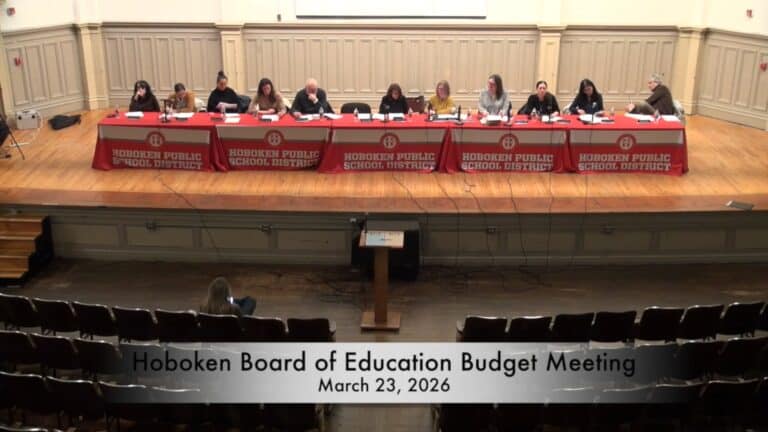
The Hoboken Board of Education (BOE) held a special meeting in March 2026 to present and approve a tentative school budget for the 2026–2027 scholastic year. The proposal totals $104,848,035, an increase of $16,436,133 compared with the prior year’s spending plan.
Superintendent Dr. Christine Johnson opened the presentation by describing the complexity of preparing the spending plan.
“This was a very challenging year in regard to the construction of a budget for so many reasons,” Johnson said. “In an effort to be as clear as possible and as transparent as possible, I’m going to present the most pertinent information first and then work backwards.”
- The Hoboken Board of Education approved a tentative $104,848,035 budget for the 2026–2027 school year, including a 27 percent increase in the school tax levy.
- The proposed tax levy totals $93,865,800, which is $19.9 million more than the previous school year.
- For the average Hoboken home assessed at $532,600, the change would mean $822.60 more per year in school taxes, or $68.64 per month.
Board Approves Preliminary Budget in 9–0 Vote
Following the presentation and discussion, the board approved the preliminary budget unanimously, 9–0, through the consent agenda.
The budget discussion comes as Hoboken City Hall faces a $17 million municipal deficit, adding pressure to the local tax environment.
Proposed Tax Levy Would Rise to $93.8 Million
The tentative budget includes a school tax levy of $93,865,800, which is $19.9 million higher than the 2025–2026 school year. This increase produces the 27 percent tax hike tied to the proposal.
Using the city’s estimate of the average Hoboken home value of $532,600, district officials calculated that the change would increase school taxes by $822.60 per year, equal to $68.64 per month.
Johnson said the home value figure was provided by the city earlier that day and could change slightly depending on updated assessment information.
Enrollment Growth Adds More Than 200 Students
Student enrollment growth is one factor behind the rising costs.
The district expects 211 additional students in kindergarten through 12th grade during the 2026–2027 school year compared with the previous year.
Johnson compared the increase to the size of an existing elementary school building.
“That 211 students would be like adding more than half of an additional Connors Elementary School in one school year,” she said.
The increase requires staffing and classroom resources for additional students throughout the district.
Healthcare Benefits Projected to Increase About 30 Percent
Healthcare benefits represent another cost driver in the proposed spending plan.
Johnson explained that the Hoboken Public School District participates in the New Jersey State Health Benefits Plan, which includes medical, dental, prescription, and vision coverage for employees.
Insurance brokers advised districts to prepare budgets using three potential ranges for healthcare cost increases:
- 35 to 37 percent as a conservative budgeting range
- 32 to 35 percent as a moderate range
- Below about 30 to 32 percent is considered potentially unrealistic for planning purposes
After questions from trustees, Business Administrator and Board Secretary Victoria Lopez confirmed the district budgeted for approximately a 30 percent increase in healthcare costs.
Johnson also explained that the district must address a previous shortfall. During the prior year, healthcare costs were under-budgeted by about $2.5 million, which contributes to the increase appearing larger in the new budget.
State Aid Increase Provides Limited Budget Impact
The district received a state aid increase of slightly more than $1.1 million, representing a little over a 4 percent rise in funding.
However, Johnson explained that only $411,171 of that increase can be applied to the 2026–2027 budget cycle.
Part of the reason is that $71,425 of the increase was designated for preschool aid, while Hoboken’s preschool enrollment has remained relatively stable. The district’s enrollment growth is occurring primarily in kindergarten through 12th grade, which limits how much the preschool funding can offset overall costs.
Charter School Payments Increase 9.65 Percent
Payments to charter schools have also risen.
Board President Ailene McGuirk said the district’s contributions to charter schools are 9.65 percent higher than the previous year. She linked those payments and insurance costs to the size of the tentative budget.
“I think this budget, while maybe when you look at it just from a dollars and cents standpoint may seem a little shocking, but as you dig deeper, it’s actually really a reflection of increased enrollment at a time when costs that are outside our control are increasing exponentially and we have to be able to account for those,” McGuirk said.
Additional Cost Drivers Include Special Education and Transportation
Other budget factors include expenses tied to special education tuition and transportation for students attending programs outside the district.
Utilities and instructional resources also contribute to the spending plan. Johnson explained that the district must continue funding textbooks, technology, classroom supplies, and furnishings for both current classrooms and new spaces needed to accommodate enrollment growth.
Preschool Classroom Relocation Adds Financial Pressure
Facility limitations inside Hoboken’s elementary schools have led to plans to relocate preschool classrooms.
The board approved a project to lease space at 38 Jackson Street, where preschool programs will eventually move. That relocation will not take place until the 2027–2028 school year.
For the 2026–2027 year, district officials are negotiating temporary lease agreements with other locations to house preschool classrooms. Johnson explained that these arrangements address space needs in elementary schools but also reduce the district’s rental revenue.
She added that moving preschool classrooms does not resolve space constraints at Hoboken Middle School.
Board Questions Address Revenue From PILOT Agreements
During the discussion, Trustee Antonio Graña asked about projected revenue from payment in lieu of taxes (PILOT) agreements.
Lopez explained that the district previously estimated $250,000 in PILOT payments, but the projects tied to that revenue had not yet come online. The district therefore adjusted its estimate for the new budget to match what was actually received.
“If we get more, it will be a pleasant surprise,” Lopez said.
County Tuition Proposal Could Add $750,000 in Future Costs
Trustee Tom Kluepfel asked whether financial issues at the Hudson County Schools of Technology might lead to tuition charges for local districts.
Johnson explained that the topic was discussed about a month and a half earlier during a county roundtable meeting. The proposal would have required local districts to pay tuition for students attending county vocational schools.
Officials later informed districts that the change would not be implemented this year, though Johnson said the discussion indicated it could happen in the future.
For Hoboken, the potential cost was estimated at about $750,000 annually, including transportation expenses.
Superintendent Plans Revenue Strategies and Partnerships
Johnson told the board she is preparing a comprehensive revenue generation plan that will be presented in the coming weeks.
The plan includes ideas such as expanding competitive grant applications, which the district has increasingly pursued in recent years. Johnson said she is also exploring partnerships with private out-of-district special education schools.
These discussions involve the possibility of satellite programs in Hoboken, which could reduce transportation expenses while bringing tuition revenue from students in other districts.
Johnson also mentioned potential programs focused on dyslexia and dysgraphia, though available classroom space remains a challenge.
Councilwoman Suggests Expanding Facility Use for Recreation
Second Ward Councilwoman Tiffanie Fisher was the only member of the public to speak during the meeting.
She acknowledged financial pressures affecting the state, county, city, and school district, adding that Hoboken itself expects a tax increase exceeding 20 percent.
Fisher suggested that the school district explore ways to generate revenue by increasing the use of school facilities. She referenced demand for recreational activities such as pickleball, explaining that thousands of adults now seek indoor recreation space in the city.
Fisher suggested that the district and city discuss whether school facilities could be used for expanded recreation programming, which could provide revenue for the district.
Public Hearing Scheduled for May 5
The board invited residents to provide feedback on the tentative budget through email at [email protected], an address monitored daily.
A public hearing is scheduled for Tuesday, May 5, where residents can comment on the proposal before the board moves toward adoption.
The final budget vote is scheduled for May 12 at the board’s regular meeting.