


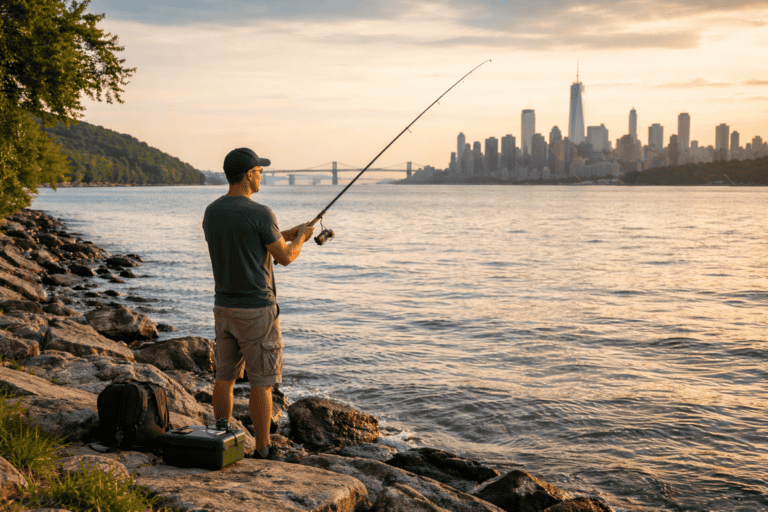
New York health officials released updated fish consumption advice on April 1, 2026, revising statewide guidance that includes fish caught in the Lower Hudson River between the Rip Van Winkle Bridge in Catskill and the Battery in Lower Manhattan.
Officials said declining contamination levels in certain species prompted the update. The advisory states that people can eat specific fish from this river section under strict limits.
State officials said the update follows testing that detected lower concentrations of polychlorinated biphenyls (PCBs) in several fish species. The chemicals have historically limited the consumption of fish from the Hudson River.
- New York State updated fish consumption guidance on April 1, 2026, permitting limited eating of certain fish from the Lower Hudson River for the first time in about 50 years.
- Pregnant women and children under 15 may eat one 8-ounce fish meal per month from specific species caught in the Lower Hudson River.
- Carp and smallmouth bass remain unsafe to eat, and environmental advocates say PCB contamination in the river still requires continued cleanup.
Consumption Limits Differ For Sensitive Groups
The advisory establishes separate consumption limits for two population groups.
Sensitive populations — defined as pregnant women, people who may become pregnant, and children under age 15 — may eat one fish meal per month, with a meal defined as 8 ounces.
These individuals may eat fish caught from the Lower Hudson River if they are one of the following species:
- Brown bullhead
- Striped bass
- Yellow perch
- White perch
The general population may eat up to four meals per month from approved fish species caught in the same portion of the river.
Fish frequently caught in the Hudson River that fall within these limits include striped bass and trout.
State health officials say several species remain unsafe to eat due to contamination levels. These include:
- Carp
- Smallmouth bass
Officials advise anglers to review local consumption guidance before eating fish caught in any New York waterway.
Health Officials Recommend Removing Fat To Lower PCB Exposure
The New York State Department of Health advises anglers to follow specific preparation steps when cooking fish from the Hudson River.
PCBs accumulate in fatty portions of fish tissue. Health officials recommend removing the skin and fatty sections before cooking.
Cooking methods that cause fat to drip away from the fish can reduce contamination levels in the meal.
According to the Department of Health, these preparation steps reduce PCB exposure by about half.
Industrial PCB Discharges Contaminate Hundreds Of Miles Of Riverbed
PCB contamination in the Hudson River originated from industrial discharges during the mid-20th century.
The U.S. Environmental Protection Agency states that two General Electric capacitor factories located in Fort Edward and Hudson Falls discharged more than 1 million pounds of PCBs into the Hudson River between 1947 and 1977.
The pollution contaminated approximately 200 miles of the riverbed.
PCBs were used for multiple industrial applications, including fire retardants, electrical insulation, coolants and lubricants in electrical equipment, and components in paints and sealants.
The chemicals were banned in the United States in 1979 due to their toxicity and environmental effects.
The Hudson River was later designated a federal Superfund site in 1984, beginning long-term environmental cleanup and monitoring.
PCBs persist in the environment and increase in concentration as they move up the food chain. Health effects linked to PCB exposure include thyroid disease and birth defects.
Cleanup and monitoring of the river have continued for more than 20 years.
Environmental Advocates Warn Cleanup Work Is Not Finished
Environmental groups say PCB contamination still affects fish in the Hudson River.
“Eat the fish, but don’t go crazy if you are in the general population,” said Drew Gamils, senior attorney for Riverkeeper.
Gamils said sensitive groups should follow strict limits.
“I’d have to caution women under 50 and children under 15. [They] should be very cautious of how much they’re eating because the change allows them to eat one fish meal per month. It’s very limited. And definitely no feasting. Nobody should feast.”
Gamils said the advisory change applies only to a small section of the river.
“It’s extremely limited. These are not crazy changes,” he said. “This is not ‘Go and eat the fish without any restrictions.’ And we’re dealing with a very small portion of the river.”
He also said contamination levels remain above cleanup targets.
“We’re not reaching those targets. As far as the cleanup goes, we think more work is needed to eliminate or continue to reduce PCBs in the Hudson River and in fish,” Gamils said.
“They’re not declining enough where we can say PCBs are no longer a problem in the Hudson River and efforts through the Superfund program are still ongoing to continue to reduce.”
State Agencies Continue Annual Testing Of Fish Across New York Waters
State regulators monitor fish contamination levels through ongoing sampling programs.
Each year, more than 1,000 fish samples are tested to determine whether consumption advisories should be updated.
“New York’s waterways are world-renowned for abundant fishing opportunities,” said New York State Department of Environmental Conservation Commissioner Amanda Lefton.
“It remains critical to advise of any potential health risks from contaminants that may build up in fish tissue in certain bodies of water so that anglers can make well-informed choices about consuming their catch.”
Lefton said the Department of Environmental Conservation works with the Department of Health to monitor contamination and update public guidance.
“DEC prioritizes cleaning up contaminants and restoring water quality to support fish consumption and will continue to work with our partners at the Department of Health to track and address harmful contaminants and use the latest science and data to help protect public health and our shared environmental resources.”
The advisory change also drew comment from New York State Health Commissioner Dr. James McDonald.
“It’s a great day when the Department can relax guidance for certain fish in the lower Hudson River, allowing people who may become pregnant and children to eat fish from one of the most important fisheries in New York State,” McDonald said in an online statement.
Wildlife Sightings Along The Hudson Suggest Ecosystem Recovery
Wildlife sightings along the Hudson River have increased in recent years.
In 2021, observers near the Hoboken waterfront reported seeing an Atlantic sturgeon swimming in the river. The species has a bony, plated appearance and is often described as prehistoric.
Atlantic sturgeon inhabit rivers and coastal waters along the East Coast, using rivers and estuaries as spawning areas before migrating to the ocean.
All five populations of Atlantic sturgeon are currently classified as endangered or threatened because of overfishing and habitat loss.
Additional wildlife sightings followed in 2022. A dolphin swam with kayakers near the Hoboken Boathouse, and a baby seal appeared along the Hudson shoreline in Hoboken.