

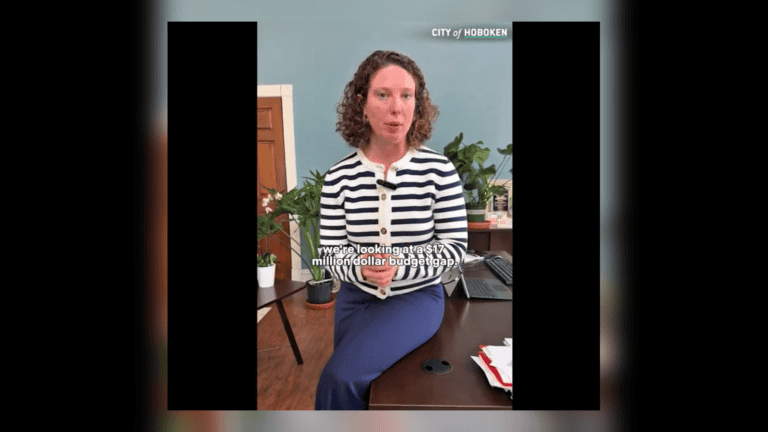
Hoboken Mayor Emily Jabbour announced that the city’s initial municipal budget contains a roughly $17 million deficit, a gap that could lead to a municipal tax increase exceeding 20 percent before any spending reductions or new revenue sources are considered.
Jabbour delivered the update through a video posted on Hoboken’s social media pages. The preliminary figures represent the starting point of the budget process before revisions, cuts, or adjustments.
The mayor explained that closing the $17 million gap may require a tax increase of more than 20 percent if the city does not reduce spending or generate additional revenue.
- Hoboken’s preliminary budget shows a $17 million deficit, and closing the gap could require a municipal tax increase of more than 20 percent, according to Mayor Emily Jabbour.
- Rising costs are driving the shortfall, including about $3 million in health insurance expenses, nearly $2 million in infrastructure debt payments, and around $3 million in contractual salaries and public safety staffing.
- The city’s budget surplus fell from $24.1 million in 2018 to about $10.4 million today, while the proposed municipal tax increase would equal roughly a 6–7 percent rise overall when combined with county and school taxes.
Expenses Driving the Budget Gap
Jabbour identified several cost increases that contribute to the deficit. These include state requirements and financial commitments from previous agreements.
#Hoboken, you deserve transparency, especially when it comes to how your tax dollars are being used. In New Jersey, we are required to pass a balanced budget each year, and that means making thoughtful decisions about how we spend and invest in our community. pic.twitter.com/EDb0Qy6JgZ
— City of Hoboken (@CityofHoboken) March 3, 2026
Health insurance expenses account for approximately $3 million of the additional costs in the proposed budget.
Debt payments tied to infrastructure projects contribute nearly $2 million in spending. These payments are associated with projects described as critical infrastructure improvements.
Contractual salary obligations and required public safety staffing add around $3 million more to the budget.
These three categories—health insurance, infrastructure debt payments, and contractual salaries with public safety staffing—represent a substantial share of the projected deficit.
Decline in the City’s Budget Surplus
Financial reserves available to help cover expenses have decreased during the past several years.
According to Jabbour, Hoboken’s budget surplus was approximately $24.1 million in 2018. The surplus is now about $10.4 million.
The decrease occurred during the administration of Ravi Bhalla, who served two terms as Hoboken’s mayor from 2018 through 2025. Bhalla currently serves as a state assemblyman for New Jersey’s 32nd Legislative District.
During those years, Jabbour served as a councilwoman-at-large and voted in favor of each municipal budget presented to the city’s governing body.
Credit Rating Outlook and Changes to the Budget Process
Last month, S&P Global Ratings assigned Hoboken a negative debt rating outlook.
Following that development, Jabbour revised the city’s budgeting process. The new approach includes a public survey and open workshops before the budget is formally introduced.
The process also involves seeking feedback from City Council members prior to the mayor’s introduction of the budget, a step that had not been part of previous budget cycles.
City Council’s Role in Budget Approval
Under Hoboken’s municipal structure, the mayor introduces the budget. Approval requires votes from at least five members of the City Council.
Second Ward Councilwoman Tiffanie Fisher described the new approach as an opportunity for council members to review the plan earlier in the process.
Fisher also explained how municipal taxes affect the full property tax bill paid by residents. Hoboken’s tax bill includes three components: the municipal government, Hudson County, and the local board of education.
A 20 percent increase in the municipal portion would equal approximately a six to seven percent increase overall if the county and school budgets are not included in the calculation.
Fisher stated that she will provide additional input once the public survey is released.
Council Concerns About Spending and Taxes
First Ward Councilman Paul Presinzano addressed the city’s budgeting practices and the issue of affordability.
Presinzano stated that responsible budgeting requires discussion of expense reductions before considering tax increases. He also said that the term “cut” had not been used in city budgeting discussions for several years.
He referenced the recent municipal election, which centered on affordability.
Presinzano stated that both renters and homeowners will feel the impact of a tax increase. He also warned that the current fiscal pattern could continue in future years.
Effects on Hoboken Residents
A municipal tax increase would affect property owners and tenants throughout Hoboken.
Property tax increases often lead landlords to raise rents, which can extend the financial impact to renters.
Hoboken is one of New Jersey’s most densely populated municipalities, and housing costs are a concern for many residents.
The potential tax increase arrives as city officials review spending levels, financial reserves, and required expenses.
Ongoing Budget Review
Jabbour’s administration is examining options to close the $17 million deficit before introducing the final budget proposal.
These options include identifying additional revenue sources, improving operational efficiency, and reducing expenses across municipal departments.
Public surveys and budget workshops are scheduled to gather input from residents before the City Council considers the proposal.