


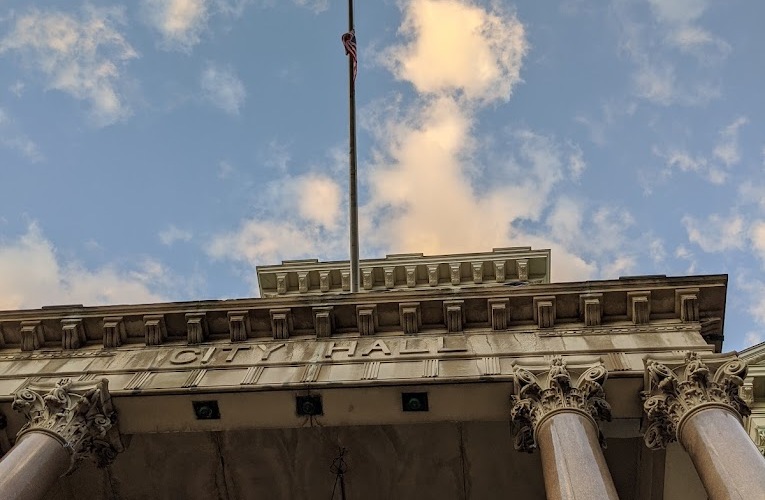
Jersey City councilmembers are considering whether to approve outside legal representation for two police officers sued over the Aug. 27, 2023, fatal shooting of Andrew Washington. The issue surfaced during a City Council caucus ahead of a vote scheduled for a 6 p.m. meeting inside City Hall at 280 Grove St., which will also stream live on Microsoft Teams. Washington’s aunt, Toni Ervin, is scheduled to address the council before the vote.
- Jersey City officials are considering outside legal representation for Officers Stephen Gigante and Felix DeJesus, defendants in a civil lawsuit over the Aug. 27, 2023 fatal shooting of Andrew Washington.
- In April 2025 a New Jersey grand jury voted “no bill,” declining to criminally charge Gigante after reviewing evidence that included a 911 call, body-camera footage, witness interviews, photographs, ballistics reports, and autopsy results.
- Washington’s death during a mental-health crisis led to statewide policy changes, including a $12 million Community Crisis Response Pilot Program and revised use-of-force rules.
Councilmembers Seek Clarification on the City’s Legal Obligations
The council is reviewing two resolutions that would authorize hiring attorneys for Officer Stephen Gigante and Officer Felix DeJesus, both defendants in a wrongful death lawsuit filed by Washington’s family against the city and the police department.
Councilmembers Mike Griffin, Frank “Educational” Gilmore, Jake Ephros, and Elena Little asked whether the city must provide representation and what could happen if the council rejected the proposal or abstained.
“I just want to understand the consequences of a no vote or abstention,” Ward D Councilperson Jake Ephros said.
Corporation Counsel Sarah Levine explained that municipalities must provide legal representation to employees sued for conduct performed during official duties.
“The city has a legal obligation to obtain representation … for city employees and officers who are sued for conduct in their official business,” Levine said.
She explained that the city cannot directly represent the officers in this case because their legal interests may differ from the city’s.
“In this case, there are two separate officers with whom the city has a legal conflict because the city’s interest, the city’s legal position, could diverge from the officers,” Levine said. “The officers are separately situated from each other.”
If the city failed to provide representation, Levine said the officers could take legal action against the city.
“We have a legal obligation to represent these two officers. If we fail to, they could sue the city, and they would likely prevail.”
Two Law Firms Proposed for Officers Named in the Same Lawsuit
Ephros asked why the council was considering two separate resolutions for attorneys when the officers are defendants in the same case.
Levine explained that each officer requires separate counsel because their legal interests could conflict.
“These are defendants in the same case,” Levine said.
Ward E Councilwoman Elena Little asked whether declining representation would leave the city responsible for reimbursing the officers later.
“If we were to refuse to provide them legal representation … it would essentially be gifting the officers money. Is that your assessment?” Little asked.
Levine replied that the officers could pursue reimbursement for legal costs. She added that providing counsel to municipal employees is required by state law, although councilmembers retain authority over the vote.
Councilman Frank Gilmore asked about potential liability if the case proceeds to trial and the plaintiffs prevail.
“If we get to a point where no agreement or settlement can be reached and we go to court and the plaintiffs win … at what point does the onus fall back on them?” Gilmore asked.
“This is a very thorny legal question … There are no clear lines on this issue,” Levine replied.
Gilmore also asked whether the city must still provide representation if an officer committed an infraction.
“That’s correct,” Levine said.
When Gilmore asked whether the obligation would continue if an officer were terminated, Levine explained that those circumstances are highly specific and rarely encountered.
Questions Raised About Legal Costs and Outside Representation
Ward C Councilman Tom Zuppa, a former assistant Hudson County prosecutor, asked whether the city continues defending itself in the lawsuit while hiring outside counsel for the officers.
“The city is still defending them actively right?” Zuppa asked.
Levine explained that the city continues defending itself and other officers who do not have legal conflicts with the city.
“The city is still defending itself as well as all of the other officers who do not have conflicts with the city’s interests,” she said. “It is just the two officers who are named defendants who do have specific conflicts who we’re engaging outside counsel for.”
Zuppa also questioned the proposed legal fees.
The contracts permit attorneys to bill $225 per hour with a cap of $65,000.
“In my experience, these attorneys are going to piggyback off everything the city does as lead counsel … and double up their work,” Zuppa said.
Levine replied that the rates had been negotiated down.
“This is not a back door for these firms to provide additional services … This hourly rate and this number of hours is what is necessary for this contract,” she said.
She also explained that finding attorneys willing to take the case proved difficult because the matter has drawn national attention and is being litigated in federal court.
“It was difficult to obtain representation in this case,” Levine said. “This is a case with potentially high exposure for the city. It is a case that has very high national attention, high profile matter.”
If the council approves the measure, Gigante would be represented by Cedar Grove-based O’Toole Scrivo, LLC, where Port Authority Chair Kevin O’Toole is a managing partner. DeJesus would be represented by Philadelphia-based Bennett, Bricklin & Saltzburg, LLC.
Councilman Michael Griffin said his personal connection to Washington’s family affected his decision.
“We have personal relationships with the family, so I’m looking at abstaining,” Griffin said. “I can’t vote on this.”
Police Response to a Mental Health Crisis on Aug. 27, 2023
Andrew Washington, 52, died on Aug. 27, 2023 after his family called for help while he was experiencing a mental-health crisis at his apartment building on Randolph Avenue in Jersey City.
According to the investigation, at approximately 2:36 p.m. the Jersey City Police Department responded to a 911 call from Jersey City Medical Center reporting an emotionally disturbed person alone in his home.
When officers arrived, they spoke with Washington’s family members outside the residence. Relatives said a neighbor had called earlier that day after hearing loud noises and banging from Washington’s apartment.
Family members also told officers that Washington had bipolar disorder, believed he had stopped taking his medications, and needed to go to the hospital. According to the lawsuit filed later by the family, Washington had bipolar disorder, schizophrenia, and episodes of psychosis involving auditory hallucinations.
A sergeant notified a supervisor and requested assistance from the Jersey City Police Emergency Services Unit after officers, medical workers, and a crisis interventionist were unable to resolve the situation.
Negotiation Efforts Before Officers Entered the Apartment
Emergency Services Unit officers arrived at approximately 2:57 p.m. and spoke with family members outside the building.
Officer Felix DeJesus had interacted with Washington about two weeks earlier when he helped Washington go to the hospital following a mental-health incident. DeJesus asked relatives about Washington’s condition, but they said Washington would not speak with them.
Beginning at approximately 2:59 p.m., ESU Officer Stephen Gigante, a trained negotiator, spoke with Washington through the closed apartment door.
For about thirty minutes, Gigante attempted to persuade him to come out and seek help. Gigante told Washington he was not in trouble and that officers were there to check on his well-being.
During the conversation, Washington said he was seeing ghosts and referred to a “suicide mission.” Eventually, he stopped responding.
At approximately 3:14 p.m., supervisors approved a forced entry after officers had not heard from Washington for a period of time and became concerned for his safety.
Officers planned a “breach and hold,” which involves forcing open the door and pausing before entering.
Officers Breach the Door and Use a Taser and Firearm
Gigante stood at the top of the staircase directly in front of the apartment door, holding a tactical shield and his service weapon. DeJesus positioned himself on a landing outside the door with his CED device drawn while other ESU officers stood behind Gigante on the stairs.
At 3:28 p.m., Gigante breached the door.
Washington stood several feet from the doorway inside the apartment. Gigante shouted, “He’s got a knife, drop the knife, drop the knife.”
Washington advanced toward the officers, holding a large knife in his right hand. As the door began to close, Washington opened it and continued advancing.
DeJesus deployed his Taser while Gigante fired two shots from his service weapon.
Washington fell onto the landing at the top of the stairwell. Officers recovered a knife measuring approximately 13 inches next to him.
Emergency medical personnel who had been waiting outside entered and provided first aid. Washington was transported to Jersey City Medical Center, where he was pronounced dead at approximately 4:47 p.m.
Audio recordings of the 911 call, police radio transmissions, and police body-camera footage were released publicly, though Washington’s family initially asked that additional body-camera footage be released.
Grand Jury Decision and Continuing Civil Lawsuit
In April 2025, a New Jersey grand jury declined to criminally charge Gigante.
Jurors reviewed evidence that included the 911 call, body-camera footage, witness interviews, photographs, ballistics reports, and autopsy results before voting “no bill.”
The decision followed statements from Jersey City Mayor Steven Fulop and Public Safety Director James Shea, who defended the officers soon after the shooting.
Washington’s family continues a civil rights lawsuit against the city and the police department.
Amelia Green, a partner at Neufeld Scheck Brustin Hoffmann & Freudenberger, LLP, represents Washington’s sister, Courtnie Washington, in the civil case.
“We are disappointed by the grand jury’s decision,” Green said in a statement. “We must be clear, however—this is not an exoneration of the officers who killed Andrew Washington.”
“We will prove these officers violated Drew’s constitutional rights in multiple ways when they shot and killed him when he was in the midst of a mental health episode,” Green said.
“Drew’s death is the result of ongoing systemic failures by the Jersey City Police Department in its interactions with those with mental health disabilities. The grand jury’s decision only makes the family’s civil rights lawsuit all the more important in holding the Jersey City Police Department accountable for Drew’s death.”
Statewide Programs and Policy Changes After Washington’s Death
Washington’s death occurred five months after Paterson police shot and killed community activist Najee Seabrooks, 31, during a standoff in March 2023. A grand jury later declined to indict the officers involved in that case.
In January 2024, Gov. Phil Murphy signed legislation named for Washington and Seabrooks.
The law created the Community Crisis Response Pilot Program and allocated $12 million to support programs in six counties.
The program is administered by the Office of Alternative and Community Responses, established in March 2024 by Attorney General Matt Platkin.
Following a competitive grant process, organizations in Camden, Newark, Paterson, Trenton, and Jersey City received approximately $2 million each to develop local crisis response teams.
The Jersey City initiative includes the Anti-Violence Coalition of Hudson County.
These teams provide community-based services such as outreach, de-escalation, stabilization, and connections to resources for individuals experiencing behavioral health crises.
The programs complement existing initiatives operated by the Department of Law and Public Safety, the Department of Health, and the Department of Human Services, including ARRIVE Together and community-based violence intervention programs.
Jersey City announced participation in ARRIVE Together in October.
Pam Johnson, executive director of the Anti-Violence Coalition of Hudson County and a candidate for city council in Ward A, criticized the current system.
“The core of this is that the system is broken for those who need it the most,” Johnson said. “We watch these decisions unfold in front of us and then we expected to pick up the pieces and just move forward and continue to fight! This is extremely frustrating to watch.”
Changes to Statewide Use-of-Force Policy
In August 2024 Attorney General Platkin announced revisions to New Jersey’s statewide use-of-force policy.
The changes require police responding to barricaded individuals — particularly those experiencing behavioral, mental health, or substance use crises — to contact designated tactical teams that include trained crisis negotiators so those incidents are handled by specialized units.
Council Receives Updates on Animal Control and Franklin Street Bike Lane
During the same caucus meeting, the council also heard updates from Division of Animal Care & Control Director Mark Byrnes.
Byrnes took over the division two years ago after the city brought animal control services in-house following problems with Liberty Humane Society.
He described a pet food pantry created to help residents who cannot afford to keep their animals.
“People are just unable to keep their own cats and they’re releasing them into the streets, so in order to get ahead of that, we started the pet food pantry, where we are accepting donated food,” Byrnes said. “When you call us and say that you can’t keep your animal, if we can, we’ll feed your animal for you.”
He said abandoning cats increases costs.
“It costs us more money in the long run when cats are just let out and you pretend like you never had it,” Byrnes said.
The department also supports trap-neuter-return programs that provide reduced rates for registered caretakers of feral cat colonies.
“That works out for us, because we then know where these colonies are, and we have a much better gauge on how many feral cat colonies we’ll have within the boundaries of the cities,” Byrnes said.
“Last year, we fixed 900 feral cats in the city, so if having reproduced that’d be almost 5000 cats that would be roaming in the city right now, not vaccinated, potentially catching and spreading disease, specifically rabies … we’d have a health crisis on our hands, at least potentially.”
Councilmembers praised volunteer cat rescue groups.
“Those ladies are the best. They’re everywhere. I hope we can figure out a way to get them some funding,” Gilmore said.
Councilwoman Mamta Singh said the city should consider financial assistance.
“I think eventually we should come up with a plan where we can compensate them or raise funds so at least they don’t have to spend money from their pockets,” Singh said.
Byrnes also received authorization to hire an in-house veterinarian.
“It’s not fair to the taxpayers of Jersey City to pay a vet to treat someone’s animal,” Byrnes said. “When someone has bred 20 cats in their house, it doesn’t cost the taxpayers $5,000, it cost the taxpayers a day of our surgeon’s work.”
Infrastructure officials also addressed the proposed Franklin Street bike lane near Stop & Shop, Charles E. Trefurt School (P.S. 8), and a cardiology clinic.
Acting Deputy Public Safety Director Loren Hart said a fire department “snapshot” study found about a one-minute increase in response time for four or five calls.
When Councilman Tom Zuppa asked about firefighters continuing to deliver “excellent service,” Hart said: “I would say that we are concerned about the increase in response times, but we always go above and beyond to protect our residents.”