

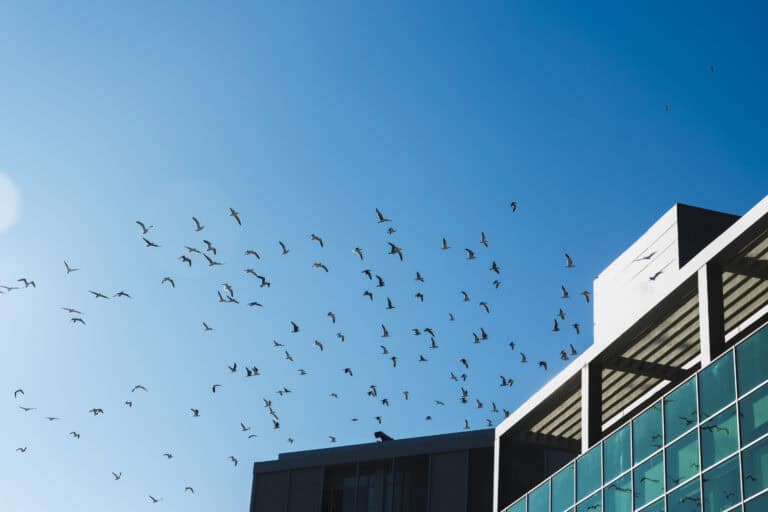
Ordinance 26-008, which regulates bird-safe materials for buildings, has been reintroduced to the Jersey City Council agenda. The measure is identical to the version vetoed last year by Mayor Steven Fulop due to concerns about development costs. Its return surprised advocates, the planning department, and members of the council.
- On February 10, Jersey City’s planning department stated that cost scenarios presented by opponents were “wild” and said claims that the ordinance would burden development are “false.”
- Ordinance 26-008 would apply bird-safe material requirements to all new construction, rehabilitation, and additions citywide.
- Proposed amendments include lowering the height threshold from 100 feet to 75 feet, permitting “low-cost” compliance methods such as interior solar shades, and exempting projects that do not require site plan review.
Dispute Over Construction and Cost Claims
Lorraine Freeney, founder of Jersey City Birds, wrote that claims describing bird-safe development as harmful to construction and affordable housing are inaccurate. She stated that Better Blocks NJ, a pro-developer group, has opposed the legislation for months and portrayed it as anti-development and anti-affordable housing.
Freeney wrote that the ordinance has widespread public backing and strong support from Mayor Solomon. It came back before the council after what she described as an unpopular veto by Fulop based on inaccurate claims.
During the February 10 caucus meeting, Jersey City’s planning department addressed data shared with the council by opponents. When asked whether that information had been misleading, planning responded affirmatively and stated they wished to go on record “to dispel the myth of this being more costly.” They described the cost scenarios presented as “wild.”
Planning officials also stated that claims that changes to zoning and design standards would create a costly burden on development are false.
Freeney wrote that the arguments used by Better Blocks demonstrate a misunderstanding of bird-friendly design. She stated that experts at the American Bird Conservancy, with whom Jersey City Birds regularly consults, have studied the issue for decades. According to Freeney, drafting the ordinance required expertise in housing policy, migratory patterns, and wildlife challenges in urban environments, and experts in planning and at the American Bird Conservancy wrote the ordinance.
She wrote that proposed amendments from Better Blocks should be treated with caution and stated that, to her knowledge, the group has not consulted with the American Bird Conservancy.
Geographic Scope and Application of Standards
Better Blocks NJ has pushed for a narrower version of the ordinance that would require bird-safe materials only for buildings near parks and high-risk zones like the waterfront. The group has also proposed requiring remediation for properties with documented high numbers of bird collisions.
Freeney wrote that limiting standards to parks and waterfronts is not sound policy. She cited studies showing that birds are drawn by artificial light into the densest areas of cities during migration and away from what would conventionally be considered natural habitat.
Ordinance 26-008 applies to new construction only. Retrofitting existing buildings would require a different approach. Freeney wrote that she looks forward to Better Blocks supporting remediation efforts in the future.
Planning Board Action and Possible Revision
Originally, the ordinance applied only to new construction that reached the site plan review threshold. When the Jersey City Planning Board unanimously and enthusiastically approved the ordinance last September, they added an amendment applying it to all new construction.
Freeney wrote that she has signaled support to the council for reconsidering that amendment to alleviate potential burden on the planning department. She described this as addressing concerns from planning and council while maintaining the ordinance’s intent and efficacy.
Council Discussion and Administrative Concerns
At the caucus meeting, planning officials stated they would prefer the ordinance exempt buildings that do not require a site plan.
Ward C Councilman Tom Zuppa, described as a staunch ally to union workers and a champion of affordable housing projects such as 701 Newark, raised concerns about the unintended costs of the ordinance.
Ward E Councilperson Eleana Little, described as an advocate for environmentally sustainable cities and transit-oriented development, suggested that compromise may be possible between housing affordability advocates, such as Better Blocks members, and ordinance advocates who are members of Jersey City Birds.
A representative from Better Blocks wrote that they would welcome a compromise and presented amendment proposals based on discussions with planning and council members.
Proposed Amendments from Better Blocks NJ
The first proposal calls for explicitly permitting “low-cost” methods for preventing bird strikes within the ordinance’s language. These methods would apply to all window openings where transparency is required for residential and commercial uses. Examples include interior solar shades in place of costlier exterior architectural elements or specialized windows.
The second proposal recommends lowering the height applicability from 100 feet to 75 feet. Better Blocks stated that most bird strikes occur within the first 40 feet of height and that a 75-foot threshold would correspond with New York City’s standards.
The group argued that higher height requirements burden smaller home builders more than larger waterfront developers. They provided cost comparisons: compliance for a 50-story high-rise building may equal 1–2% in added costs, while for a smaller mid-rise building, glass costs could add 5–6% to the total budget.
The third proposal supports granting the planning department’s request to exempt projects that do not require a site plan. Better Blocks also proposed considering exemptions for five-over-one “stick” construction, describing these as the most affordable type of new housing produced in Jersey City. These buildings typically have smaller windows and a higher opaque façade-to-window ratio, which they described as presenting a lower threat profile.
Better Blocks wrote that, as drafted, the ordinance would place a tremendous burden on the planning department by requiring review of all new construction, rehabilitation, and additions and by adding a new administrative task to an already busy department.
Current Status
Ordinance 26-008 remains before the Jersey City Council. Supporters have expressed interest in seeing it pass for a second time and be signed into law by Mayor Solomon. Opponents continue to advocate for amendments addressing cost, height thresholds, and project exemptions.