
Home Blog Page 46

Weehawken Trails: The Top Picks for Your Next Outdoor Adventure

What are your plans for this weekend?

If you’re still deciding, how about exploring the beautiful trails near Weehawken?

Taking time to explore the outdoors can be one of the most refreshing things you can do, especially if you’ve been feeling cooped up or burned out lately.

That’s why we’ve done the hard part for you and put together a list of top trail recommendations.

Plus, these are the trails with great reviews from hikers online and some personal touches from our experiences.

So, let us guide you to the perfect outdoor adventure for your weekend!

Key Takeaways
  • If you want a simple city walk with great views, the High Line is a 1.5-mile path above the streets with gardens, benches, and art.
  • If you enjoy walking by the water, Liberty State Park has a 4.8-mile trail with clear views of the Statue of Liberty and New York City.
  • If you like history and amazing sights, the Brooklyn Bridge Walk is a 1.1-mile path with views of the river, Manhattan, and Brooklyn.

1. Liberty State Park

Liberty State Park in Jersey City is a big, open park where you can enjoy walking and taking in some of the best views of New York City.

The trail is 4.8 miles long, easy to follow, and gives you amazing sights of the Manhattan skyline and the Statue of Liberty.

Along the way, you’ll also pass landmarks like the Columbus Monument and the Liberation Monument.

The trail has smooth paved paths and natural walkways, so it’s great for walking, jogging, or a relaxed family stroll.

There’s even an Interpretive Center where you can stop to learn more about the park and its environment. It’s a nice way to add a little education to your outing.

If you have a dog, you’ll love that the park is pet-friendly, as long as your dog is on a leash.

One of the best times to visit Liberty State Park is at sunset.

The sky lights up with beautiful colors, and you can enjoy stunning views of the skyline and the Statue of Liberty as the sun sets behind them.

2. High Line

The High Line in Manhattan is not your typical trail—it’s an old railway line turned into a walkway above the city streets.

It’s about 1.5 miles long and 30 feet above the ground, with plants, seating areas, and great views of the Hudson River and the city.

The pathway is flat and easy to walk, with plenty of spots to stop, sit, and enjoy the surroundings.

Perhaps the most interesting thing about the High Line is how you’ll find nature, art, and city views all in one place.

The walkway is lined with gardens carefully designed to match the neighborhoods you’re walking through.

You’ll see flowers, trees, and plants that make the space feel calm and green.

Along the trail, there are also changing art pieces, such as sculptures and murals.

This means that even if you’ve visited before, there’s always something new to see.

You can stop on a bench and enjoy the views of the Hudson River on one side and the city’s tall buildings on the other.

The High Line is also a place where a multitude of events happen.

You might encounter a guided tour, a yoga class, or even a live performance as you walk.

Depending on when you visit, there might be pop-up art shows or food stands to check out.

At the end of your walk, you can stop by Chelsea Market, which is nearby.

This indoor market is full of food stalls where you can grab something to eat, like fresh seafood, baked goods, or international dishes like sushi or tacos.

3. Brooklyn Bridge Walk

The Brooklyn Bridge Walk is one of the best ways to see New York City from above.

The 1.1-mile trail takes you from Brooklyn to Manhattan, offering wide views of both skylines and the East River below.

The pedestrian walkway is made of wood and sits above the lanes of traffic, so you have a clear and safe path to walk.

You’ll also see the bridge’s huge towers, which are built from limestone and granite, rising high into the sky.

As you walk, you’ll notice plaques along the way with facts about the bridge, like how it was finished in 1883 and was the longest suspension bridge in the world at the time.

One fun story you’ll see mentioned is how, in 1884, P.T. Barnum marched 21 elephants across the bridge to show it was safe.

The views are the main reason people come here.

You can see the Statue of Liberty in the distance, the Manhattan skyline on one side, and Brooklyn on the other.

It’s especially nice around sunrise or sunset when the light makes the city look even more beautiful.

The bridge can get busy, especially during the day, so mornings or weekdays are better if you want more space.

When you reach the Manhattan side, you’ll end up near City Hall Park, a good spot to relax or start exploring lower Manhattan.

Since this walk combines amazing views, a bit of history, and the feel of New York all in one, it’s something you have to try at least once.

4. Northwest Central Park Loop

The Northwest Central Park Loop is a 3.63-mile trail that gives you a peaceful experience in one of the quieter areas of Central Park.

Unlike the busier sections of the park, this loop offers a more relaxing atmosphere, making it ideal for families, walkers, and joggers.

The path is well-kept, and while there are moderate elevation changes, it’s not too difficult for most people.

You’ll enjoy open, sunny spaces and shaded areas under the park’s trees as you go along the trail.

The biggest highlight is the beautiful view of the Jacqueline Kennedy Onassis Reservoir.

The calm water, surrounded by greenery and the distant skyline, makes this spot particularly stunning.

It’s a great place to pause, take in the view, or even snap a photo.

And best of all, the loop is enjoyable in every season.

In the spring, you’ll see flowers blooming along the trail, and in the fall, the trees burst into shades of red, orange, and yellow, creating a colorful and calming environment.

5. Jacqueline Kennedy Onassis Reservoir Running Path

The Jacqueline Kennedy Onassis Reservoir Running Path is a 1.68-mile loop that circles the iconic reservoir in Central Park.

This trail is flat and easy to follow, which makes it popular for both walkers and runners.

The scenery really stands out here, with the peaceful water of the reservoir on one side and the towering New York City skyline on the other.

If you want to enjoy this path at its best, go early in the morning.

At that time, the trail is less crowded, and you can fully appreciate the calm atmosphere.

The morning light reflecting off the water adds to the peaceful vibe and makes the views even more stunning.

This trail is especially beautiful in the spring when cherry blossoms bloom along certain parts of the path.

In the fall, the trees around the reservoir turn bright colors––a favorite spot for photographers and nature lovers.

It’s a short loop, but it’s perfect if you want to fit in a quick run or take a relaxing walk while enjoying some of Central Park’s best views.

6. Brooklyn Botanical Gardens

The Brooklyn Botanical Gardens feature a 1.34-mile loop trail that’s like stepping into a quiet, natural retreat in the middle of Brooklyn.

This trail takes you through a variety of gardens filled with plants and flowers from around the world.

What makes this place extra special is how it changes with the seasons.

In spring, for example, the cherry blossoms are the star of the show.

The trees burst into pink and white blooms, creating a beautiful canopy that draws visitors from all over.

As you follow the trail, you’ll pass ponds, small groves, and open green spaces, all designed to make the walk relaxing and visually interesting.

And you’ll undoubtedly be mesmerized when you see the Japanese Hill-and-Pond Garden.

The gardens are located next to the Brooklyn Museum, so it’s easy to plan a full day by visiting both.

7. Prospect Park Loop

The Prospect Park Loop is a 3.65-mile paved trail that circles Brooklyn’s most famous park.

It takes you through open fields, shady paths, and some of the park’s most popular areas.

The trail has a gentle elevation gain of 223 feet, so it’s easy enough for walking, jogging, or biking.

The most noticeable feature along the loop has to be the Long Meadow, a massive 90-acre stretch of open grass that’s ideal for picnics or playing games.

The trail also leads you past Prospect Park Lake, a peaceful spot where you can watch ducks, sit by the water, or even rent a pedal boat in the summer.

The trail is wide and usually busy, especially on weekends, so expect to share the space with plenty of other people.

Another highlight is the Zucker Natural Exploration Area, a playground made from salvaged trees that were knocked down during Hurricane Sandy.

Kids love it because it feels more like a little forest adventure than a typical playground.

If you’re walking the loop with family, it’s a great place to stop for a while.

For those interested in wildlife, the Prospect Park Zoo is also along the loop.

It’s small but well-loved by locals and features animals like red pandas and sea lions.

The trail is accessible year-round, but the experience changes with the seasons.

In spring, the trees and flowers bloom, and you’ll get lost in the vibrant and colorful beauty.

And in summer, the shaded areas are a welcome relief from the heat.

Fall is probably the most stunning time to visit, though, as the trees show off their bright orange and red leaves.

It’s a heavily used trail, but it’s well-maintained and offers plenty to see along the way.

8. Dyckman Hill/Carpenter’s Grove Loop

The Dyckman Hill/Carpenter’s Grove Loop in Englewood Cliffs, NJ, is a 4-mile trail that’s perfect if you want a mix of a good workout and great views.

The trail gains 400 feet in elevation, and parts of it can be pretty steep, especially the climb back up the Palisades.

It’s not the easiest hike, but it’s short enough to be doable for most moderately active people.

The hike starts at Allison Park, where you can catch sweeping views of the Hudson River and Manhattan skyline before you even begin.

As you descend along the Dyckman Trail, you’ll make your way down stone steps toward the river.

This part of the trail feels very quiet and peaceful, with lots of trees and shade.

At the bottom, you’ll reach the Englewood Boat Basin, a small marina where you can take a short break.

The next part of the hike takes you along the Shore Trail, which runs right beside the river.

This section is probably the most scenic, especially when you approach the George Washington Bridge.

The towering bridge, the river, and the cliffs make for some really dramatic views, especially on a clear day.

The hardest part comes when you climb back up the Carpenter’s Grove Trail.

The steps are steep, and it’s definitely a workout, but the reward is the view from the top, which takes in the river, the cliffs, and the city in the distance.

This loop is a great option for hikers who want a challenge but don’t want to commit to a long hike.

9. Hike at Mills Reservation

Mills Reservation in Cedar Grove, NJ, is a simple, quiet 2-mile loop trail that’s great for a short outing.

It’s not a difficult hike, with only 200 feet of elevation gain, but it’s enough to feel like you’re getting a little exercise.

The trail is wide and mostly flat, making it ideal for families, dog walkers, or anyone looking for an easy walk in the woods.

The highlight of the hike is the blue trail, which leads to a viewpoint where you can see the New York City skyline on a clear day.

It’s not a dramatic view but a nice reward after walking through the forest.

The rest of the trail takes you through a mix of shaded wooded areas and open sections.

It’s particularly pretty in the fall when the leaves turn bright shades of red, orange, and yellow.

Parking is available near the trailhead, though the lot is small and can fill up on weekends.

There’s another parking option a short drive away if the main lot is full.

The reservation is relatively quiet compared to other hiking spots, and the trails are easy to follow with clear markers.

It’s where you go if you’re looking for a relaxing walk rather than a big adventure.

10. Bethpage Bikeway

The Bethpage Bikeway is a long, 13.4-mile asphalt trail that runs through suburban Long Island, connecting several parks and natural areas.

It’s a well-maintained path, mostly flat, and great for cyclists, runners, and walkers.

While it’s not a very secluded trail, it’s long enough to make you feel you’re getting away from it all.

The trail starts in the Massapequa Preserve, one of the most scenic parts of the route.

This section features ponds, wetlands, and plenty of wildlife.

From there, the path takes you through Bethpage State Park, where you’ll see more open fields and wooded areas.

The bikeway continues into Trail View State Park, offering stretches of shade and quiet away from the busier suburban areas.

While parts of the trail do run alongside busy roads, the quieter sections make up for it.

There are plenty of places to stop along the way, including parking areas and rest spots, so you can tackle the bikeway in smaller sections if the full 13.4 miles feels like too much.

Fall is probably the best time to use the bikeway because the trees along the trail put on a beautiful display of colors.

The bikeway is open year-round, so it’s a great resource whether you’re training for a cycling event or want a long, smooth path for a weekend ride or walk.

It’s not overly crowded, but you’ll usually see a steady flow of cyclists and joggers, especially on sunny days.

Discover These Top Trails Near You Now

What trail are you closest to, or which one have you been eyeing but haven’t yet made the time to visit?

Maybe you’ve been to a few of these spots before, but there’s always something new to discover.

If work has been running you ragged, or you’re feeling stuck in the monotony of daily life, now is the time to hit pause and recharge.

Trails like the peaceful Mills Reservation offer a chance to unwind in nature, where the only sounds you’ll hear are chirping birds and rustling leaves.

If you’re looking for a change of pace, why not challenge yourself with the Dyckman Hill/Carpenter’s Grove Loop?

Its steep steps and breathtaking views of the George Washington Bridge will leave you feeling both accomplished and refreshed.

So, lace up your shoes, grab a water bottle, and let yourself rediscover the joy of being outside.

Adventure is closer than you think—go find it!
22 States Sued New York Over $75 Billion Climate Fund Law

Twenty-two states have come together to sue New York, taking issue with its new Climate Change Superfund Act.

The act requires fossil fuel companies to pay $75 billion over the next 25 years to address environmental damage.

The lawsuit, filed in Albany, argues that the law is unconstitutional and unfairly blames a small group of companies for global greenhouse gas emissions.

New York has defended the law, saying it is a necessary step to address climate change and its impacts.

However, the opposing states argue that the law goes too far and could have serious consequences for energy producers and the national economy.

Key Takeaways
  • Twenty-two states have sued New York, alleging its Climate Change Superfund Act is unconstitutional and unfairly targets a small group of energy producers.
  • The $75 billion fund requires fossil fuel companies to pay for climate damage over 25 years based on past emissions, causing concerns about energy independence and overreach.
  • The lawsuit argues the law forces other states to subsidize New York projects and could set a precedent for similar laws nationwide.

New York’s Climate Change Superfund Act

The Climate Change Superfund Act is New York’s attempt to make major polluters pay for the environmental damage caused by their past actions.

The law focuses on emissions produced between 2000 and 2018 and requires large fossil fuel companies to pay into a $75 billion fund.

According to New York, this money will be used to repair damage caused by climate change, such as rising sea levels, flooding, and storm-related destruction.

It will also fund projects to strengthen the state’s infrastructure against future climate challenges.

Officials argue that fossil fuel companies have profited for years while contributing significantly to environmental harm.

However, the states opposing the law see it differently.

They argue that fossil fuels were essential to New York’s development during the years in question since the resources powered cities like Albany, fueled industries, and even supported the construction of iconic skyscrapers in New York City.

The opposing states claim that targeting fossil fuel companies for emissions produced is unfair when their resources are critical to New York’s growth.

Furthermore, the lawsuit raises concerns about how the fund will be used.

The states allege that New York plans to use the money for local infrastructure projects, such as a new sewer system in New York City.

They contend that these projects do little to address global climate change and place an unfair financial burden on out-of-state producers and consumers.

Why 22 States Are Opposing the Law

At this point, it’s important to understand why 22 states have decided to challenge this law.

Led by West Virginia Attorney General JB McCuskey, the coalition includes states like Alabama, Texas, Georgia, and Ohio, many of which are major energy producers.

These states argue that the law sets a dangerous precedent.

If other states follow New York’s example, they believe it could create chaos in the energy market and harm the national economy.

The coalition is also concerned about the potential impact on energy independence.

They warn that as countries like China and Russia expand their energy production, U.S. producers could be left at a disadvantage if they are weighed down by financial demands like those in New York’s law.

In addition, the states argue that the law unfairly blames fossil fuel companies for a global issue.

They point out that energy consumers, industries, and other states have all contributed to greenhouse gas emissions.

From their perspective, placing all the financial responsibility on a small group of companies is wrong.

New York’s Defense of the Law

On the other side, New York remains firm in defending its legislation.

State officials argue that the law is necessary to address the urgent challenges posed by climate change.

They believe the fossil fuel industry has avoided accountability for too long despite its causing environmental damage.

New York officials see the $75 billion fund as essential for addressing the growing costs of climate change.

They point to rising sea levels, stronger storms, and other climate-related challenges that are already straining the state’s resources.

According to New York, this fund will help the state adapt to these challenges and protect its infrastructure and communities.

State officials reject the idea that the lawsuit is about fairness.

Instead, they argue that it is an attempt by fossil fuel companies to avoid paying their fair share.

They believe these companies should be held accountable for the environmental harm they’ve caused, especially after profiting from their activities for decades.

The Stakes and What Could Happen Next

Looking at the bigger picture, this lawsuit is about more than just New York’s law.

It raises questions about how states can address climate change and who should bear the financial burden.

If the court upholds New York’s law, it could set a precedent for other states to pass similar legislation.

This could lead to more fossil fuel companies being held accountable for climate damage, potentially reshaping how the U.S. addresses climate challenges.

However, critics warn that such laws could disrupt energy markets, increase consumer costs, and create uncertainty for energy producers.

On the other hand, if the court rules against New York, it could limit how far states can hold companies accountable for their role in climate change.

This might force states to find other ways to fund climate-related projects without relying on contributions from the energy industry.

Analyzing the New York Knicks Trade: Delon Wright Joins as Knicks Stay Quiet at the Deadline

When the dust finally settled on the flurry of activity that was this year’s NBA trade deadline, the New York Knicks were among the teams that chose a quieter path.

No blockbuster trades, no seismic shifts, just a subtle move that barely rippled through the news cycle.

They sent backup center Jericho Sims to the Milwaukee Bucks and, in return, brought in 10-year NBA veteran Delon Wright.

If this feels underwhelming for a team currently the third seed in the Eastern Conference with a 34-17 record, you’re not alone.

But what does this deal actually mean for the Knicks?

Was it a shrewd move that fits their calculated approach to team-building, or did they let an opportunity slip through their fingers?

To answer that, let’s take a closer look at the players involved and the context of the move.

Delon Wright: Can He Be More Than a Stopgap?

Delon Wright is, by all accounts, not having a good season—calling it rough might be an understatement.

His 2024-25 numbers look more like something out of a developmental league than a 10-year NBA veteran: 2.5 points, 1.8 rebounds, and 1.8 assists per game while shooting a horrendous 26.8% from the field and 24.5% from three-point range.

So why would the Knicks take a chance on a player who’s been this unproductive?

The answer lies in what Wright has done in the past and what he still potentially brings to the table.

At 6-foot-5, Wright is a smart and versatile defender who can guard multiple positions and disrupt opposing offenses.

He’s never been a go-to scorer, but the defense has been his calling card throughout his decade in the league.

Teams value that, even when the offensive side of his game disappears.

For the Knicks, who have struggled with depth and size on the perimeter, Wright fills a need—at least on paper.

He could become an insurance policy for their bench, which has leaned heavily on Immanuel Quickley and Quentin Grimes.

The question, though, is whether Wright can shake off his shooting woes and make meaningful contributions in a system where minutes aren’t guaranteed.

At this stage in his career, that’s a big “if.”

Jericho Sims: A Young Player, Let Go Too Soon?

On the other side of this trade is Jericho Sims, a player who might best be described as “unrealized potential.”

Sims, a second-round pick in 2021, hasn’t seen much action this season.

He’s athletic, energetic, and has the size (6-foot-10) to carve out a role as a rim-running big man.

But in Tom Thibodeau’s tight rotations, Sims became an afterthought, especially with Karl-Anthony Towns logging heavy minutes and Mitchell Robinson on the brink of returning from injury.

Sending Sims to the Milwaukee Bucks feels like a parting gift from the Knicks—a way to give the young center an opportunity to play somewhere he might be used.

Milwaukee, thin on big men behind Brook Lopez, Giannis Antetokounmpo, and Bobby Portis, is likely a better fit for Sims.

But did the Knicks let him go too soon?

It’s not often you find a 6-foot-10 athlete with untapped potential on an expiring contract.

Surely, the Knicks could have found a better return than Delon Wright and a bit of cash.

Or could they?

This wasn’t the first call the Knicks made about Sims.

Reports suggest the team shopped him to Dallas, New Orleans, and San Antonio before landing on Milwaukee as the best fit.

This feels more like a goodwill move than a business one—an unspoken thank-you for Sims’ patience while being underutilized in New York.

Mitchell Robinson: The Real Story Behind the Deadline

For all the focus on Wright and Sims, the real reason the Knicks didn’t make a bigger splash at the deadline lies in Mitchell Robinson.

Robinson, their defensive anchor, is on the verge of returning from ankle surgery that has kept him out since April.

And make no mistake—Robinson’s return is as big as any trade the Knicks could have made.

When healthy, Robinson is a game-changer.

His rim protection and offensive rebounding are elite, and his presence in the paint makes life miserable for opposing offenses.

The problem, of course, is keeping him healthy.

Robinson has missed significant time over the past few seasons, and his durability is a constant concern.

Still, the Knicks seem confident that Robinson’s return will address their biggest weaknesses, particularly on defense.

This is why the team didn’t go all-in at the trade deadline.

Robinson is their midseason “acquisition.”

But what happens if he gets hurt again?

Without Sims, the Knicks are left with just Karl-Anthony Towns, Precious Achiuwa, and Ariel Hukporti as their natural frontcourt players.

That’s a thin rotation for a playoff run, and it feels risky to put all their eggs in Robinson’s fragile basket.

The Buyout Market: A Waiting Game

The trade deadline may be over, but the Knicks still have an open roster spot and a chance to improve.

The buyout market, which will heat up as teams finalize their rosters, offers New York a second chance to bolster their bench.

But there’s a catch—as a first-apron team, the Knicks are restricted from signing players who made more than $12.8 million before being waived.

This rules out many of the bigger names likely to hit the market, such as Malcolm Brogdon or Bruce Brown.

That leaves the Knicks hunting for mid-tier players who fit their needs.

Chris Duarte, known for his defense and three-point shooting, could be a solid target.

So could Torrey Craig, a veteran who brings size and versatility.

Alternatively, the Knicks could promote TJ Warren from their G League affiliate, the Westchester Knicks.

Warren has the scoring ability and experience to help the team, even if he’s not the player he once was.

Was This Deadline a Missed Opportunity?

At first glance, the Knicks’ trade deadline feels underwhelming.

They didn’t make a major move, didn’t address their frontcourt depth, or bring in anyone who moves the needle offensively.

But this was never going to be a big-splash deadline for New York.

The team is 34-17, one of the top five in the league, and already made its big moves in the offseason by acquiring Karl-Anthony Towns and Mikal Bridges.

This deadline was about fine-tuning, not reinventing.

Still, the decision to trade Sims for Wright feels like a gamble that might not pay off.

Wright’s best days might be behind him, and relying on Robinson’s health is a high-stakes bet.

The buyout market offers some hope, but the Knicks will need to act quickly and decisively to fill their remaining gaps.

In the end, the Knicks are betting that the team they’ve built is already good enough to compete.

And maybe it is.

But in a league where every advantage matters, standing still can feel dangerously close to falling behind.

Time will tell if this quiet trade deadline was the right call—or a missed opportunity.

Craft Clique Secaucus Launches New Open Kids’ Art Studio and Mommy & Me Classes

Craft Clique in Secaucus has some exciting news!

They’ve started offering two new events at their new location, 1317 Paterson Plank Road.

Their new classes give children and parents a chance to get creative, have fun, and try something new, all at a price that’s easy on the wallet.

Key Takeaways
  • Open Kids’ Art Studio runs every Tuesday from 4-7 p.m., offering kids a range of artistic activities for just $10 per hour.
  • Mommy & Me (and Daddies, too) Sunday morning classes cater to infants and toddlers with music, playtime, and crafts for $15 per session.
  • Both events are held at Craft Clique’s new location, 1317 Paterson Plank Road in Secaucus, welcoming walk-ins and fostering family creativity.

A Place for Kids to Explore Their Creativity

One of their new offerings is the Open Kids’ Art Studio, held every Tuesday from 4 p.m. to 7 p.m.

For just $10 per hour, children can choose to:

  • Paint ceramics.
  • Build and create with wood.
  • Design their own jewelry.
  • Paint on canvas.
  • Try out the “craft of the day,” which changes weekly to keep things fresh and exciting.

Kids can choose whichever activity they like best or try a little bit of everything.

They can come for an hour or stay all three—whatever works for them (and their parents).

A Sunday Morning Treat for Parents and Toddlers

In addition to the kids’ art studio, Craft Clique has also introduced a Mommy & Me (and Daddies, too) class.

This special session is designed for parents and their little ones, from newborns up to three years old.

It takes place every Sunday morning from 9:30 to 10:15 a.m. and costs $15 per session.

During this 45-minute class, parents and their children can enjoy:

  • Fun, playful music to keep the little ones entertained.
  • A bit of playtime to help kids move, explore, and interact.
  • The chance to make a keepsake craft together gives you a sweet memory to take home.

This class is a wonderful way to bond with your baby or toddler while encouraging their creativity and motor skills.

And walk-ins are welcome, so you can easily fit this fun activity into your weekend plans.

Visit Craft Clique’s New Space

The Open Kids’ Art Studio and the Mommy & Me (and Daddies, too) class are held at Craft Clique’s new home at 1317 Paterson Plank Road in Secaucus.

If you’d like to learn more about the events or have questions, you can call Craft Clique directly at 551-697-4971.

They’re happy to provide details about the classes, answer your questions, or help you plan your visit.

Stop by on a Tuesday evening or Sunday morning and discover the joy of art at Craft Clique.

With affordable pricing, flexible schedules, and a welcoming space, it’s an experience you won’t want to miss!

Julio Marenco Withdraws from LD-33 Race to Fully Commit to North Bergen Housing Authority Leadership

Two big decisions have changed the political scene in Hudson County, raising questions about what comes next for the June primary.

Assemblyman Julio Marenco and Assemblyman John Allen, both important figures in New Jersey politics, have announced they won’t run for re-election.

This has shifted plans for Jersey City Mayor Steven Fulop, who had both of them on his team for the election.

Now, with districts like LD-33 left open, new candidates will likely step in, creating both challenges and opportunities.

So, why did Marenco and Allen step aside now?

And how will their decisions affect the political landscape as other leaders make their moves?

Here’s what’s happening and why it matters.

Key Takeaways
  • Assemblyman Julio Marenco (D-33) decided to stop running for re-election so he could fully focus on his job as the director of the North Bergen Housing Authority.
  • His decision changes the race in LD-33, leaving candidates like Senator Brian Stack, Larry Wainstein, and Gabe Rodriguez as main contenders.
  • Marenco may return to politics in the future and has strong support from North Bergen Mayor Nick Sacco and other local leaders for his work.

Marenco Steps Down to Focus on North Bergen Housing Authority

Assemblyman Julio Marenco, a Democrat representing New Jersey’s 33rd Legislative District, has announced he will not run for re-election in the upcoming June 10th primary.

This decision comes as Marenco chooses to focus fully on his role as executive director of the North Bergen Housing Authority, a position he took on in September.

Marenco, known for his dedication to public service, has always worked closely with his community.

His career began with serving the nation in the U.S. Navy, where he worked on nuclear submarines.

Later, he became a trusted figure in local government, including serving as the president of the North Bergen Board of Education and a township commissioner.

In 2023, he was elected to the state Assembly, working with state Senator Brian Stack and Assemblyman Gabe Rodriguez, all of whom were backed by the Hudson County Democratic Organization (HCDO).

In his announcement, Marenco said he believed stepping down was the best decision for the people he serves so he can dedicate himself fully to his work at the Housing Authority.

While he won’t be running for office this year, he hinted at a possible return to politics in the future.

His announcement has already drawn support from local leaders who admire his commitment to his community.

Fulop’s Slate Adjusts as Marenco and Allen Exit

Marenco’s withdrawal from the race isn’t the only change in Hudson County politics.

His decision follows Assemblyman John Allen (D-32), who also recently stepped away from running again.

Both were initially part of Jersey City Mayor Steven Fulop’s slate, which aims to back strong candidates in this year’s elections.

While Marenco and Allen have left the team, Fulop’s slate still includes Assemblywoman Barbara McCann Stamato (D-31) and Bayonne 2nd Ward Councilwoman Jackie Weimmer.

Both women remain part of the campaign, alongside Assemblywoman Jessica Ramirez (D-32).

This team is central to Fulop’s plans as he prepares for a potential run for governor.

North Bergen Mayor Nick Sacco has voiced his support for Marenco’s decision, praising his leadership.

Sacco highlighted Marenco’s excellent work at the North Bergen Housing Authority, especially during challenging times.

Sacco also shared his confidence in Marenco’s potential to return to elected office someday, describing him as an important leader for the community.

What’s Next for LD-33 and Its Candidates?

Marenco’s exit leaves an open question about who will take his place in the race for LD-33.

For now, state Senator Brian Stack, who is also the mayor of Union City, remains a central figure in the district.

Stack continues to enjoy the strong backing of the HCDO, which has also endorsed Assemblyman Gabe Rodriguez and Larry Wainstein.

Wainstein, who has run against Sacco for mayor three times, is a divisive figure in the region’s politics, and his inclusion in the race makes LD-33 more competitive.

While Wainstein and Rodriguez are expected to face opposition, the other candidates running against them have not yet been announced.

Earlier in the year, Jersey City Mayor Steven Fulop had suggested adding Hector Oseguera, a 2020 congressional candidate, to the LD-33 slate.

Fulop described Oseguera as a “phenomenal” candidate, raising expectations about his potential entry into the race.

However, as of now, no formal announcements have been made regarding his candidacy.

African Dream Academy Hosts Mardi Gras Gala in NYC to Support Free Education and Healthcare

The African Dream Academy will host a Mardi Gras-themed gala on February 27, 2024, at the Brick Church on Park Avenue in New York City.

The event starts at 6:30 p.m. and focuses on raising support for children in Liberia by funding free education and healthcare. It promises to be a night of music, food, and purpose.

The theme of the event, “Let the Dream Roll On,” highlights the Academy’s mission to help children in Liberia reach their potential.

The gala will feature live jazz led by saxophonist Geoff Burke, well-known for playing with artists like Harry Connick Jr.

His performance will create a lively, Mardi Gras-like vibe, bringing energy and excitement to the evening.

In addition to the music, the event will offer authentic New Orleans-inspired food.

Guests can enjoy dishes like gumbo and beignets, as well as signature cocktails that fit the Mardi Gras theme.

Key Takeaways
  • The African Dream Academy Gala will be held on February 27 at the Brick Church on Park Avenue, starting at 6:30 p.m.
  • The theme, “Let the Dream Roll On,” highlights the Academy’s mission to support 1,500 Liberian students with free education and healthcare.
  • Guests will enjoy live jazz, New Orleans-style food, and dancing, with performances by renowned saxophonist Geoff Burke.

Why This Gala Matters

The African Dream Academy was founded in 2012 and runs a tuition-free school in Liberia.

Right now, the school provides education to 1,500 students, ranging from nursery to 12th grade, which is critical in Liberia, where many children have no access to proper schooling.

Beyond education, the Academy also ensures students receive free healthcare through a nearby clinic, helping families who might otherwise struggle to afford even basic medical care.

By addressing education and health, the Academy gives children a real chance to grow and succeed.

Liberia has faced many challenges, including civil wars and the Ebola outbreak.

Resources in the country are limited, and many children cannot attend school.

The Academy’s work provides hope and opportunity where it’s needed most.

Funds raised at the gala will go directly to support these programs, including maintaining the school, providing supplies, and expanding access to healthcare.

Every ticket sold and every donation helps the Academy keep its doors open and its programs running.

What Guests Can Expect

The gala combines celebration with purpose.

Geoff Burke’s jazz performance will set the tone for the evening, filling the Brick Church with lively, soulful music. His talent will transport guests to a Mardi Gras atmosphere.

And the food is another highlight.

Guests will be treated to New Orleans-inspired dishes, giving them a taste of the city’s famous flavors.

The menu, which includes everything from gumbo to sweet treats like beignets, reflects the event’s Mardi Gras theme, and it’s expected to be incredible.

How to Join

Tickets for the gala are available on the African Dream Academy’s website.

Those who can’t attend can still support the cause by donating.

Every contribution helps provide free education and healthcare to children in Liberia.

The Academy’s work ensures that children in Liberia can dream of a better future and have the tools to achieve it.

This night is a chance to support that mission and make a real difference.

Mark February 27 on your calendar and join the African Dream Academy in celebrating Mardi Gras with a purpose.

Gleyber Torres’ Exit, Chisholm’s New Role, and Arenado Rumors Leave Yankees Searching for Answers

The New York Yankees, a team that prides itself on legacy and dominance, find themselves in an uncharacteristic tangle of unresolved questions surrounding their infield as they prepare for the 2025 MLB season.

It is rare to see this franchise, often synonymous with control and precision, fumbling to patch holes in its roster, especially in a position as critical as third base.

Yet, much of this current instability is the fallout of what could only be described as a collision of egos and miscalculations during last year’s trade deadline.

Key Takeaways
  • Gleyber Torres didn’t want to play third base after Jazz Chisholm Jr. joined the Yankees, which caused problems and led to Torres being traded to the Detroit Tigers.
  • The Yankees struggle to figure out who will play third base, with options like DJ LeMahieu, Oswald Peraza, and Oswaldo Cabrera, but none seem like the perfect choice.
  • The team is considering trading for Nolan Arenado, a talented third baseman, but his age, high salary, and recent drop in performance make it a big risk.

Torres: The Stubborn Superstar

The controversy begins with Gleyber Torres.

Once seen as a cornerstone of the Yankees’ future, Torres became an emblem of defiance when he refused to switch from second base to third after the Yankees acquired Jazz Chisholm Jr. at the 2024 trade deadline.

What might have been a simple adjustment for the team’s greater good turned into a public relations debacle that still casts a shadow over the Yankees today.

When recalling the events during a recent appearance on YES Network’s Yankees Hot Stove, Yankees General Manager Brian Cashman did not mince words.

According to Cashman, the organization had planned to bring in Chisholm as a second baseman while moving Torres to third to better align the team’s infield dynamics.

However, things did not play out so smoothly.

When I acquired Jazz, I acquired Jazz to be our second baseman and move Gleyber [Torres] to third the rest of last year,” Cashman explained.

[Manager Aaron Boone] wanted to do it the other way. He moved Jazz to third after we got him and kept Gleyber [Torres] at second because Gleyber didn’t want to move to third and was unwilling.

That word—“unwilling”—is a strong one.

For a player like Torres, who had once been praised for his flexibility and offensive skill, his refusal to switch positions revealed a stubborn streak that didn’t sit well with the Yankees or their fans.

Torres, nevertheless, didn’t seem the least bit regretful.

He responded to Cashman’s comments with a short, almost dismissive post on social media: “Still? just turn.”

The brief message shows the tension between Torres and the Yankees, leaving fans and analysts wondering if the team was right to let him go or if they could have handled things differently.

Jazz Chisholm’s Baptism by Fire at Third Base

Caught in the aftermath of Torres’ defiance was Jazz Chisholm Jr., who found himself thrust into a role for which he had no prior experience.

Despite being acquired to play second base, Chisholm was forced to take over at third—a position completely foreign to him—because Torres had dug in his heels.

In what can only be described as trial by fire, Chisholm managed to hold his own, impressing just enough to quell the immediate panic over the infield reshuffle.

Jazz wound up getting baptized at a position he never had played, played it well enough, and now gives us a little more flexibility entering the ’25 year,” Cashman said, a comment that seems equal parts praise and tempered relief.

Chisholm’s adaptation was commendable, but it is hard to ignore the fact he never intended to be a long-term solution at third base.

While his athleticism and quick learning curve helped patch things up for the remainder of the 2024 season, the Yankees now face whether to keep Chisholm at third base or move him back to his natural position at second base.

Cashman and Manager Aaron Boone are left juggling multiple players capable of filling gaps but none who seem like definitive solutions.

The Search for Infield Stability

If Chisholm isn’t the long-term solution, who is? The Yankees have a few options, but none of them seem like the perfect answer.

DJ LeMahieu, Oswald Peraza, and Oswaldo Cabrera are all considered potential contributors at either second or third base, but the team’s confidence in these options feels shaky at best.

LeMahieu, for all his experience and accolades, appears to be a shadow of his former self.

Once a two-time batting champion, his offensive production has dipped noticeably over the past two seasons, largely due to injuries.

While his defense remains reliable, the Yankees cannot afford to rely on him as their primary answer at third base if his bat continues to underperform.

On the other hand, Peraza is an exciting young talent whose defensive skills make him an intriguing option.

However, his inconsistency at the plate raises concerns about his readiness for an everyday role.

Similarly, Cabrera offers versatility as a switch-hitter and utility player, but he, too, has struggled to establish himself as a consistent offensive presence.

Cashman seemed resigned to the idea of experimentation when he commented, “I do think we can have one of these candidates emerge or multiple guys emerge into a platoon situation at worst, or a solo shot at best, and if not, there’s also the marketplace to play around with as we move forward.

This statement, though practical, highlights the team’s lack of a clear and confident plan for the infield heading into spring training.

The Nolan Arenado Trade Rumors

Amid the uncertainty, the Yankees are reportedly in serious pursuit of a blockbuster trade for Nolan Arenado, the veteran third baseman of the St. Louis Cardinals.

He is one of the most decorated players in the game, with eight All-Star appearances and ten Gold Gloves—the kind of player who could bring stability and leadership to a Yankees infield that sorely needs both.

But—and this is a big but—Arenado isn’t the player he was five years ago.

At 34 years old, his offensive production has started to dip, though his defensive skills remain elite.

The Yankees, who are already juggling financial commitments, would have to take on Arenado’s significant contract.

And they’re not the only team interested; the Boston Red Sox and Los Angeles Dodgers are also reportedly in the mix.

For the Yankees, a trade for Arenado would be both a solution and a gamble.

It could stabilize their infield, but at what cost?

And if the trade doesn’t happen, what then?

The Yankees are left with an infield built on “what ifs,” a dangerous foundation for a team with championship aspirations.

Strong Offseason Moves Can’t Fix the Infield

The Yankees find themselves in an unfamiliar position of vulnerability. They’re working to address last year’s fallout while piecing together an infield that can carry them through the 2025 season.

With Torres gone, Chisholm adjusting, and the chase for Arenado ongoing, the team’s future is far from clear.

The Yankees have made strong offseason moves to strengthen other areas of their roster, including the additions of Cody Bellinger and Paul Goldschmidt to boost their offense and the re-signing of reliever Tim Hill on a one-year, $2.5 million deal to stabilize the bullpen.

That said, these acquisitions alone cannot mask the glaring question marks in the infield.

As spring training approaches, the Yankees face mounting pressure to find answers.

Whether they can rally behind internal options like LeMahieu, Peraza, and Cabrera or swing big with a blockbuster trade for Arenado remains to be seen.

For now, this isn’t the dominant and self-assured Yankees team fans have come to expect.

Instead, it’s a squad wrestling with questions of identity and direction in a league that offers no easy answers.

Igor Shesterkin’s Injury Exposes Deeper Defensive Issues as Rangers Struggle to Stay Competitive

NY Rangers Player Injury

The New York Rangers’ season has taken another hit with the announcement that their star goalie, Igor Shesterkin, will miss 1-2 weeks with an upper-body injury.

This setback happened during the team’s 3-2 loss to the Pittsburgh Penguins on February 7 at Madison Square Garden.

Late in the second period, Shesterkin was involved in a scramble near the net. And while he stayed in the game, his discomfort was noticeable as he flexed his wrist.

Despite his efforts—stopping 23 of 26 shots—the team couldn’t pull off a win, and his injury is now another challenge they must face.

On the bright side, the timing of the injury could have been much worse.

With the NHL taking a break for the 4 Nations Face-Off tournament from February 12 to 20, Shesterkin is unlikely to miss too many games.

Rangers coach Peter Laviolette acknowledged this, saying, “You don’t want to see any of our players go down with injuries, but where there is a little bit of time coming up here, that’s useful. There’s no games being played, so that’s a useful thing.”

Key Takeaways
  • Igor Shesterkin, New York Rangers’ starting goalie, is sidelined for 1-2 weeks with an upper-body injury. The break for the NHL 4 Nations Face-Off reduces the number of games he will miss.
  • Shesterkin’s injury highlights both his importance and the struggles of the Rangers’ defense, which allows 30 shots per game, placing them among the NHL’s worst in this category.
  • The injury raises concerns about Shesterkin’s durability and performance despite his status as one of the league’s highest-paid goalies, earning $11.5 million AAV.

The Rangers’ Defense Isn’t Helping

While Shesterkin’s absence is a big problem for the Rangers, it points to an even bigger issue that has been plaguing the team all season: their defense.

To put it bluntly, the Rangers’ defensive play has been sloppy and inconsistent.

They allow an average of 30 shots per goal per game, the fourth-worst in the league.

To understand how significant that is, compare it to a team like the Florida Panthers, who only allow 27 shots per game.

The extra pressure on a goalie adds up quickly.

This defensive struggle means Shesterkin has been forced to work harder than he should in nearly every game.

And while his stats this season might not look elite—a 2.87 goals-against average, a .906 save percentage, and three shutouts—they don’t fully reflect the challenges he’s faced.

He’s been left out to dry far too often, with breakdowns in coverage and a lack of support from the skaters in front of him.

Over his last ten games, Shesterkin has a 5-4-1 record, a 2.57 goals-against average, and an .897 save percentage.

These numbers might not jump off the page, but considering the defensive lapses in front of him, they show just how much he’s been doing to keep his team competitive.

Critics Question Shesterkin’s High Salary

Every mistake or bad stretch becomes a talking point when a goalie is paid as much as Igor Shesterkin.

At $11.5 million AAV, Shesterkin is the highest-paid goalie in the league, even surpassing the legendary Carey Price’s $10.5 million cap hit.

With that kind of money comes enormous pressure to perform at an elite level every night.

Unfortunately, Shesterkin’s numbers haven’t been what people expect from a goalie with his paycheck this season.

Between January 25 and February 7, he posted a .835 save percentage, the second-worst in the NHL among goalies who played at least three games during that stretch.

His 3.84 goals-against average during that time wasn’t much better, ranking fifth-worst in the league.

However, it’s far too simplistic to blame Shesterkin alone for these struggles.

Many goals he has allowed come from defensive lapses, deflections, and tough screens that no goalie could reasonably be expected to stop.

Critics often ignore the lack of defensive support when pointing fingers at Shesterkin, which feels unfair and shortsighted.

Jonathan Quick Steps In, but Questions Remain

With Shesterkin sidelined, veteran goalie Jonathan Quick stepped up in the Rangers’ 4-3 win over the Columbus Blue Jackets on February 10.

Quick made 22 saves, proving he can still deliver in key moments.

However, relying on a 37-year-old as the team’s primary goalie isn’t a long-term solution.

To fill the gap, the Rangers also called up Dylan Garand from their minor-league affiliate, the Hartford Wolf Pack, to back up Quick.

While Garand has some NHL experience, he’s still untested at this level and was quickly sent back to Hartford after Saturday’s game.

Although Quick’s performance is reassuring for now, the Rangers know they can’t rely on him for too long.

If Shesterkin’s recovery takes longer than expected, the team could be in a difficult spot, especially with important games on the horizon.

The NHL Break Brings Hope and a Chance to Reset

Fortunately for the Rangers, Shesterkin’s injury comes at a time when the NHL is on pause for the 4 Nations Face-Off tournament.

This break gives him an opportunity to recover without missing too many games and also allows the team to regroup.

Without Team Russia participating in the tournament, Shesterkin can focus entirely on his recovery and prepare for the second half of the season.

The Rangers’ next games are on February 22 and 23, when they face the Buffalo Sabres and Pittsburgh Penguins in back-to-back matchups.

If Shesterkin’s recovery stays on track, he could return in time for those critical games.

Still, even with Shesterkin back, the team must address the deeper issues holding them back all season.

The Rangers’ Defensive Issues Threaten Their Season

It’s clear that the Rangers’ problems go far beyond Shesterkin’s injury.

This team was once dominant enough to win the President’s Trophy, but now they look like a shell of their former selves.

Their defense has been inconsistent, their offense hasn’t been reliable, and their overall team play has fallen short of expectations.

Even when Shesterkin is healthy, the lack of defensive support has been glaring.

The team has failed to protect him, allowing too many shots, rebounds, and easy scoring chances.

It’s no wonder his numbers have taken a hit this season.

If the Rangers want to turn their season around, they can’t keep relying solely on Shesterkin to bail them out.

This break gives them a chance to fix their mistakes, but whether they actually take advantage of the opportunity remains to be seen.

Can the Rangers Save Their Season?

As the second half of the season approaches, the Rangers are running out of time to prove they can contend.

Igor Shesterkin’s health will be crucial, but so will the team’s ability to address their defensive problems.

Without real changes, the Rangers risk wasting another season full of high expectations.

Shesterkin might return soon, but if the team continues to leave him exposed, even an elite goalie won’t be enough to save them.

The clock is ticking, and the pressure is on.

If the Rangers want to make a deep playoff run, they’ll need to figure things out quickly—or face another disappointing finish.

Hoboken Events 2025: The Best Festivals, Markets, & Live Music Around Town

Hoboken Events

Hoboken doesn’t need much of an excuse to throw an event.

One day, it’s a massive street festival; the next, it’s live music by the water, and then there’s a food festival where you suddenly find yourself way too invested in a mozzarella competition.

The big ones are back—The Hoboken Arts & Music Festival, Hoboken Mutzfest, and the Hoboken Italian Festival.

But there’s plenty more happening: pop-up markets, concerts, food festivals, and bar crawls that seem like great ideas until the next morning.

Basically, if you’re looking for plans, here are a few highlights of what’s coming up in Hoboken 2025—we’re in for a treat this year.

February Events in Hoboken

2nd Annual Black Jubilee Celebration

Date: Sunday, February 2, 2025 | 4:00 PM – 5:00 PM

Location: Hoboken Historical Museum, 1301 Hudson Street

Back for its second year, the Black Jubilee Celebration is a community event honoring Black art, culture, and history.

Hosted by Mile Square Mommies in collaboration with the Hoboken Historical Museum, the event features live performances, spoken word poetry, and visual art exhibitions.

PAWS & Kisses Pawty!

Date: Sunday, February 16, 2025 | 11:00 AM – 2:00 PM

Location: The Ale House, 1034 Willow Ave

Valentine’s Day isn’t just for humans—at least, not in Hoboken.

PAWS & Kisses is a Valentine-themed dog party featuring a “Smooch the Pooch” kissing booth, a doggie treat truck, and a photo session so you can capture your pup looking their best.

The event includes activities, drink specials, and giveaways for pet owners. If your dog enjoys the spotlight (or just loves treats), this is the perfect way to spend a Sunday.

Hoboken Mardi Gras Bar Crawl

Date: Saturday, February 22, 2025

Location: Multiple bars throughout Hoboken

You don’t have to go to New Orleans to celebrate Mardi Gras—Hoboken’s bar crawl brings the party right here.

So, you can expect beads, themed drinks, DJs, and plenty of people in festive outfits making their way through some of the best bars in town.

Participating venues will offer drink specials and entertainment, and the night typically starts at a designated check-in bar, where you’ll grab a wristband and a crawl map.

March Events in Hoboken

Hoboken LepreCon Bar Crawl

Date: Saturday, March 1, 2025

Location: Various bars throughout Hoboken

Love it or hate it, LepreCon is back.

This unofficial St. Patrick’s Day kickoff turns Hoboken into a sea of green as thousands of people make their way from bar to bar, taking advantage of drink specials, live DJs, and general chaos.

Most bars in town participate, with some requiring wristbands and cover fees, so if you’re joining in, plan ahead and pace yourself.

This event tends to draw a massive crowd, and it’s not for the faint of heart—but if you’re looking for an all-day party, you’ll find it here.

You’ll be in for a wild one, so why not kick off your day at one of Hoboken’s best brunch spots?

Hoboken St. Paddy’s Day Bar Event 2025

Date: Saturday, March 15, 2025

Location: Various bars in Hoboken

If you missed LepreCon (or just want to go another round), Hoboken’s official St. Patrick’s Day event is where you’ll find more festive drinks, live music, and people wearing way too much green.

Bars throughout town will have specials lined up, so expect packed venues and plenty of Guinness on tap.

Unlike LepreCon, this one leans more toward celebrating the holiday rather than just day-drinking your way through town—but let’s be real, that’s still part of the deal.

April Events in Hoboken

Hoboken Mutzfest 2025

Date: Sunday, April 27, 2025 | 1:00 PM – 5:00 PM

Location: Under the 14th Street Viaduct (between Grand and Adams Street)

If you live in Hoboken, you already know that mozzarella is a big deal here. And Mutzfest is where the city takes its mozzarella obsession to the next level.

This annual event is a cheese lover’s dream—local delis go head-to-head, showing off their best fresh-pulled mutz, and you get to eat your way through all of it.

You’ll find a solid lineup of handmade mozzarella, sandwiches, Italian specialties, live music, games, and cannoli-eating contests.

May Events in Hoboken

Hoboken Cinco de Mayo Bar Crawl

Date: Saturday, May 3, 2025

Location: Multiple bars throughout Hoboken

As we’ve already seen, Hoboken loves a bar crawl, and Cinco de Mayo is one of the biggest of the year.

Organized by PubCrawls.com, this event takes over the usual bar scene, packing spots like Green Rock, The Shannon, and Madd Hatter with drink specials, tequila flights, and DJs playing every reggaeton song you can think of.

Your ticket gets you access to a crawl map of participating venues, exclusive drink deals (discounted margaritas, cervezas, and shots), and entry to themed parties throughout the night.

If you’re not into overcrowded bars and people who peak too early, maybe keep your distance from Washington Street after sundown.

Hoboken Spring Arts & Music Festival

Date: Sunday, May 18, 2025 | 11:00 AM – 6:00 PM

Location: Washington Street (Observer Highway to 7th Street)

Hoboken’s Spring Arts & Music Festival returns this May, bringing together over 300 artists, crafters, food vendors, and live performers for an all-day celebration of local talent.

Washington Street turns into an outdoor market filled with handmade goods, photography, and artwork while multiple stages host live music throughout the day.

This year’s festival is set to feature Grammy-nominated singer Brenda K. Starr as a headliner, along with a packed lineup of regional and local musicians.

You will love indulging in festival food favorites, international eats, and activities for kids.

The fall edition of this festival will take place later in the year, so if you can’t make it to this one, you’ll get another chance to experience Hoboken’s biggest arts and music event.

June Events in Hoboken

The Yellow Stocking Play

Dates: June 5–29, 2025

Location: Mile Square Theatre, 1400 Clinton Street, Hoboken

Mile Square Theatre’s newest show, The Yellow Stocking Play, runs all month this June.

The fast-paced, quick-change comedy is inspired by Shakespeare’s Twelfth Night—but with way more chaos.

The story follows a 17th-century traveling theater troupe that’s completely falling apart.

From food poisoning to avalanches, missing actors, and general backstage disasters, they’re left scrambling to put on a show—with only four actors to cover an entire cast of characters.

July Events in Hoboken

St. Ann’s Italian Festival

Date: July 24–28, 2025

Location: St. Ann’s Church, 704 Jefferson Street, Hoboken, NJ

One of Hoboken’s longest-running traditions, St. Ann’s Festival brings five days of Italian food, live music, and cultural celebrations.

But the biggest draw is, undoubtedly, the famous homemade zeppole. But, of course, there’s no shortage of classic dishes like sausage and peppers, fresh pasta, and top-tier mozzarella.

Each night features live performances, from Italian classics to high-energy cover bands, plus a religious procession honoring St. Ann.

So, if you’re looking for a taste of old-school Hoboken, you’ve found it on a plate with some marinara sauce.

Fourth of July Fireworks on the Hudson

Date: Friday, July 4, 2025 | Fireworks at 9:30 PM

Location: Hoboken Waterfront (Best spots: Pier A & Pier C Parks)

Hoboken’s waterfront offers a front-row seat to the Macy’s 4th of July Fireworks, one of the biggest displays in the country.

Thousands gather at Pier A Park for the best views but arrive early—it fills up fast.

But you can avoid the heaps of people there by going to Pier C Park––it still has an incredible view, but with fewer crowds.

Many local restaurants and rooftops also offer fireworks watch parties, so if you’d rather skip the piers, book a reservation in advance.

September Events in Hoboken

Hoboken Italian Festival

Date: Expected September 4–7, 2025 (official dates TBA)

Location: Sinatra Park, Hoboken, NJ

Hoboken’s biggest Italian celebration takes over Sinatra Park for four days of authentic food, live music, and cultural traditions. The festival honors Madonna Dei Martiri, a tradition dating back to 1399 in Molfetta, Italy.

But the highlight is the grand procession of the Madonna statue through Hoboken’s streets, ending with a fireworks display over the Hudson River.

Whether you’re here for the fried calamari, zeppole, or the energetic live performances, this festival brings the community together in one of the city’s most anticipated fall events.

While this event traditionally takes place in September, official 2025 dates have yet to be confirmed.

Be sure to check Hoboken city calendars and event organizers’ websites for the latest updates as the dates approach!

October Events in Hoboken

Hoboken Harvest Festival

Date: Expected October 2025 (official date TBA)

Location: 770 Jackson Street Plaza and Seventh & Jackson Resiliency Park

The Hoboken Harvest Festival is one of the city’s favorite fall traditions, bringing together families, local vendors, and live music for a full day of autumnal festivities.

If it follows previous years, we can expect it to occur in October 2025, though the official date has yet to be announced.

Kids can enjoy hayrides, pumpkin painting, bounce houses, and a petting zoo, while adults can check out a beer garden in Jackson Street Plaza.

Local artisans, food vendors, and live music round out the event, and it’s as welcoming as you can imagine.

Just check back closer to fall for official date confirmation and event details.

Hoboken Halloween Bar Crawl

Date: Saturday, October 25, 2025 | 3:00 PM – 9:00 PM

Location: Starting at Mike’s Wild Moose Saloon, 92 River Street, Hoboken, NJ

Get your costumes ready for the Hoboken Halloween Bar Crawl, one of the city’s most anticipated nightlife events.

Join fellow revelers as you hop between some of the best bars in Hoboken, each offering spooky drink specials and themed festivities.

What better way to show off your creative costumes, meet new people, and experience the city’s famous nightlife in a new light?

Remember to check in at the starting location to receive your wristband and event map.

November Events in Hoboken

Hoboken Turkey Trot 5K

Date: Saturday, November 22, 2025 | 10:00 AM

Location: Pier A Park, 100 Sinatra Drive, Hoboken, NJ

If you need an excuse to get some exercise before Thanksgiving dinner, the Hoboken Turkey Trot 5K is it.

This annual run brings locals together for a scenic route along the waterfront, offering stunning views of the Manhattan skyline as you work up an appetite.

Whether you’re aiming for a PR or looking for a fun way to kick off the holiday season, this is friendly, like-minded people coming together at its finest.

Oh, and I can’t forget about the free hot chocolate after the race.

Friendsgiving at Madd Hatter

Date: Friday, November 21, 2025 | 8:00 PM – Late

Location: Madd Hatter, 221 Washington Street, Hoboken, NJ

Thanksgiving is for family, but Friendsgiving is for the people you actually choose to hang out with.

Madd Hatter throws one of the biggest pre-holiday parties in town, complete with live DJs, drink specials, and a high-energy crowd ready to kick off the holiday season the right way.

It’s a great excuse to gather your crew, raise a glass, and let loose before the chaos of family gatherings begins.

December Events in Hoboken

Hoboken Holiday Banding Concert Fundraiser

Date: Expected December 2025 (official date TBA)

Location: Willie McBride’s, 616 Grand Street, Hoboken, NJ

A long-standing local tradition, the Hoboken Holiday Banding Concert brings together New Jersey musicians for a night of live performances, all in support of community initiatives.

Hosted at Willie McBride’s, this fundraiser is where you’ll find festive tunes, a great atmosphere, and a chance to give back during the holiday season.

In 2024, the event took place on December 15, and if it follows previous years, we can expect it to return around the same time in 2025.

Lineups and details will be announced closer to the date, so check back for updates as the holiday season approaches.

New Year’s Eve at The Hoboken Biergarten

Date: Wednesday, December 31, 2025 | 9:00 PM – 1:00 AM

Location: The Hoboken Biergarten, 1422 Grand Street, Hoboken, NJ

Ring in 2026 at The Hoboken Biergarten’s NYE Party.

With a curated selection of craft beers, classic cocktails, and an electric atmosphere, your New Year’s Eve will be nothing short of spectacular.

Dance into the new year with beats from a live DJ, toast with champagne as the clock strikes midnight, and enjoy every moment surrounded by friends and fellow revelers.

Tickets often include access to a 4-hour mid-shelf open bar. Be sure to secure your spot early, as prices may increase closer to the event.

A Few Events Worth Showing Up For

Hoboken has its go-to events—the ones that bring the community together, fill the streets and give everyone a reason to get out.

From long-standing traditions like the Italian Festival to newer favorites like Mutzfest, there’s always something to look forward to.

But we’ve barely scratched the surface––plenty of events haven’t been announced yet, and we’re still awaiting official dates.

So, keep an eye out as the year goes on; Hoboken has some magic up its sleeves for 2025.

US Sports Betting Revenue, Total Handle & Comparison by States: Legal Betting Set to Hit $100B in Wagers

Sports betting in the United States has evolved from a niche interest to a mainstream phenomenon, reshaping the landscape of recreational and professional sports.

This transformation has been propelled by significant legislative shifts, most notably the repeal of the Professional and Amateur Sports Protection Act (PASPA) in 2018, which opened the floodgates for states to legalize and regulate sports betting.

This article delves into the ever-expanding world of US sports betting, presenting an analysis of market size, sports betting industry revenue streams, and the variegated performance across states.

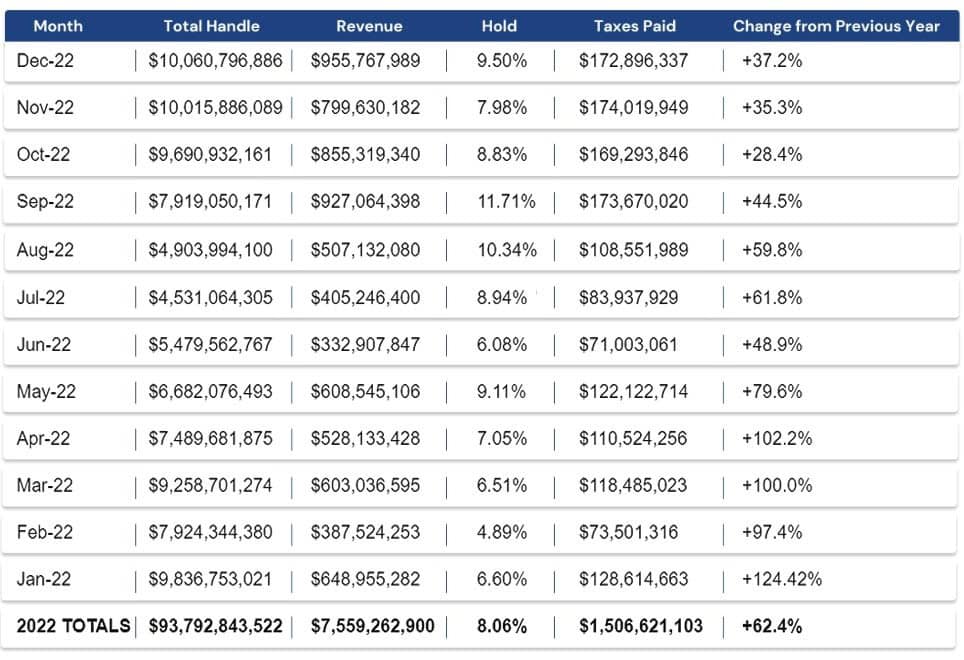
US Sports Betting Revenue & Handle (2023/2022)

US Sports Betting Revenue

Handle Vs. Revenue Vs. Hold

When talking about how much money gambling brings in, the two most common terms are “Handle” and “Revenue,” but the difference might not be immediately obvious.

Handle is the term used to describe the total amount of money used by bettors to place their wagers. Revenue describes the amount of money the gambling establishments make after all winnings are paid out. Basically, you can write it out as Handle – Player Winnings = Revenue.

On the other hand, the Hold is the percentage of the Handle that is kept by the gambling establishment. So if a legal sportsbook brought in $1,000,000 in handle, and kept $50,000 in revenue, that would be a hold of 5%.

Sports Betting Revenue, Total Handle & Comparison by State

US Sports Betting Revenue

To fully understand the scope of sports betting in the US, we need to look at the industry on a state level.

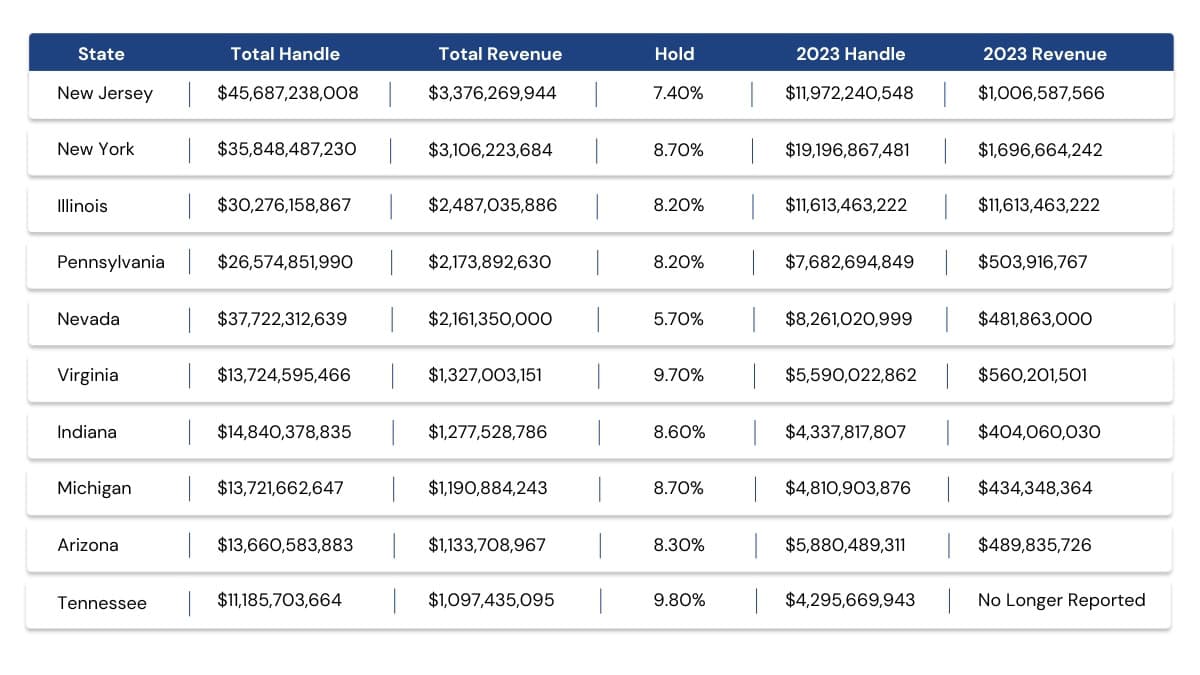
First, we’ll take an eagle-eyed view of the top 10 states in 2023 by revenue, then break down each and every one of the 38 states where sports betting is legalized.

Top 10 USA States by Betting Revenue in 2023

Top 10 USA states

Arizona

Legalization Date September 2021
Total Handle Since Legalization $13.66 Billion
2023 Handle $5,880,489,311.80
2023 Gross Revenue: $489,835,726.20
Change from Mean National +70.4%
Change from Colorado +25%
Change from Nevada +1.65%

Sports betting was a smash hit right out of the gate in Arizona, earning over $31 million in revenue in its first month even with only two brick-and-mortar operators and eight online sportsbooks participating.

Since then, revenue growth has been fairly consistent, with players having access to 14 physical locations and 17 online operators as of December 2023.

Arkansas

Legalization Date July 2019
Total Handle Since Legalization $701,142,375
2023 Handle $404,764,327.45
2023 Gross Revenue: $37,190,265.01
Change from Mean -87.1%
Change from Louisiana -89.9%

Though betting was approved and legalized back in 2019, Arkansas has been slow to embrace this option, with only three physical sports betting locations and no online or mobile options until March of 2022.

Colorado

Legalization Date May 2020
Total Handle Since Legalization $15,775,272,906
2023 Handle $5,560,232,285.15
2023 Gross Revenue: $391,773,823.59
Change from Mean National  +36.3%
Change from Arizona 20%
Change from Kansas +114.8%
Change from Wyoming +2,165.5%

Voting on whether or not to make sports betting in Colorado legal took place in November of 2019 and the measure very nearly didn’t pass. Votes were split, and PropositionDD was pushed through with a meager 50.8% of the vote.

Since then, Colorado has gone from having only 6 online operators to a robust 25 online and 17 brick-and-mortar bookmakers, generating over $61 million in taxes to date.

Connecticut

Legalization Date October 2021
Total Handle Since Legalization $3,619,352,854
2023 Handle $1,762,933,823
2023 Gross Revenue: $174,817,802
Change from Mean +39.1%
Change from Massachusetts -63.8%
Change from New York -89.7%
Change from Rhode Island +334.1%

Bettors took to legalized sports betting in a big way in Connecticut, reaching their first billion dollars in handle within the first nine months.

One thing we found interesting is that Connecticut restricts betting on in-state college teams unless that team is participating in a tournament. However, this is not too unheard of, as many states have special caveats like no single-player wagers, and so on.

Delaware

Legalization Date June 2018
Total Handle Since Legalization $605,492,659
2023 Handle $65,326,807
2023 Gross Revenue: $14,539,393
Change from Mean -94.9%
Change from Maryland -97.2%
Change from New Jersey -98.6%
Change from Pennsylvania -97.9%

Sports betting in Delaware is not a new thing — though it’s a lot less restrictive now — as it is one of four states that had limited sports betting grandfathered in under PAPSA.

Even though it was one of the first states to embrace sports betting since PAPSA was lifted, it still only offers three brick-and-mortar bookmakers and has yet to legalize online sports betting apps.

District of Columbia

Legalization Date May 2019
Total Handle Since Legalization $669,781,869
2023 Handle $169,771,690.27
2023 Gross Revenue: $19,048,156.97
Change from Mean -93.38%
Change from Maryland -96.3%
Change from Virginia -96.6%

Though it was legalized in 2019, the first legal Washington DC sports bets were not made until May of 2020 due to hiccups with the DC Lottery’s mobile app launch.

Things have begun to pick up speed, however, as more retail locations open up across the city, including William Hill, BetMGM, and FanDuel, having set up shop in the nation’s capital.

Florida

Legalization Date December 2023
Total Handle Since Legalization No Data
2023 Handle No Data
2023 Gross Revenue: No Data
Change from Mean No Data

Due to Florida only legalizing in December of last year, there is no real revenue or data to report. Currently, the only sports betting app available to Floridians is the Hard Rock Bet, though residents of the Sunshine State will likely not have to wait long for more options to become available.

Illinois

Legalization Date June 2019
Total Handle Since Legalization $30,276,158,867
2023 Handle $11,613,463,222
2023 Gross Revenue: $1,002,257,982
Change from Mean +249.55%
Change from Indiana +148.1%
Change from Iowa +404.3%
Change from Kentucky +1677.5%

Illinois’ sports betting scene had a tumultuous start by bringing in nearly a million dollars in handle during its first month of operations, only to die completely for two months due to the COVID-19 shutdowns.

Once it got back up and running and suspended its peculiar online betting requirements that demanded bettors register for online betting in person, first — things took off and marked Illinois as one of the top 3 states for sports betting profits in 2023.

Indiana

Legalization Date September 2019
Total Handle Since Legalization $14,840,378,835
2023 Handle $4,337,817,807.15
2023 Gross Revenue: $404,060,030.50
Change from Mean +40.6%
Change from Illinois -59.7%
Change from Kentucky +616.6%
Change from Ohio -56.8%
Change from Michigan -6.9%

Indiana bettors have plenty of places to wager, with 15 brick-and-mortar operators and nearly as many online and mobile options. The most popular sportsbooks based on the amount of bets placed appear to be DraftKings and FanDuel.

Iowa

Legalization Date August 2019
Total Handle Since Legalization $7,609,713,003
2023 Handle $2,420,464,385.99
2023 Gross Revenue: $198,797,419.22
Change from Mean -30.83%
Change from Illinois -80.2%
Change from Kansas +9%

While far from the largest state in terms of sports betting, Iowa was swift to get everything in place. From when it was legalized to when the first bets started rolling in, they only needed three months, and Iowa launched with both physical and online locations in place.

Kansas

Legalization Date May 2022
Total Handle Since Legalization $2,840,341,982
2023 Handle $2,121,564,412
2023 Gross Revenue: $182,415,461
Change from Mean -36.52%
Change from Colorado -53.5%
Change from Iowa -8.2%

Kansas requires those betting on sports to be physically present in the state — and requires geo-location tracking technology for all mobile apps and websites.

While some states have been hesitant to permit wagering on college sports, especially on local teams, Kansas’ laws specifically make provisions for these kinds of bets… so go Jayhawks!

Kentucky

Legalization Date September 2023
Total Handle Since Legalization $340,813,121.08
2023 Handle $340,813,121.08
2023 Gross Revenue: $56,382,369.32
Change from Mean -80.35%
Change from Illinois -94.4%
Change from Indiana -86.1%
Change from Ohio -93.98%
Change from West Virginia +18.13%

Kentucky is new to the scene and so there is not a lot of data to work from. The state started by accepting wagers at brick-and-mortar locations at the beginning of September and, within three weeks, was also set up with seven online sportsbooks.

It’s also worth noting that Kentuckians as young as 18 years of age can bet on their favorite sporting events — as opposed to the 21-year cutoff of most US states.

Louisiana

Legalization Date October 2021
Total Handle Since Legalization $5,275,035,907
2023 Handle $2,905,136,865
2023 Gross Revenue: $366,965,819
Change from Mean +27.69%
Change from Arkansas +886.5%
Change from Mississippi +616.2%

Sports betting is approved and legal in 55 of the 64 parishes in Louisiana, with mobile betting becoming available in 2022. However, mobile bets will still not be able to be made in parishes that have banned sports gambling, so players in those areas may have to travel a bit.

Maine

Legalization Date August 2022
Total Handle Since Legalization $82,091,923.45
2023 Handle $82,091,923.45
2023 Gross Revenue: $9,210,175.63
Change from Mean -96.73%
Change from Connecticut -94.7%
Change from Massachusetts +98.1%
Change from New York -99.5%

Sports betting was slow to roll out in Maine, even after it was legalized. Even though it was voted in early 2022, Maine bettors were not able to get in on the action until November of 2023, giving us little information to work with so far.

Maryland

Legalization Date May 2021
Total Handle Since Legalization $5,613,460,397
2023 Handle $4,617,323,132
2023 Gross Revenue: $514,081,189.02
Change from Mean +78.9%
Change from District of Columbia +2,598.5%
Change from Pennsylvania -25.1%
Change from Virginia -8.2%

Maryland specifically built its legislation with a ‘lens of inclusion’ in mind to make it easier for women and minority-owned sportsbooks to set up shop in-state.

Other interesting facts about the Maryland legislation include licensed betting kiosks available to small businesses and the inclusion of betting options at professional sports venues, casinos, and 1,000+ video lottery terminals.

Massachusetts

Legalization Date August 2022
Total Handle Since Legalization $4,988,637,586
2023 Handle $4,965,975,601
2023 Gross Revenue: $483,059,490.20
Change from Mean +68.1%
Change from Connecticut +176.4%
Change from Maine +5143.7%
Change from New York -71.5%
Change from Pennsylvania -29.7%

While Massachusetts legalized betting in late summer of 2022, it wasn’t until the end of the following January before it started accepting bets (and not until March for online betting).

But even with a relatively late start, Massachusetts has taken in a ton of revenue, which is great for the state with its 15% tax rate on brick-and-mortar bookmakers and 20% on online sports betting websites.

Michigan

Legalization Date December 2019
Total Handle Since Legalization $13,721,662,647
2023 Handle $4,810,903,876
2023 Gross Revenue: $434,348,364
Change from Mean +51.13%
Change from Illinois -56.6%
Change from Indiana +7.5%
Change from Ohio -53.6%

Michigan is another state where its slow adoption of legalized online sports betting created something of a dead zone during the COVID-19 shutdowns. Having just started accepting bets in March of 2020, all activity stopped for April through July as the state’s sole options were shut down.

In August, however, everything picked back up, with Michiganders placing almost $16 million in bets, with revenue jumping up immensely in January of 2021 with the introduction of legal online betting options.

Mississippi

Legalization Date August 2018
Total Handle Since Legalization $2,483,461,600
2023 Handle $474,275,129.90
2023 Gross Revenue: $51,224,141.03
Change from Mean -82.21%
Change from Arkansas +37.7%
Change from Louisiana -86.0%

Mississippi was able to start taking bets almost immediately after PAPSA was overruled due to the state having voted to legalize sports betting in preparation for changes in federal law.

While Mississippi has not legalized online sports betting just yet, it does make up for it by hosting almost 30 brick-and-mortar bookmakers.

Montana

Legalization Date May 2019
Total Handle Since Legalization $179,163,546
2023 Handle $62,258,820
2023 Gross Revenue: $8,446,611
Change from Mean -96.99%
Change from South Dakota +736.3%
Change from Wyoming -51.1%

Montana’s entire sports betting scene is operated by the Montana Lottery and requires players to be on-site at a lottery location to place their wagers — even if using the Sports Bet Montana mobile betting app.

Nebraska

Legalization Date May 2021
Total Handle Since Legalization No Data
2023 Handle No Data
2023 Gross Revenue: No Data
Change from Mean No Data

Little information is available in Nebraska, due in large part to just how long it has taken to get things going.

While sports betting was stamped and signed in back in 2021, it wasn’t until June of 2023 that bets were able to be placed, and even that is restricted to only three locations — and no sign of any online sports betting options on the horizon.

Nevada

Legalization Date 1949
Total Handle Since Legalization $37,722,312,639
2023 Handle $8,261,020,999
2023 Gross Revenue: $481,863,000
Change from Mean +67.64%
Change from Arizona -1.63%
Change from Colorado +23.0%

Sports betting has been legal in Nevada since 1949, and remained available even when PAPSA was put in place thanks to Nevada being one of the few states to be grandfathered in.

Today, there are roughly 188 brick-and-mortar sportsbooks and 14 different online sports betting sites available to players — with online and mobile sports betting making up roughly 2/3rds of the handle in the last two years.

New Hampshire

Legalization Date July 2019
Total Handle Since Legalization $2,710,245,025
2023 Handle $822,107,405
2023 Gross Revenue: $80,041,744
Change from Mean -72.13%
Change from Maine +769.1%
Change from Massachusetts -83.4%
Change from Rhode Island +98.7%

In an interesting bid for power, DraftKings proposed to give the state of New Hampshire 51% of collected gross gaming revenue in return for being the only sportsbook in town. It was an offer the state could not refuse, and as such, all online and retail sports betting options are run by DraftKings exclusively.

New Jersey

Legalization Date June 2018
Total Handle Since Legalization $45,687,238,008
2023 Handle $11,972,240,548
2023 Gross Revenue: $1,006,587,566
Change from Mean +250.36%
Change from Delaware +6826.8%
Change from Maryland +95.8%
Change from New York -40.7%
Change from Pennsylvania +46.6%

The state of New Jersey spearheaded the fight to overturn PAPSA, resulting in the legalization of sports betting on the federal level and allowing every state to opt in or stay out of the sportsbook marketplace (and potentially miss out on all that sweet, sweet taxable income).

It’s no surprise that the home of Atlantic City produced 2023’s highest amount of sports betting revenue, even with only 12 retail operators and 18 online sportsbooks available.

New Mexico

Legalization Date October 2018
Total Handle Since Legalization No Data
2023 Handle No Data
2023 Gross Revenue: No Data
Change from Mean No Data

New Mexico is a bit of an oddball state. When PAPSA was overturned in 2018, the state itself did not move forward with legalizing sports betting.

However, sports betting is still permitted due to the wording of 1988’s Indian Gaming Regulatory Act which states any or all Class III games (including sports betting) are allowed.

As such, sports betting is permitted at many of the tribal casinos in the state, though revenue data is largely non-existent.

New York

Legalization Date July 2019
Total Handle Since Legalization $35,848,487,230
2023 Handle $19,196,867,481
2023 Gross Revenue: $1,696,664,242
Change from Mean +489.73%
Change from Connecticut +870.3%
Change from New Jersey +68.5%
Change from Pennsylvania +147.0%

New York’s pre-emptive move on retail sports betting (an act was passed in 2013 and a proper regulatory framework set up) made it easy for New York to capitalize on the federal-level legalization of sports betting.

Between that and the 51% gross mobile revenue tax on sports betting, New York became the first state to break $1 billion in tax revenue generated — not to mention it being the only state at this point to have broken $2 billion in monthly wagers.

North Carolina

Legalization Date January 2024
Total Handle Since Legalization No Data
2023 Handle No Data
2023 Gross Revenue: No Data
Change from Mean No Data

North Carolina has finally passed the bill to legalize sports betting, though there is no data or information available as the first legal wagers were not allowed to be made until March 11th, 2024.

North Dakota

Legalization Date December 2021
Total Handle Since Legalization No Data
2023 Handle No Data
2023 Gross Revenue: No Data
Change from Mean No Data

Similar to New Mexico, North Dakota offers sports betting on the reservation lands of federally recognized tribes. This means that there are no legal online betting sites available in the state, and it does not look like there will be any move to shift this any time soon.

Ohio

Legalization Date January 2023
Total Handle Since Legalization $7,670,544,772
2023 Handle $7,670,544,772
2023 Gross Revenue: $936,365,302
Change from Mean +225.75
Change from Indiana +131.6%
Change from Michigan +36.4%
Change from Pennsylvania +115.6%
Change from West Virginia +1862.3%

The Buckeye State legalized sports betting at the beginning of 2023. It made almost $1 billion in revenue that first year, generating over $136 million in tax revenue. The gross revenue was initially taxed at a rate of 10%, but after only a few months, Ohio doubled the tax rate to 20%.

Oregon

Legalization Date January 2023
Total Handle Since Legalization $1,768,143,892
2023 Handle $635,565,166
2023 Gross Revenue: $75,663,580
Change from Mean -73.7%
Change from Montana +795.6%
Change from Nevada −84.3%

While the Oregon Lottery put Scoreboard (its own online sports betting app) together in 2019, DraftKings stepped in and took over as the state’s official sportsbook in January of 2022.

However, if you want to bet on collegiate sports, you will have to visit one of Oregon’s two retail sports betting locations, as they’re banned from the state’s sole online provider.

Pennsylvania

Legalization Date May 2019
Total Handle Since Legalization $26,574,851,990
2023 Handle $7,682,694,849
2023 Gross Revenue: $686,856,678
Change from Mean +139.04%
Change from Delaware +4623.0%
Change from New Jersey −31.7%
Change from New York −59.5%
Change from Ohio −26.6%
Change from West Virginia +1339.8%

Pennsylvania offers one of the nation’s most robust markets in terms of both in-person and online betting options — and it’s not surprising given that PA was preparing to make sports betting legal several months before PAPSA was overturned.

With 19 physical locations and 12 mobile betting sites, as well as a 34% tax rate (plus 2% local tax), Pennsylvania’s sportsbook-friendly residents stand to pour quite a lot into the state’s economy.

Rhode Island

Legalization Date November 2018
Total Handle Since Legalization $1,929,849,515
2023 Handle $461,553,426
2023 Gross Revenue: $40,277,816
Change from Mean -85.9%
Change from Connecticut -77.0%
Change from Massachusetts -94.7%
Change from New Hampshire -49.7%
Change from New York -97.6%

Rhode Island’s state lottery is the sole regulator and has a monopoly on the sports betting market.

RI bettors can wager in person at one of two casinos, as well as through the lottery-run online platform. One interesting thing that Rhode Island does is supply support, technology, and machines for the brick-and-mortar bookmakers in exchange for 51% of the gross gaming revenue.

South Dakota

Legalization Date September 2021
Total Handle Since Legalization $18,879,008
2023 Handle $9,088,690
2023 Gross Revenue: $1,009,930
Change from Mean -99.56%
Change from Iowa −99.5%
Change from Montana −88.0%
Change from Wyoming −94.2%

South Dakota has fairly limited options for sports betting, and when it was legalized, it was only voted in on a retail-only basis for casinos in Deadwood, SD. Bettors can place their bets through a mobile app, but only on the casino grounds.

Tennessee

Legalization Date June 2020
Total Handle Since Legalization $11,185,703,664
2023 Handle $4,295,669,943
2023 Gross Revenue: No Data
Change from Mean No Data

Tennessee only offers mobile and online sportsbooks to its residents, opting out of any physical operators.

Unfortunately for fans of sports betting statistics, starting in July of 2023, the state no longer reports its sports gambling revenue — likely a byproduct of being the only state to calculate its tax revenue as a percentage of the sports handle rather than the gross revenue.

Virginia

Legalization Date April 2020
Total Handle Since Legalization $13,724,595,466
2023 Handle $5,590,022,862
2023 Gross Revenue: $560,201,501
Change from Mean +94.91%
Change from Maryland +8.97%
Change from West Virginia +1074.0%

Virginia legalized sports betting in April of 2020 but didn’t wind up launching a proper retail sportsbook until July of 2022, instead relying on online sports betting options.

Being late to the game in terms of brick-and-mortar options didn’t hurt the great state of Virginia, as it’s in 2023’s top 10 states when sorted by revenue.

Washington

Legalization Date March 2021
Total Handle Since Legalization No Data
2023 Handle No Data
2023 Gross Revenue: No Data
Change from Mean No Data

Washington state has some pretty restrictive limitations that seem to cause a lot of bettors to flock to offshore betting sites — hurdles like having to use mobile apps on-site, in-person registration, and restricted betting on local college teams seem a bit too tall for some sports fans to get over.

In addition to that, finding accurate handle and revenue data has been very difficult.

West Virginia

Legalization Date August 2018
Total Handle Since Legalization $2,278,309,140
2023 Handle $483,227,416.29
2023 Gross Revenue: $47,723,640.39
Change from Mean -83.45%
Change from Ohio −94.9%
Change from Maryland −90.7%
Change from Pennsylvania −93.1%
Change from Virginia −91.5%

West Virginia has a nice blend of online and brick-and-mortar operators on tap, and all of them are subject to a business-friendly 10% tax rate.

While it’s far from the top of the list in terms of revenue, West Virginia was another in a handful of states that got all of their legislative ducks in a row before the 2018 PAPSA ruling, so their bookmakers were ready soon after the federal restrictions were lifted.

Wisconsin

Legalization Date November 2021
Total Handle Since Legalization No Data
2023 Handle No Data
2023 Gross Revenue: No Data
Change from Mean No Data

Revenue data for Wisconsin is almost non-existent due to all of the legal sports betting options being handled by tribal operators. At this time, physical locations are limited, and there are no real plans to open up online betting options.

Wyoming

Legalization Date April 2021
Total Handle Since Legalization $357,117,581
2023 Handle $172,247,303
2023 Gross Revenue: $17,293,649
Change from Mean -93.94%
Change from Colorado −95.6%
Change from Montana +104.7%
Change from South Dakota +1611.3%

While there are physical casinos on tribal lands in Wyoming, none of them are involved in the state’s sports betting industry revenue. Instead, all sports wagers are handled online through the state’s four betting apps: DraftKings, BetMGM, FanDuel, and Caesars.

US Sports Betting Revenue – FAQs

What is the Total Revenue of Sports Betting in the US?

Sports betting brought in $10.92 billion in revenue for 2023. That is an increase of almost 45% over the previous year.

How Much Do Americans Spend on Sports Gambling?

Americans wagered $119.84 billion in total across all legal betting sites and retail locations.

Which US States Have the Most Sports Bettors?

While it is difficult to say how many individual bettors there are in each state, we can guess based on how much was wagered per capita.

New Jersey leads the pack with the largest handle per capita ($11.9 billion wagered with a population of 9.2 million), followed by the state of New York($19.2 billion with a population of 19.84 million).

What is the Biggest Sport for Gambling?

The NFL is far and away the most popular sport to bet on in the United States, with data suggesting that 81% of bettors aged 18 or older have placed a wager on an NFL game.

After that is the NBA with 54%, followed by MLB with 44%, college football with 34%, soccer with 28%, NHL with 26%, and MMA, Boxing, and the UFC with a combined 26%.

Conclusion – What Does the Future of US Sports Betting Look Like?

US Sports Betting Revenue

Since the Supreme Court struck down the Professional and Amateur Sports Protection Act in 2018, almost 40 states have legalized sports betting, which has helped the popularity of this pastime spread immensely — and generated a significant amount of tax revenue.

With over $119 billion wagered by US players alone, which is expected to climb significantly as more states embrace legalized sports betting and online bookmakers, there is little doubt in our mind that, for good or ill, the industry is here to stay and grow even more in the following years.

References:

https://www.investopedia.com/sports-betting-laws-by-state-5219064

Latest News

Do Jersey City Children Have a Right to Local School?

Jersey City Preschoolers Bused 5 Miles—Do They Have the Right to...

In Downtown Jersey City, widely described as one of the most walkable neighborhoods in the United States, many daily errands can be done on...
New Jersey Bomb Cyclone Travel Ban and Snowfall

New Jersey Bomb Cyclone 2026: Travel Bans, Transit Shutdowns, and Record...

The February 2026 blizzard in New Jersey was officially classified as a “bomb cyclone.” The designation applies when a storm undergoes bombogenesis — a...
Vetoed Bird-Safe Ordinance 26-008 Back in Debate

Jersey City Council Reopens Fight Over Bird-Safe Building Costs

Ordinance 26-008, which regulates bird-safe materials for buildings, has been reintroduced to the Jersey City Council agenda. The measure is identical to the version...
Rob Menendez Slams Trump Over Hudson Tunnel Funding Freeze

Rob Menendez Urges End to Hudson Tunnel Funding Dispute After Court...

In Hoboken, after a press conference concerning an unrelated federal funding allocation, U.S. Rep. Rob Menendez (D-8) discussed the restoration of approximately $205 million...
Hudson County NAMI Caregiver Support Programs

Hudson County Caregivers Get February Mental Health Support

Hudson County residents caring for youth with mental health symptoms can participate in a six-session NAMI Basics course offered this February through NAMI Hudson...