
Home Blog Page 47

Medieval Sports: How Knights, Nobles, and Commoners Played and Trained

Medieval Sports and Games

The Middle Ages, known for its castles, knights, and battles, was when people enjoyed many different sports and games.

These activities were far more than ways to pass the time—some sports helped knights prepare for combat, while others gave peasants and nobles a chance to relax, bond, and enjoy community gatherings.

Today, we’ll explore the world of medieval sports and games, how they were played, who took part, and why they mattered.

You’ll also see how many medieval activities, like jousting, archery, and storytelling, still influence today’s sports and games.

Let’s take a step back in time to learn more about the fun and competition of the Middle Ages.

Key Takeaways
  • Medieval sports helped knights prepare for battle and united people to celebrate and compete.
  • Many modern sports, like soccer, cricket, and chess, started as medieval games, showing how these activities have lasted and changed over time.
  • Medieval sports matched society’s structure, with nobles enjoying fancy games like tennis and falconry while common people played games like wrestling, stoolball, and mob football.

A Journey into the History of Medieval Sports

Medieval sports arose from practical needs, entertainment, and social interaction.

War, religion, and a strict feudal hierarchy shaped life in the Middle Ages. However, moments of joy and leisure were found in the spirited competitions and games that brought communities together.

There were practical sports that helped men prepare for battle and stay strong, while others were simply for fun, enjoyed by nobles and common people.

In medieval times, the feudal system shaped society.

Lords ruled over land, and in return, they had to provide soldiers to their king.

Knights were a big part of this system, and they needed to be ready to fight at any time.

To maintain their skills, many sports were designed to improve weapon handling, horseback riding, and physical strength.

Jousting, tournaments, and archery contests became training exercises and public events where knights could show their bravery and gain fame.

Winning a tournament or excelling in archery could bring a knight honor, wealth, and social advancement.

At the same time, the Middle Ages were full of community spirit.

Surprisingly, people had a lot of free time compared to later centuries.

Besides Sundays, they often had about eight weeks off every year for religious holidays and festivals.

During these breaks, villages and towns came alive with celebrations, games, and competitions.

In villages, people played simple ball games or wrestling matches.

In towns, bigger events like tournaments drew large crowds, with knights showing their bravery and skill.

List of Medieval Sports and Games

Sure, medieval sports were entertainment, but they also reflected the era’s priorities and culture.

Many games were designed to sharpen combat skills, strengthen physical endurance, and encourage competition.

The noble elite and commoners participated in sports, though the activities often differed by class.

Here’s a detailed look at the most popular medieval sports and their significance.

Archery

Archery was one of the most popular and essential sports during the Middle Ages, as it was a crucial military skill.

In 1252, English law required all men aged 15 to 60 to practice archery regularly.

Designated training areas, called “Butts,” were established in villages and towns.

Archery contests were common and attracted participants from all levels of society.

The importance of archery is best seen in historical battles like the Battle of Crécy in 1346.

At Crécy, English longbowmen devastated the French army, killing around 2,000 French knights and soldiers while the English lost only 50 men.

Archery contests also became a way for commoners to gain recognition for their skill and accuracy.

Jousting Tournaments

Jousting was one of the most iconic sports of the Middle Ages, especially among the nobility.

Knights would charge at each other on horseback, using long lances to try and unseat their opponent.

These tournaments were dangerous and incredibly prestigious.

Victorious knights could gain wealth, titles, and even social advancement.

Jousting tournaments were grand public events, often held to celebrate important occasions like royal marriages or victories in battle.

Knights trained for these events using techniques like quintain and pell practice, which involved striking targets with their lances to improve accuracy and strength.

Winning a jousting tournament could greatly enhance a knight’s reputation and career, so it was a highly competitive sport.

Tournaments

Tournaments were broader combat events compared to jousting and often involved multiple participants in mock battles.

These events allowed knights to showcase their skill with various weapons, such as swords, daggers, and battle axes.

Unlike modern sports, medieval tournaments had few rules, often leading to severe injuries or fatalities.

Tournaments allowed lords to demonstrate their wealth and power while rewarding their most loyal knights.

The events were also a form of military training, allowing knights to practice combat techniques in a controlled environment.

Colf

Colf, the predecessor of modern golf, was a favorite pastime among the nobility.

This sport involved hitting a ball across large open fields toward a specific target.

Colf, as you can guess, was an elite game reserved for those with the time and resources to play.

It was less structured than modern golf, but its emphasis on precision and technique set the foundation for the sport we know today.

Falconry

Falconry was a sport exclusively enjoyed by the noble class.

It involved training birds of prey, such as hawks and falcons, to hunt small animals like rabbits, foxes, and birds.

Falconry requires extensive training for the bird and its handler, making it an expensive and time-consuming activity.

This sport was seen as a symbol of wealth and refinement, as only nobles could afford the necessary resources.

Mob Football

Mob football was a chaotic and highly physical game played by commoners.

It involved entire villages or towns competing to move a ball into the opposing team’s goal, which could be several miles away.

There were virtually no rules, and the game often devolved into violent fights.

The large number of players and the lack of structure made mob football exciting yet dangerous.

Despite its chaotic nature, the game was deeply rooted in community pride, with villages taking great pride in their victories.

Mob football is considered a precursor to modern sports like soccer and rugby.

Bowls

Bowls were a popular medieval sport enjoyed by nobles and peasants.

The game involved rolling a ball toward a target, requiring precision and control.

There were several variations of bowls, some resembling modern ten-pin bowling and others similar to boules or pétanque.

It was a relaxing yet competitive activity that brought people together in their leisure time.

Shinty

Shinty was a fast-paced game similar to modern hockey.

It was played in rural communities and involved teams using sticks to hit a ball toward a goal.

The game required teamwork, agility, and quick reflexes.

Shinty was particularly popular during festivals and gatherings, where it brought communities together in friendly competition.

Stoolball

Stoolball was one of the earliest forms of cricket.

It involved hitting a ball with a bat and protecting a “wicket,” which was often a stool, giving the game its name.

Players would score points by running between two stools or hitting the ball far enough to avoid being caught.

Stoolball was not limited to one set of rules and varied widely across regions. Therefore, it was adaptable and easy for people of all ages to play.

It was particularly popular during festivals and gatherings, where its simplicity made it accessible to everyone.

While it started as a rural pastime, stoolball eventually gained recognition among higher classes and became a precursor to modern cricket.

Hammer-Throwing

Hammer-throwing was a test of sheer physical strength and a popular sport among medieval peasants.

Participants used heavy hammers, often made of iron or stone, and competed to see who could throw them the farthest.

This sport demanded power and technique, as throwing a heavy object required a balance of force and control.

Hammer-throwing events often occurred during local fairs and festivals, where large crowds gathered to cheer on the competitors.

While primarily a rural sport, it also had roots in military training, as the skill of throwing heavy objects could be useful in battle.

Horseshoes

Horseshoes was a simple yet entertaining game in which players threw horseshoes at a target, usually a metal stake driven into the ground.

The goal was to land the horseshoe as close to the stake as possible, ideally wrapping it around the post for a “ringer.”

The game required precision, focus, and a steady hand, making it a relaxing yet competitive activity.

Horseshoes were particularly popular among commoners, as they were easy to set up and required minimal equipment.

It was often played in village squares or during festivals, where participants of all ages could join in.

Horseshoes remains a popular pastime, with many of its medieval roots still intact.

Skittles

Skittles was an ancestor of modern bowling and a favorite game in the Middle Ages.

Players used a ball or stone to knock down a set of pins, often simple wooden blocks.

The game could be played indoors or outdoors, depending on the space available, and was accessible to people of all social classes.

Skittles required accuracy and strategy, as players had to carefully aim their throws to knock down the maximum number of pins.

It was a common sight at medieval fairs and taverns, where it provided both entertainment and competition for locals.

The game’s simplicity and the minimal equipment needed made it a widespread pastime across Europe.

Quarter-Staff Contests

Quarter-staff contests were intense physical competitions where participants used long wooden staffs, often about six to eight feet long, to fight each other.

The goal was to strike the opponent while defending oneself, making it both an offensive and defensive sport.

These contests required strength, quick reflexes, and precise movements, as a single misstep could lead to a heavy blow.

Quarter-staff fighting was also a form of combat training, preparing men for real battles where similar techniques might be used.

It was popular among peasants and soldiers, as the staff was a readily available weapon and a practical tool for self-defense.

Quarter-staff contests often took place at village festivals and were a crowd favorite due to their fast-paced and intense nature.

Wrestling

Wrestling was one of the oldest and most widespread sports of the Middle Ages.

It was a physical contest where two participants grappled to try to pin each other to the ground or force the other to submit.

The sport was popular across all social classes, from peasants in rural villages to knights in royal courts.

In rural areas, wrestling was often part of festivals and communal gatherings, while in noble circles, it could be part of formal competitions.

Wrestling matches varied in style and rules depending on the region, but they were always exciting to watch and participate in.

The simplicity of the sport, requiring no equipment, ensured its popularity across Europe.

Gameball

Gameball was a simple and widespread ball game played in various forms across medieval Europe.

The rules of the game were loose and often improvised––players would use their hands, feet, or even sticks to move the ball toward a goal, often marking out boundaries with whatever was available.

Gameball was popular because it required minimal equipment, usually just a leather or stuffed ball.

The game could be played casually in small groups or as a large competition between villages, similar to mob football.

Gameball’s versatility and simplicity made it one of the most common recreational activities of the Middle Ages, laying the groundwork for modern sports like soccer and rugby.

Specialized Sports and Games

Medieval sports were not limited to physical competitions.

Specialized games and cultural activities often reflected the interests of the nobility or served specific purposes, such as political diplomacy or intellectual stimulation.

These activities provide a glimpse into the more refined and social side of medieval life.

Tennis

Tennis was an elite sport during the Middle Ages, played mostly by nobles on private courts.

The game is believed to have originated in France, where it was known as “jeu de paume,” meaning “game of the palm,” as it was initially played with bare hands before rackets were introduced.

Tennis quickly spread to England, where it became a favorite pastime for kings and nobles, but it took longer to gain popularity in places like Switzerland.

Tennis courts were built inside castles and manors, and the enclosed spaces allowed wealthy players privacy and exclusivity.

The game required skill, precision, and endurance, which made it a favorite among the nobility, who saw it as a way to compete while socializing.

Over time, tennis evolved into the modern version we know today, but its medieval roots can still be seen in the game’s emphasis on skill and strategy.

Shooting Festivals

Shooting festivals were some of the most important events in the Old Confederacy.

These contests often included archers and harquebusiers (early firearm users) and attracted participants from all over Europe.

One of the most famous events was the “Freischiessen,” held in Zurich in 1504, which saw over 360 archers and 450 harquebusiers compete.

These festivals were also opportunities for diplomacy.

For example, the Zurich festival helped build relations with Emperor Maximilian and southern German cities after the Swabian War.

Competitions often lasted weeks and drew large crowds, with participants competing for prizes that sometimes included money, goods, or political recognition.

Lotteries were often held to fund these massive events; in Zurich, around 23,000 people participated in the lottery for the shooting festival.

Shooting festivals showcased the military importance of archery and early firearms while serving as large-scale social gatherings.

Cultural and Recreational Activities

Beyond physical and competitive sports, medieval society also enjoyed more intellectual and creative pastimes.

These activities were accessible to many people and reflected the era’s love for storytelling, strategy, and games.

Chess

Chess became one of the most popular intellectual games in the Middle Ages after being brought to Europe during the First Crusade.

Nobles particularly enjoyed chess because it mirrored medieval power structures, with pieces like kings, queens, and knights representing the dynamics of real-life politics and warfare.

The game was valued for its ability to teach logic, strategy, and planning.

Over time, chess spread beyond the noble class and became accessible to commoners, with simpler boards and pieces made from materials like wood and stone.

The original pieces, like the elephant or chariot, were gradually replaced with Western equivalents, such as the bishop and rook, reflecting the culture of medieval Europe.

Board Games

Board games were another favorite pastime in medieval society, enjoyed by people across all classes.

Popular games included Nine Men’s Morris, Hnefatafl, and Alquerque, all of which had simple rules but could become highly strategic.

Nine Men’s Morris resembled modern tic-tac-toe but was more complex, requiring players to move pieces across a board to form “mills” and remove their opponent’s pieces.

Hnefatafl, a Viking-originated game, involved a king and his defenders trying to escape attackers.

Alquerque, the ancestor of modern checkers, was played on a square board with diagonal lines, and players tried to capture their opponent’s pieces by jumping over them.

Boards were often carved into stone or made of wood, with game pieces crafted from materials like bone, pottery, or ivory, depending on the player’s wealth.

Although these games were fun, gambling often accompanied them, leading to Church disapproval due to the fights and disputes gambling sometimes caused.

Storytelling and Flyting

Storytelling was one of the most beloved cultural activities in medieval society.

Oral storytelling allowed even the illiterate to enjoy epic tales and romances, which were often performed by traveling minstrels or storytellers in markets, castles, or village squares.

Stories like the Arthurian romances featuring King Arthur, the Knights of the Round Table, and magical elements like Excalibur and the Holy Grail were especially popular.

These tales often taught moral lessons while offering entertainment and escapism from the hardships of daily life.

Another unique form of medieval entertainment was flyting, a ritualized exchange of insults between participants, often done for humor or competition.

Flyting was enjoyed by nobles and peasants alike and required wit, quick thinking, and creativity to craft clever and cutting remarks.

The Enduring Influence of Medieval Sports and Games

Many medieval activities, like archery contests, stoolball, and mob football, grew into the modern sports we enjoy today, such as cricket, soccer, and golf.

While the games have changed over time, their roots in the Middle Ages still show how much they shaped the sports we know now.

Even pastimes like storytelling and chess, which were popular in medieval times, still influence how we entertain ourselves, challenge our thinking, and connect with others.

The real legacy of medieval sports is how they brought people together—whether through teamwork, friendly competition, or community celebrations.

And interestingly, when we play games, watch sports, or share stories, we continue traditions that began hundreds of years ago.

Bonus: if you enjoyed this article, perhaps you might like to dive into the complete history of scuba diving.

Global Gambling Statistics, Trends & Market Forecast for 2026

Spanning continents and cultures, the allure of gambling has grown into a colossal market, shaping the fabric of societies around the globe.

While gambling was once relegated to back alleys and hidden games, recent years have found it becoming increasingly more common — and accepted. If anything, the ability to wager online has been like fuel to a fire, causing an unprecedented explosion in worldwide gambling.

This article aims to cut to the heart of the industry, exploring the top countries where gambling is not just mere entertainment but a significant economic force, as well as the trends and innovations that keep the market.

Growth in the Online Gambling Market

Growth in the Online Gambling Market

As much as we don’t want to mention it, the biggest force behind the growth of online gambling was the pandemic.

As post-pandemic restrictions began easing around the world, the global gambling industry market size already surged to an impressive 540.27 billion U.S. dollars in 2023.

Industry expectations are that 2024 will see upwards of $580.36 billion wagered thanks to emerging market growth, the influx of younger and female gamblers, and increased interest in online esports betting markets.

This is roughly a 16% increase from 2020’s $465.7 billion, and the growth of gambling doesn’t show any signs of stopping. In fact, it looks like we can expect a compound annual growth rate (CAGR) of around 7.5% through 2025, with the global online casino market reaching $674.7 billion by that time.

With roughly 60% of the world’s population, it’s unsurprising that the Asia-Pacific region accounts for the bulk of the online gambling market share, with 38.2% of the total market in 2020 (roughly $177.9 billion).

Asia-Pacific is followed swiftly by North America and Western Europe in terms of global gambling market size, though both regions have countries that hold enough market share to top the list of top individual countries in their own right.

What Contributed to This Growth?

As you might imagine, as the world was shutting down (even if only for a short while), many casino goers shifted towards online gambling platforms.

Several U.S. states — and countries around the world — relaxed their bans on online sports betting and casinos, leading to an influx of new players. Many of these bettors would previously have restricted their efforts to brick-and-mortar gambling establishments, while others may not have played at all.

There was also increased interest in offshore sportsbooks and casinos (platforms run from countries with lax gambling laws that accept players from the United States and other nations where betting might be forbidden).

The online casino market share has jumped from $16.6 billion in 2019 to $34.8 billion in 2023.

When you take into account all of the other online gambling options (sports betting, e-sports betting, online lottery, et cetera), the entire online gambling market is expected to reach $107.30 billion by the end of 2024, with a projected user penetration (percentage of the population using online gambling) to reach an astonishing 2.5%.

And it is not just pre-existing gamblers who jumped into online gambling during the pandemic. A recent survey by the UK Gambling Commission found that roughly 9% of young women who gambled started their betting journey during the shutdown — compared to 4% of all gamblers, with most of the gambling being done during this time on online gambling sites.

Key Takeaways
  • The global online gambling market revenue surged to 540.27 billion U.S. dollars in 2023, with a 16% increase from 2020’s $465.7 billion.
  • Based on expert forecasts, 2024 will see upwards of $580.36 billion wagered.
  • The Asia-Pacific region accounts for the bulk of the online gambling market share (38.2%).
  • The offshore casino market share jumped from $16.6 billion in 2019 to $34.8 billion in 2023.
  • Based on a recent survey by the UK Gambling Commission, roughly 9% of young women started gambling during the pandemic.

Top 5 Countries in the Global Online Gambling Industry

Country 2023 Revenue % Worldwide Revenue
United States $66.52 billion 12.31%
United Kingdom $19.06 billion 3.52%
Australia $16.7 billion 3.09%
Canada $12.5 billion 2.31%
Singapore $4.91 billion 0.77%
Rest of the World $420.58 billion 77.84%

Now that we understand just how big the impact on the global economy is, let’s drill down further to get a clearer picture of what is actually going on on a country-by-country basis.

We will look at each of the top five countries for gambling revenue and market share and see if there are any valuable insights into how their populations engage with their country’s gambling industry.

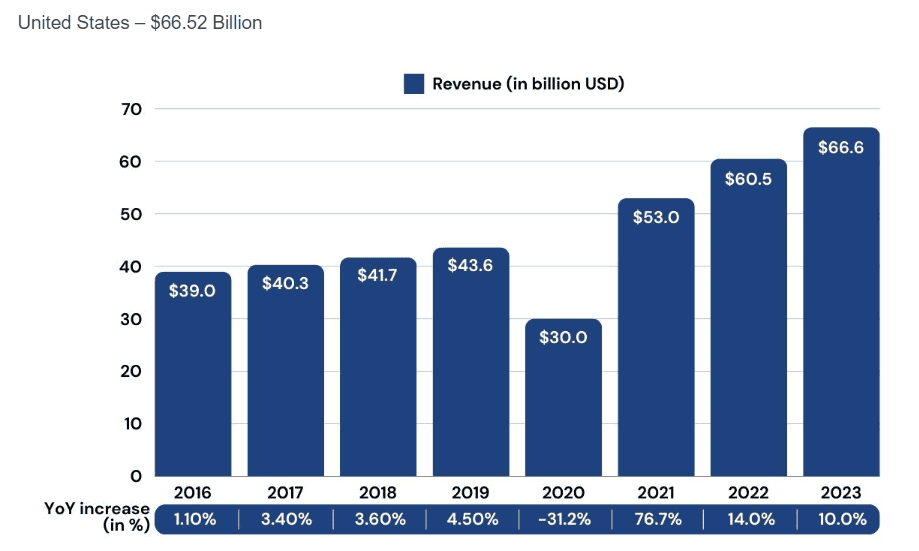
United States – $66.52 Billion

Global Gambling Statistics 8

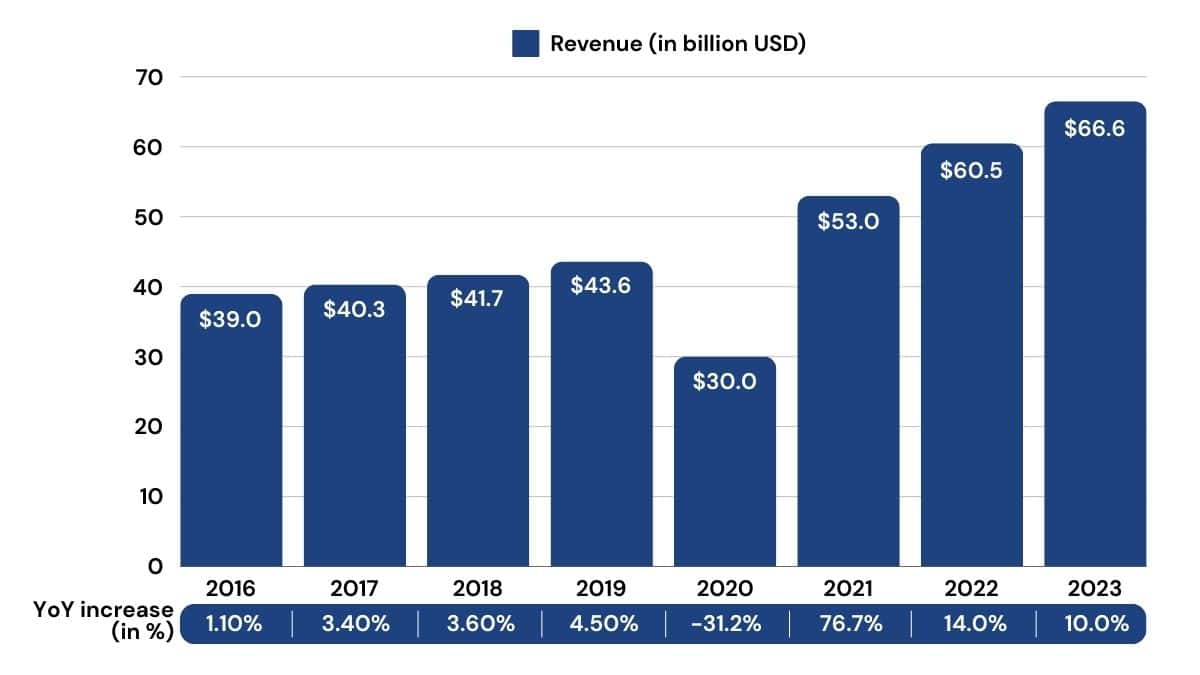
While 2022 was a blowout year for the United States, with over $60.46 billion for the full year (up 14% from the year before), with the last report released by the American Gaming Association, 2023 was shaping up to be even bigger.

From January to November 2023, the United States gambling market was sitting at $59.84 billion in total revenue, up 9.5% from the same months from the year before.

While most states featured significant increases in revenue — particularly Nebraska, which saw a 722.3% increase over the year before — other states saw a small dip when compared to the year before.

For example, Mississippi was down 3.8%, Indiana 3.1%, and Washington DC saw a dip of 20.2% compared to 2022.

The UK – $19.06 Billion

UK-Table

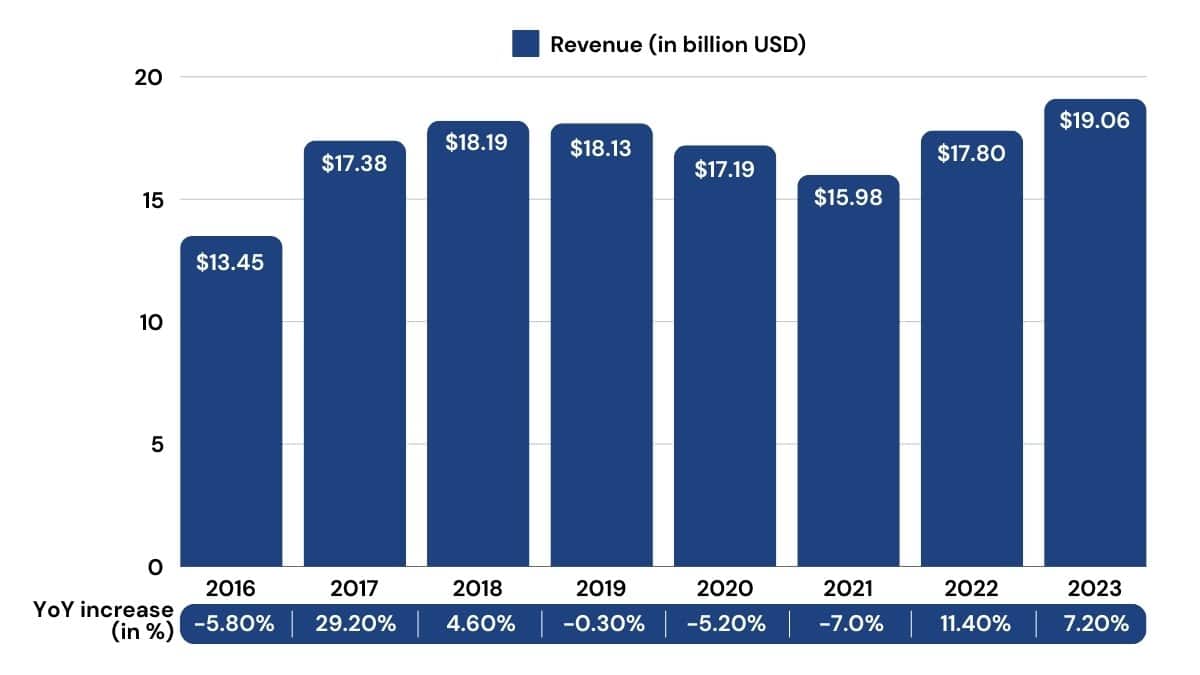
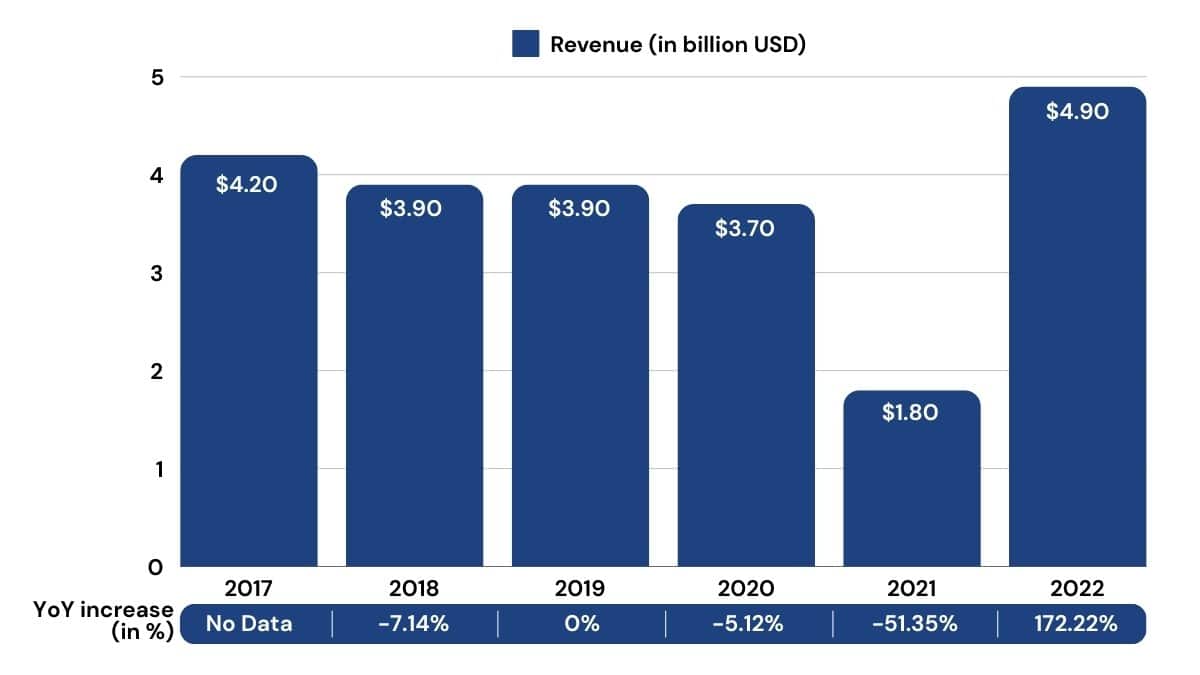
It is estimated that 44% of the adult population participated in some form of gambling in 2023, with £14.1 billion (roughly $19.06 billion American) being generated.

That 44% is made up of Brits 16 and older, and a significant portion of that population (26% of all adults) used an online gambling platform.

Interestingly, this is a somewhat smaller percentage of the population than what participated pre-pandemic, as a study by the United Kingdom Gambling Commission showed that 47% of respondents aged 16 and up participated in 2019.

Similarly, the total GGY for the United Kingdom’s gambling market has also dropped from that time, with the 2018-2019 year representing a total of £14.32 billion.

Australia – $16.7 Billion

Australia-Table

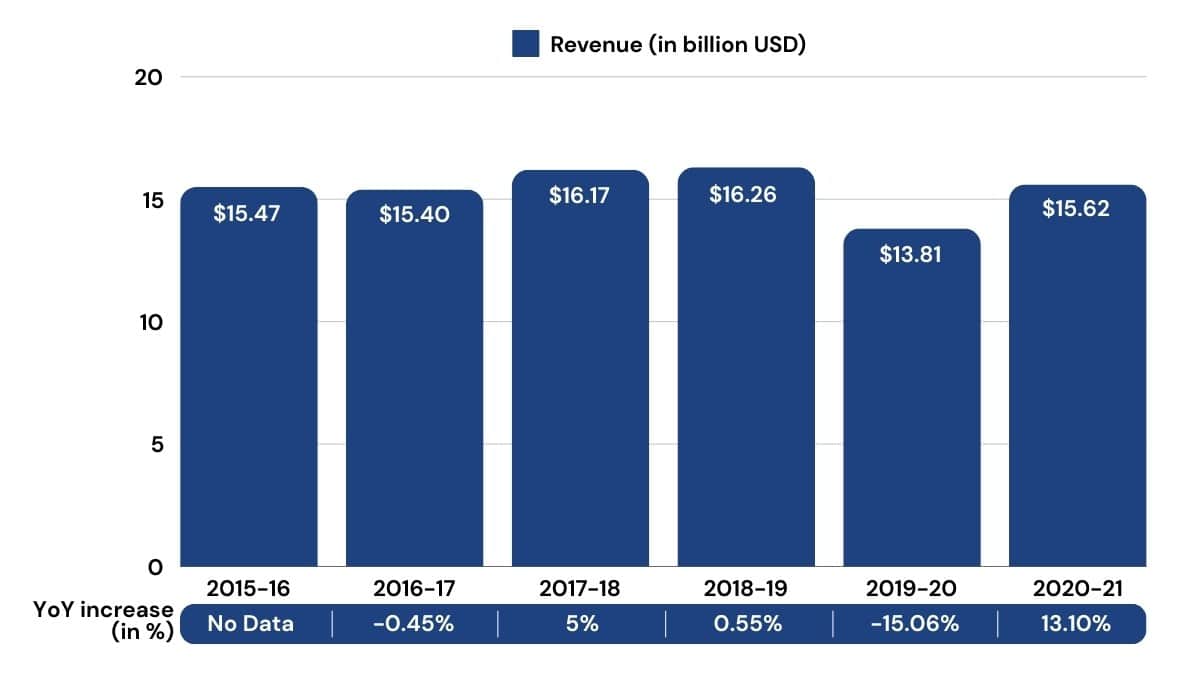
Australia loves its gambling, particularly in the form of pokies (the local term for video slot machines), with individual players wagering about $1,093 per year, cementing itself as the third-highest gambling nation in the world back in 2018.

An estimated $25 billion AUD ($16.7 billion USD) is spent per year, making Australia the highest-spending country per capita, generating $6.6 billion in revenue for the state.

Canada – $12.5 Billion

Canada-Table

Canada has proven to be another safe space for individuals loving the element of risk that gambling games afford. Nearly half of all Canadians view betting favorably enough that they agree it should be allowed (48%).

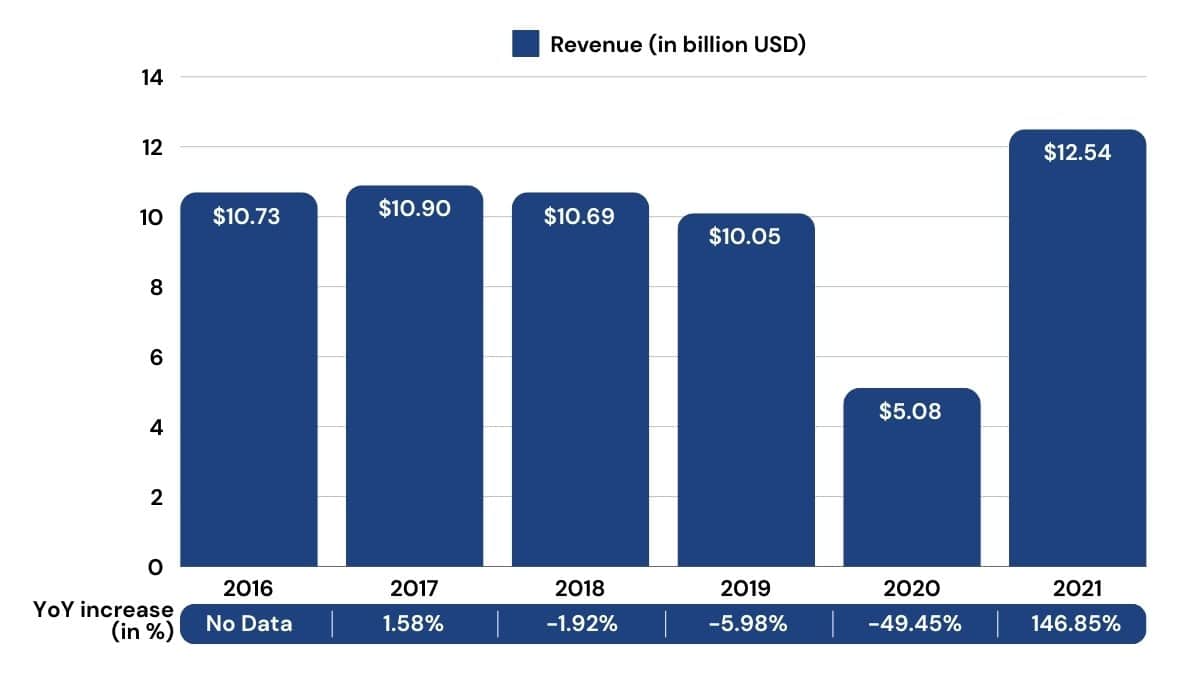
And though Canada was faced with a similar decline in market revenue, a combination of new and existing players taking up online gambling has caused a surge in the online market share since 2020.

In fact, the beginning of lockdowns saw up to 15% of the population gambling online compared to the 5% that played in 2018.

Singapore – $4.91 Billion

Singapore-Table

A recent addition to the top five global casino markets, Singapore recently beat out Macau’s $1.5 billion market share.

It is estimated that the average Singapore bettor spends $1,731 annually, which helped bring Singapore’s gambling revenue up from $1.8 to $2.5 billion for 2022 with a total Gross Gaming Revenue of $4.91 billion.

In a trend that lines up with other top countries, 44% of Singapore residents over the age of 18 participated in gambling back in 2019.

Other Countries of Note

Macau

Recently knocked out of the top five by Singapore, Macau’s casino and betting market is the only part of China where gambling is legal — making it a hot destination for Chinese players looking to do any sort of legalized gambling.

Ireland

Ireland has a strong history of gambling, making up 2.6% of Europe’s gambling market revenue, even though it consists of only 1.1% of the population.

A large part of this seems to be due to what many consider to be exceedingly lax regulation around online gambling and the marketing of such… though steps are being made to reduce the prevalence of gambling ads.

For example, a 2022 bill was introduced to require consumers to “opt-in” to receiving gambling advertisements rather than having these sorts of marketing materials just… showing up. Whether or not these steps are working remains to be seen, as there is a projected 2.53% growth over the next few years.

Key Takeaways
  • Gambling in the US leads the industry with a $59.84 billion revenue.
  • Sports betting in the US is the main force behind the huge revenue, with an increase from $4.34 billion in 2021 to $7.5 billion in 2022.
  • 44% of the UK’s population has participated in some form of online gambling in 2023.
  • £14.1 billion (roughly $17.75 billion American dollars) of gambling revenue was generated in the UK in 2022.
  • Australia leads the way for wagering per capita, with individual players wagering about $1,093 per year.
  • Over 48% of Canadians think online betting should become legal in the entire country.
  • Singapore knocks Macau out of the 5th position with a $1.5 billion market share and $4.91 billion being wagered.
  • Ireland makes up 2.6% of Europe’s gambling market revenue.

 What Do the Top Countries Gamble On the Most?

Now that we know who the biggest players are, its time to dive deeper into just what those numbers mean — and one of the best ways we can do that is look at what each country’s citizens are playing.

United States – Slots

Global Gambling Statistics 7

In both 2022 and 2023, traditional brick-and-mortar casinos and gambling halls still dominated the scene, with both iGaming and sports betting seeing astonishing growth.

Sports betting revenue increased from $4.34 billion in 2021 to $7.5 billion in 2022, with Americans placing over $93 billion in sports wagers throughout the year — the biggest cause of this being Louisiana, Maryland, and New York legalizing mobile betting while Kansas finally opened itself up to sports betting in general.

In fact, it looks like opening up these additional betting avenues has made a massive impact, as New York has become the country’s largest state for sports betting. New York residents placed a total of $16.7 billion in wagers through mobile betting platforms, generating $1.4 billion across the state.

However, if we look beyond simple sports betting in the US, it’s no surprise that Nevada, home to the almost-mythical Las Vegas, is the #1 state for gambling, generating $14.84 billion in gross gaming revenue in 2022. Nevada is followed distantly by Pennsylvania and New Jersey with $5.3 and $5.2 billion, respectively.

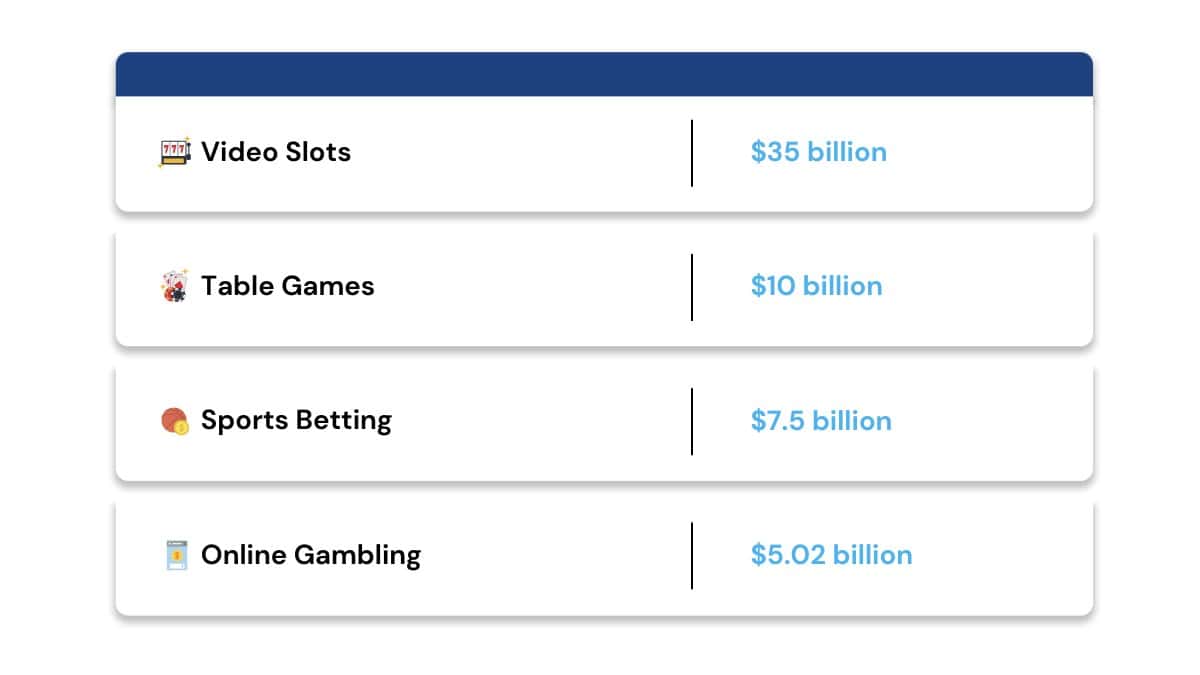
While we’re waiting for updated casino statistics on 2023’s Q4 revenue, we can look to 2022 to see that American players heavily favor slot machines. Over $34 billion of the $60.42 billion in gross gaming revenue consists of video slot games, while $10 billion was generated at the tables, and $7.5 billion for sports betting nationally.

This leaves online gambling (iGaming) with the last $5.02 billion — an increase of 35.2% over the year before, proving that even with things opening up, American players continue to rush toward online platforms.

United Kingdom – The National Lottery

Global Gambling Statistics 4

Though there has been a slight downward trajectory in casino participation over the last few years, Great Britain’s punters still made a respectable showing.

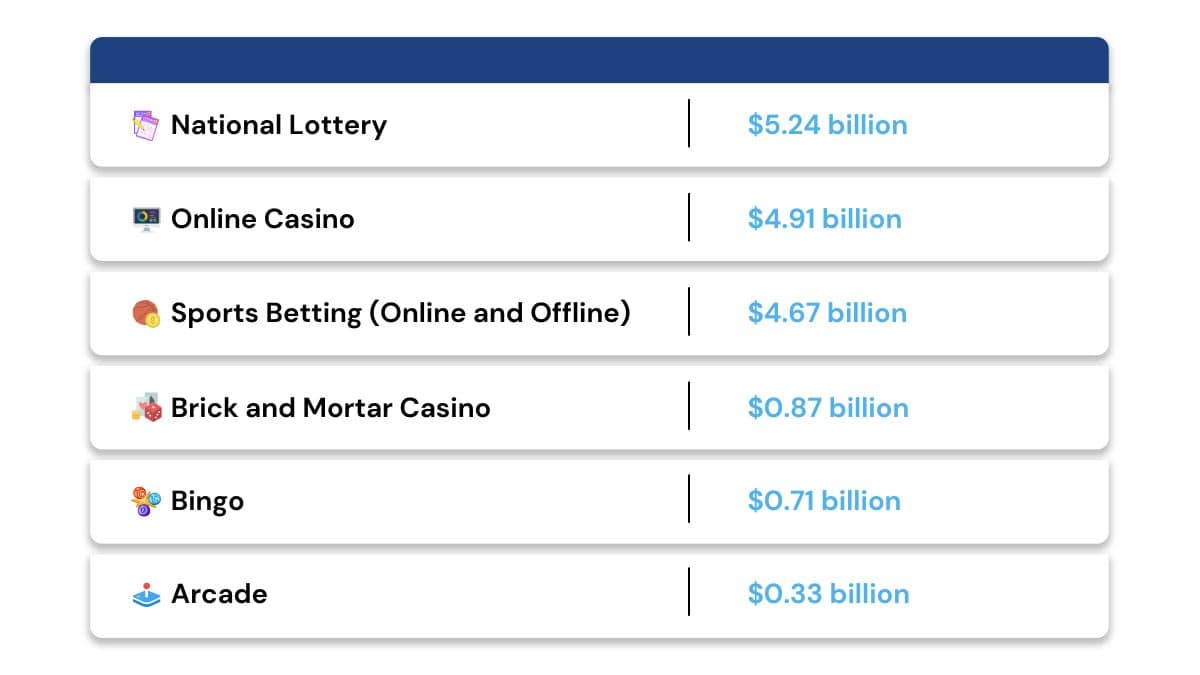
Unsurprisingly, bingo games are a massive draw in the UK, making up £388.6 million in Gross Gaming Yield — making it the UK’s fourth most profitable sector for operators, even with the number of bingo premises steadily declining since 2014.

According to UK gambling statistics, the most popular method of gambling was the National Lottery, which generated £8.1 billion between April 2021 and March 2022, a slight decline from the previous year’s £8.3 billion.

And while event (sports) betting and casino gambling (particularly slots) were still popular, they were easily overshadowed by online casino games and remote sports betting. £6.4 of the total £14.1 GGY were made up of online gaming options in 2022, with 32.65 million Brits signing up to play online slots, table games, and partake in the online sports betting market between April 2021 and March 2022.

Australia – Slots

Global Gambling Statistics 3

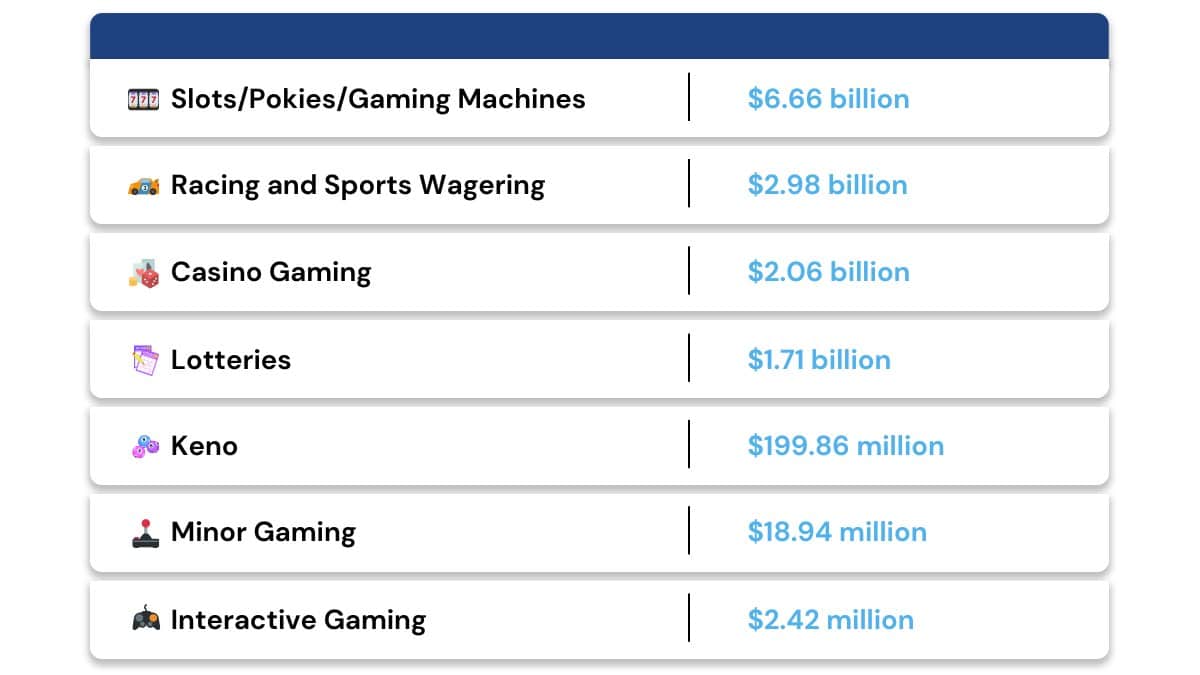
Based on a gambling facts sheet released by the Australia Gaming Council (AGC) for the 2019/2020 year, roughly half of what was spent on gambling by Australians that year –$6.66 billion of the $13.87 billion overall — was spent on gaming machines, primarily consisting of slots.

After that $2.06 billion went into regular casino games, $1.71 billion into lotteries, and about $221 million split between other forms of casino games. This leaves $2.98 billion for race and sports betting during that year.

Online gambling is expected to make an annual growth of 5.22%, bringing it up from the projected $11.39 billion for 2024 to a high of $13.96 billion by 2028. As players made the move to online gambling to continue playing through the pandemic, more players stick around for the ease and convenience it offers, especially for sports betting enthusiasts.

Canada – Slots

Global Gambling Statistics 1

Changes to the laws in Canada saw a significant increase in online sports betting since these new laws permit gamblers to bet not just on individual games but elements within a game, making the sports betting market more appealing to a country that otherwise seemed disinterested.

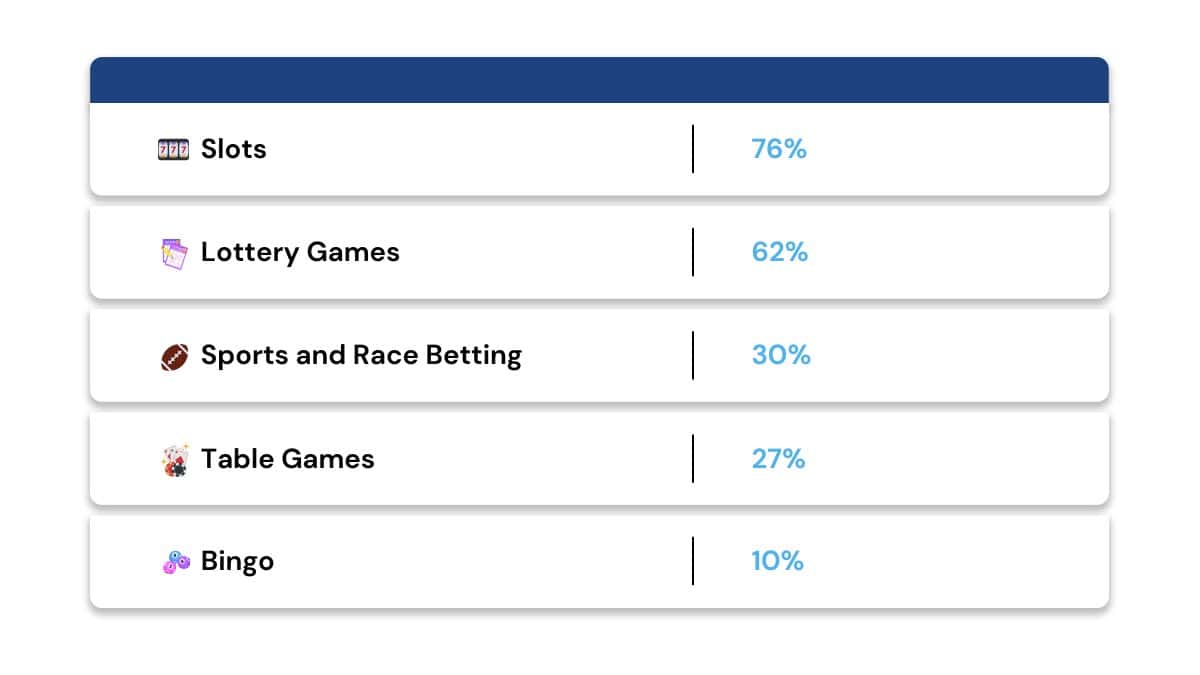
As is usually the case, slot games make up the bulk of action at Canadian casinos with a participation rate of 76%, followed by 62% for lottery games, 30% for sports and race betting, 27% for skill games like poker and blackjack, and a strong (though not quite so strong as the UK) showing for bingo with a 10% participation rate.

The online gambling market in Canada is expected to reach $4.19 billion in 2024, with an annual growth rate of 6.84%, bringing the total up to $5.46 billion. This is in line with what we’ve seen in most of the other top countries, and with more and more young (tech-savvy) people getting into gambling, we expect to see more players adopting the online model, especially for sports wagering.

Singapore – Sports Betting

As with most of the Asia-Pacific market, online sports betting is the main thing behind the revenue. And with the popularity of esports in the region, it’s no surprise that betting on live esports events is catching on, especially as mobile online betting platforms get better at embracing this new betting market.

One of the more interesting facets of the Singapore gambling scene is that the majority of land-based gambling takes place in two integrated resorts.

The Marina Bay Sands and Resorts World Sentosa act not just as casinos but as tourist attractions themselves — contributing to the surprisingly massive GGR as players from around the world come to embrace a premier tourist experience.

Which Country Gambles The Most Per Capita?

Global Gambling Statistics 6

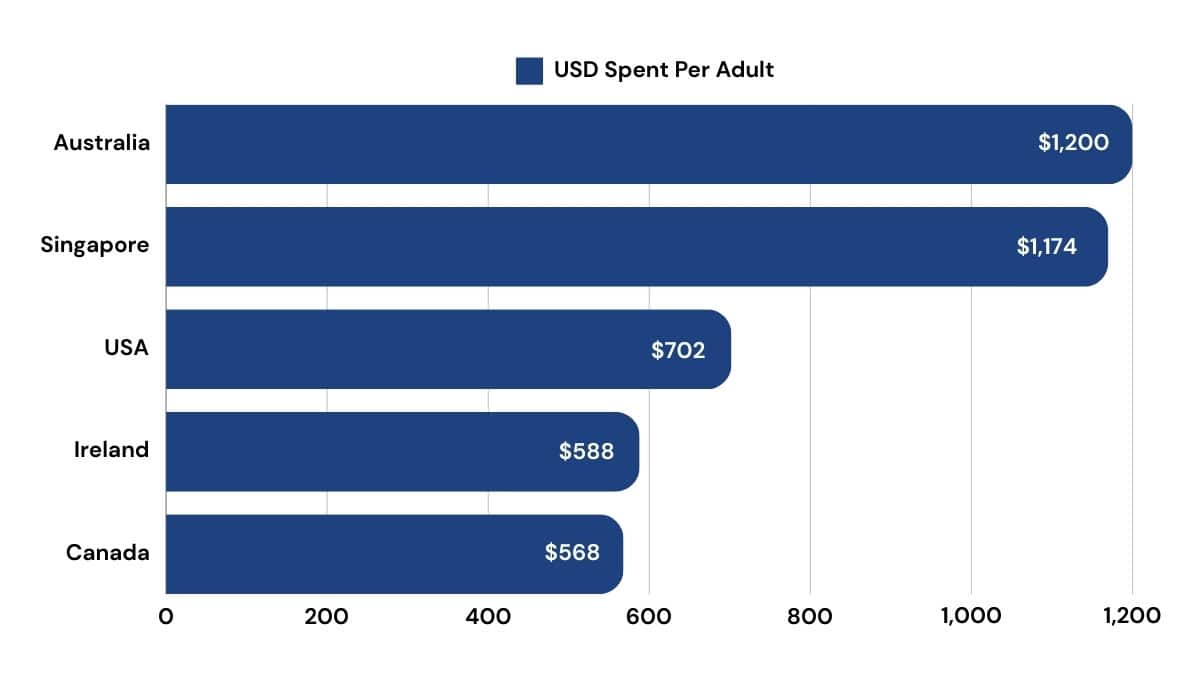
Australia: The per-capita gambling expenditure from one state to the next varies greatly, with the lowest being the island state of Tasmania at $393 and the highest being New South Wales at a whopping $984 per person back in 2019, though the average amount spent per adult in 2023 has shot up to an impressive $1,200.

Singapore: Coming in a close second is Singapore, spending $1,174 per adult.

USA: As legislation expands and gives US bettors greater access to gambling opportunities, we expect that the $702 per adult reported today is not going to increase drastically in the coming years.

Ireland: We were surprised to include Ireland on this list, but when crunching the numbers we found Ireland made up about 2.6% of all of Europe’s gambling revenue, spending $588 per adult.

Canada: Just behind Ireland, Canada’s robust betting industry brings in roughly $568 per adult and closes out our top five highest-spending countries per capita.

Gambling Worldwide – The Overall Number of Active Gamblers

Country Regular Gamblers % of Population
Global Community 2 billion 26%
United States 198 million 60%
France 29 million 44%
United Kingdom 29 million 43%
Canada 23 million 60%
Australia 9.7 million 38%

It is estimated that roughly 26% of the entire world regularly engages in some form of gambling, meaning over 2 billion adults are placing bets around the globe — though it is no surprise that some countries are pulling a little more than their share of weight.

Gambling Participation By Age

Global Gambling Statistics 5

Global Gambling Statistics 2

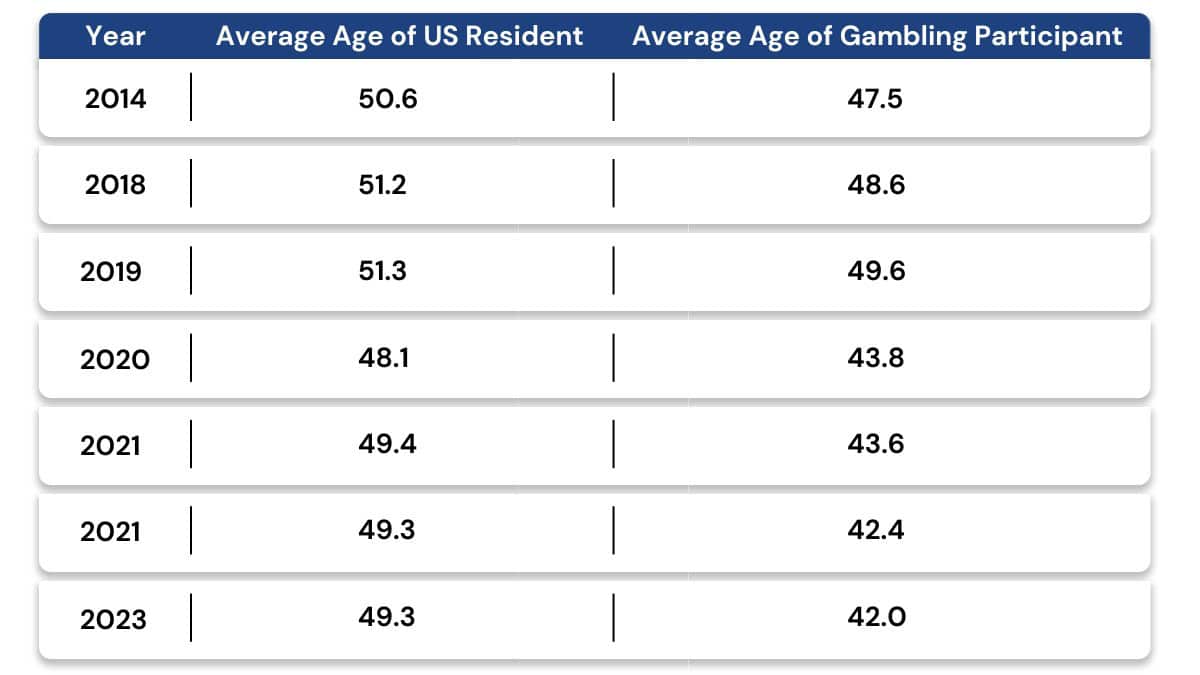
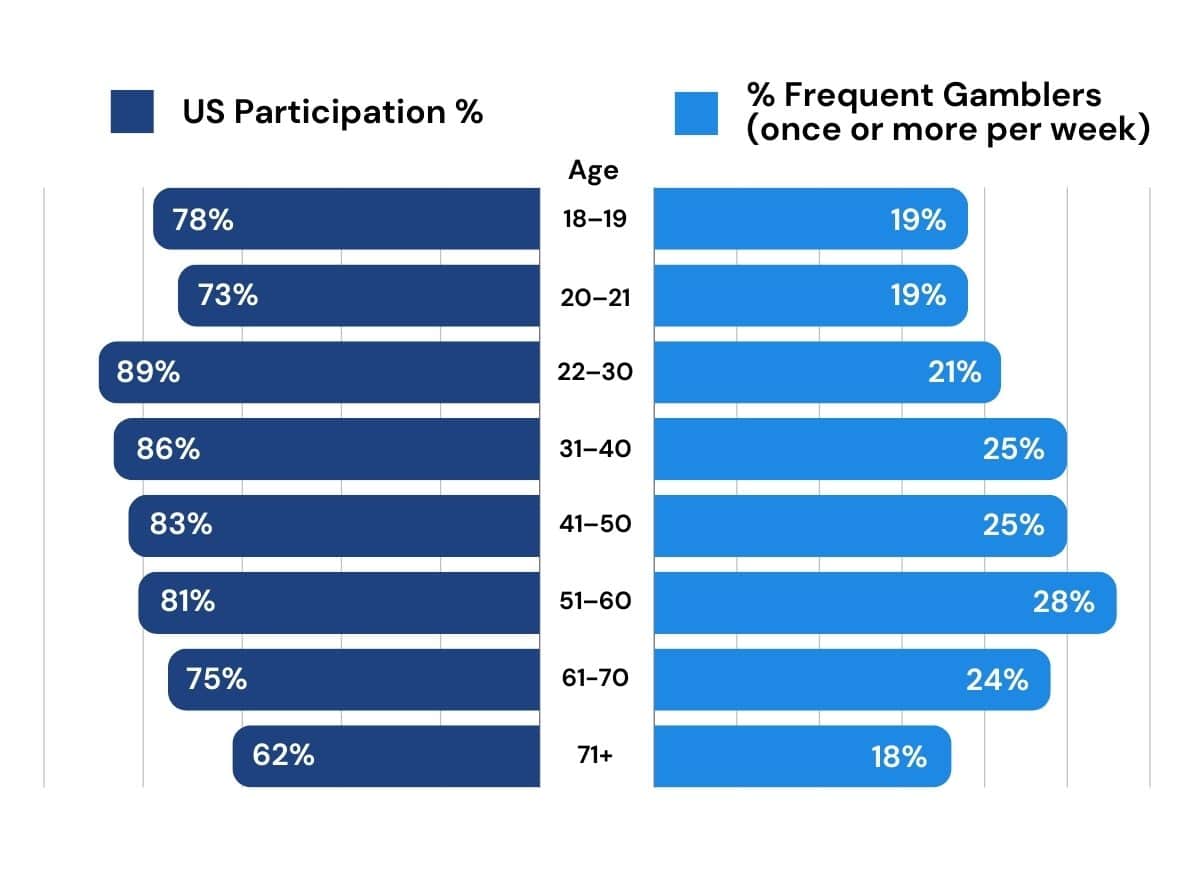
While gambling has generally been regarded as a form of entertainment for more “mature” individuals (45+) there has been a significant increase in interest among the younger crowds, as evidenced by the latest demographic studies conducted in the United States. With so many younger players joining the scene, we have seen a drop in the average age of gamblers in the US for four consecutive years, even though the average age of residents has remained relatively unchanged.

Biggest Changes to the Global Face of Gambling

In the last few years, there have been a ton of sociological developments, legislative pushes, and technological advances that have shaped the gambling market we’re faced with today and given us insight into what we can expect to get out of it moving forward.

Here are a few of the more impactful line items.

Legalization of Sports Gambling in the United States

In 2018, the US Supreme Court overturned the Professional and Amateur Sports Protection Act (PAPSA) of 1992, opening the door for individual states to legalize sports betting, significantly expanding the gambling market in the country.

PAPSA was meant to define the legal status of sports betting throughout the US, and while it was in place, there were only a few states that could legally place wagers on sports. But now, over 5 years after it was overturned, 33 states plus Washington D.C. have legalized sports betting in some form with more pending legislation.

The Supreme Court opening these doors has caused a boom in sports betting, with more than $220 billion in legal sports wagers placed since 2018 — generating $3+ billion in tax revenue for the legalized states.

The UK’s Tightened Online Gambling Regulations

It’s no surprise that the ease with which players can access online betting sites is causing a stir — particularly in the heavier markets.

The UK has been introducing strict laws to regulate online stake limits, perform more identification and affordability checks (to protect players from spending more than they can afford to lose), and even give gambling regulators the power to take down illegal betting sites and unauthorized operators.

These regulations could also see even more restrictions on bonus offers like free spins and free bets, limiting some of the marketing tactics online casino operators rely on to get new players in the digital door.

Early estimates expect these regulations’ collective impact on remote (online) operators to range from an 8% to 14% reduction in GGY, suggesting a significantly reduced profitability and smaller market share.

New Demographics

In recent years, gambling has seen a dramatic increase in two key demographics: women and younger gamblers.

In studies done in both the UK and Canada, experts have found an increase in participation from women, with both groups finding that nearly half (42-43%) of women have gambled within the last four weeks.

Additionally, the American Gaming Association found that the average age of casino goers has consistently dropped over four consecutive years from 49.6 to 42 years of age. This implies that more and more young players are embracing online gambling at a rate significantly faster than those who are aging out.

The Rise of Online Gaming

The advent of mobile gaming and online casinos has dramatically transformed the market, making it possible to capture the portion of society that would not otherwise be interested in stepping foot in a traditional casino or bookmaker’s establishment.

Taking into account all forms of mobile and online gambling, this market is expected to reach a revenue of over $107 billion in 2024, with $23 billion of that coming from the United States alone.

This shift to personal technologies like desktop computers, tablets, and mobile phones has not only broadened the gambling market’s reach, attracting a younger, tech-savvy demographic, but also intensified competition between operators to offer more engaging, user-friendly mobile platforms.

The impact is a more dynamic, accessible, and diversified gambling landscape.

Exciting New Technologies

Trading Graph Online

New technologies are emerging all the time, and any establishment looking to stay competitive is bound to find some way to integrate them to gain an edge.

We’ve already seen many online gambling sites take to and embrace cryptocurrencies and other blockchain technologies, including “Provably Fair” games. The bones of these games are built in such a way that the randomization for a given game can be checked and verified by any player.

Now that virtual reality games and hardware are becoming more commonplace, top minds in the industry are building and testing metaverse casinos to offer a truly immersive experience.

PokerStars — one of the biggest names in online poker — has taken a fairly successful stab at integrating the technology with their Vegas Infinite, though, as with all new technologies — it may take a while to catch on.

We are also already seeing AI popping up in the form of intelligent chatbots for customer support, though we can expect online casinos to leverage artificial intelligence to make game suggestions, create personally tailored bonuses and promotions based on an individual’s preferences, and more.

Key Takeaways
  • 33 states have legalized online sports betting in the US to some degree, with more pending.
  • The participation of women and younger people in online gambling has dramatically increased.
  • The mobile gaming market is expected to grow to $107 billion in 2024.
  • Poker Stars is the first gambling platform to make efforts to introduce VR technology into online gambling

Global Gambling Statistics – Conclusion

The gambling industry has proven that when faced with enough adversity, it has the innovation and gumption not just to weather the storm but find a way to thrive under any conditions.

Markets like the United States, the UK, Australia, Canada, Singapore, and many other countries all saw wild growth, creating a global market worth over half of a trillion dollars in 2023, and is expected to go well beyond that in the years to come.

We can’t wait to see how the industry evolves as new legislation is put forth, new technologies are developed, and new players sign on.

References:

The Mills at Jersey Gardens: Designer Deals, Top Brands, and Easy Access from New York City

Jersey Garden Mall

The Mills at Jersey Gardens is New Jersey’s largest indoor outlet mall, featuring 200+ designer and brand-name stores—plus the nation’s largest Tommy Hilfiger outlet. Located in Elizabeth, it’s about 30 minutes from Times Square and minutes from Newark Liberty International Airport, making it an easy stop for layovers or weekend shopping.

Shoppers come for major discounts and New Jersey’s no sales tax on clothing and shoes, then stay for the extras like AMC Theatres (with IMAX) and family-friendly dining. This guide breaks down the best stores, where to eat, how to get there, nearby hotels, and tips to maximize your visit.

Top Retail Stores and Designer Outlets

The Mills at Jersey Gardens is home to powerhouse anchors like Saks Fifth Avenue OFF 5TH, Bloomingdale’s The Outlet Store, Primark, Marshalls, Burlington, and Pottery Barn Outlet—offering everything from fashion to home essentials at outlet prices.

Designer shoppers will find plenty to explore, with Michael Kors, Coach, Kate Spade New York, Marc Jacobs, and Tory Burch, plus a Polo Ralph Lauren Factory Store and the largest Tommy Hilfiger store in the U.S., a standout highlight of the mall.

Athletic fans won’t be disappointed either. The lineup includes the Nike Factory Store, Adidas Outlet, PUMA, Under Armour, New Balance, and Reebok, making it a go-to for sneakers and workout wear.

Beyond clothing, the mall also offers accessories and gift favorites such as Swarovski, TUMI, Claire’s, Lovisa, and Perfumania, along with outdoor gear staples such as Columbia, The North Face, and Finish Line.

From luxury fashion to sportswear and everyday basics, The Mills at Jersey Gardens delivers a one-stop shopping experience with something for every style and budget.

Complete Guide to Store Categories

The Mills at Jersey Gardens has over 200 stores. They’re spread across different categories, so here’s a breakdown of what kinds of stores you’ll find inside the mall:

Accessories

Stores focused on jewelry, bags, eyewear, and other extras.

  • Claire’s
  • Coach Men’s
  • Coach Outlet
  • Cohen’s Fashion Optical
  • Lids
  • Lovisa
  • Perfumania
  • Swarovski
  • TUMI

Active Lifestyle & Outdoor Gear

Shops for sportswear, sneakers, and outdoor brands.

  • Columbia Factory Store
  • Finish Line
  • The North Face Outlets
  • Under Armour Factory House

Apparel

Most of the mall is clothing-focused. Here are the clothing retailers by name:

  • Abercrombie & Fitch
  • Aerie
  • Aéropostale
  • Against All Odds
  • American Eagle
  • Ann Taylor Factory Store
  • Armani Exchange Outlet
  • Banana Republic Factory
  • Bloomingdale’s The Outlet Store
  • BOSS Outlet
  • Brooks Brothers Factory Store
  • Burlington Coat Factory
  • Calvin Klein
  • Camille La Vie
  • Cohoes
  • Express Factory Outlet
  • Forever 21
  • G by GUESS
  • GAP Factory
  • Garage
  • G-Star RAW
  • GUESS Factory
  • H&M
  • Hollister
  • Hot Topic
  • Hurley
  • J.Crew Factory
  • Karl Lagerfeld Paris
  • Kate Spade New York Outlet
  • Kohesion
  • LACOSTE Outlet
  • Levi’s® Outlet Store
  • LOFT Outlet
  • Lucky Brand
  • Mandee
  • Marshalls
  • Michael Kors Outlet
  • Nautica Factory Store
  • Old Navy Outlet
  • Perry Ellis
  • PINK
  • Polo Ralph Lauren Factory Store
  • Portabella II
  • Prato Fine Men’s Wear
  • Primark
  • Saks OFF 5TH
  • Scrubs & Beyond
  • Steps NY
  • Tommy Hilfiger
  • Tory Burch
  • True Religion Outlet
  • U.S. Polo Assn.
  • Victoria’s Secret Outlet
  • Vineyard Vines
  • Volcom
  • Windsor
  • XIOS
  • Zumiez

Footwear

Shoes, sneakers, and boots—casual and athletic.

  • Adidas
  • Burlington Shoes
  • Clarks
  • Converse
  • Crocs
  • ECCO
  • Famous Footwear Outlet
  • Foot Locker
  • Journeys
  • New Balance Factory Store
  • Nike Factory Store
  • PUMA Outlet
  • Reebok Outlet
  • Skechers Superstore
  • Timberland Factory Store
  • UGG
  • Vans Outlet

Games, Gifts & Home Goods

For home décor, gifts, games, and entertainment.

  • GameStop
  • Pottery Barn Outlet
  • Spencer’s

Kids

Clothing and shoes for babies, toddlers, and kids.

  • Abercrombie Kids
  • Carter’s
  • The Children’s Place
  • Disney Outlet
  • Journeys Kidz
  • Kids Foot Locker
  • Kids Outlet
  • Kidstown
  • OshKosh B’Gosh
  • Polo Ralph Lauren Children’s Factory Store

This guide highlights the main retail categories and key stores you’ll find. For full details—including hours, floor locations, and maps—check the mall’s complete directory to plan your visit.

Dining Options at and Near The Mills at Jersey Gardens

After walking through 200+ stores, you’re probably going to need a bite to eat. The Mills at Jersey Gardens has plenty of food options right inside the mall, and there are also local spots nearby if you want to step out. Here’s a full list of what’s available:

  • Applebee’s
  • Auntie Anne’s Pretzels (two locations)
  • Burger King
  • Chili’s
  • Cinnabon (two locations)
  • Cold Stone Creamery
  • Doc Popcorn
  • Dunkin’ Donuts
  • Great American Bakery and Cafe
  • Haagen-Dazs
  • IHOP – International House of Pancakes
  • Jamba Juice
  • Johnny Rockets
  • Kelly’s Cajun Grill
  • Moe’s Southwest Grill
  • Nathan’s Famous
  • Popeye’s Chicken
  • Potato Corner
  • Real Fruit Bubble Tea
  • Sbarro
  • Starbucks Coffee
  • T-Swirl Crepe
  • Wetzel’s Pretzels
  • Woops!
  • Yeung’s Lotus Express

Most are open during regular mall hours (10 a.m. to 9 p.m.), but it’s a good idea to double-check if you’re going late or early.

Entertainment and Leisure Options

Beyond shopping and dining, The Mills at Jersey Gardens features several attractions to enjoy during your visit.

AMC Theatres with IMAX

First, there’s a 20-screen AMC Theatre inside the mall. One of the screens is IMAX, which means a bigger picture and better sound. So if you want to watch a movie after shopping—or take a break during—it’s easy to fit it into your visit.

Kid-Friendly Stores and Features

Next, if you’re visiting with kids, there are a few places that might help. The mall has stores like:

  • Disney Outlet
  • LEGO Store
  • The Children’s Place

Also, baby changing stations are available in all restrooms, which is useful for families.

Other Useful Amenities

The mall includes:

  • Free Wi-Fi in public areas
  • ATMs throughout the building
  • AEDs (emergency defibrillators) in the Mall Management Office
  • Accessible entrances at all main entry points (A–E)
  • Handicap parking options
  • A currency exchange booth
  • A Guest Services Booth where visitors can get the official coupon book

Overall, while the mall is mainly for shopping, these extra features make the visit easier—especially if you’re staying for a few hours or bringing kids along.

Operating Hours and Transportation Details

The Mills at Jersey Gardens is open seven days a week. Here’s when you can visit:

  • Monday–Saturday: 10:00 a.m. – 9:00 p.m.
  • Sunday: 11:00 a.m. – 7:00 p.m.

If driving, there are two main ways to get there:

  • From the New Jersey Turnpike, take Exit 13A, then follow the signs for Jersey Gardens Blvd.
  • From Routes 1 & 9, take the North Ave East exit, then follow signs for Jersey Gardens Blvd.

If coming by bus, there are a few options depending on where you’re starting:

  • From New York City, take NJ Transit bus #111 or #115 from the Port Authority Bus Terminal.
  • From Newark, take NJ Transit bus #40.
  • From Orange, Elizabeth, or Newark, take Coach USA bus #24.

The mall’s location near Newark Liberty International Airport also makes it an easy stop for travelers.

Recommended Hotels Near the Mall

If you plan to stay overnight or make a weekend of your visit, there are a few hotels near The Mills at Jersey Gardens that offer Shop & Stay packages. These spots are close to the mall and are set up for both travelers and shoppers.

  • Embassy Suites Newark Airport
  • Courtyard Elizabeth
  • Hampton Inn & Suites Newark Airport
  • Country Inn & Suites by Radisson

Depending on the hotel, Shop & Stay packages may come with:

  • A $25 Visa gift card
  • A mall shopping bag
  • A complimentary coupon book
  • Shuttle service to and from the mall (at participating hotels)

Discover the Ultimate Outlet Shopping Experience

Plan your trip to The Mills at Jersey Gardens, New Jersey’s premier outlet mall with 200+ designer and brand-name stores, deep discounts, and tax-free shopping on clothing and footwear.

Browse favorites like Nike, Coach, and Bloomingdale’s The Outlet Store, boost your savings with the mall’s digital coupon book, then recharge with on-site dining or catch a movie at the 20-screen AMC Theatres. Make a day of it—shop, save, dine, and unwind under one roof.

P.S. After your day of outlet shopping, why don’t you head to one of the best restaurants in New Jersey?

Hoboken ZIP Code 07030 – What You Need to Know

Hoboken Zip Code a

Hoboken, NJ, has one ZIP Code: 07030. Simple, right?

For a place that’s only 1.25 square miles, it works.

But this little number is a lot more than a way to send mail.

It connects a tight-knit community, covers iconic neighborhoods, and represents over 60,000 people who call this place home.

In this guide, we’ll break down what makes Hoboken’s 07030 ZIP Code unique.

From the people who live here to how the city’s set up, and even practical tips about ZIP+4 codes, we’ve got it covered.

Whether you live here or not, this is your no-nonsense guide to Hoboken’s one and only ZIP Code.

Why Hoboken, NJ Has Only One ZIP Code

The Hoboken, NJ ZIP Code—07030—covers the entire city, and honestly, it makes perfect sense.

As we discussed a moment ago, Hoboken is tiny—1.25 square miles of land plus 0.72 square miles of water—and home to over 60,000 people.

And since it’s one of the most densely populated cities in the country, there’s no need for more than one ZIP Code.

07030 stretches across all of Hoboken, from Castle Point to Uptown and Washington Street.

Castle Point sits at the highest spot in the city, Uptown adds some newer developments, and Washington Street is Hoboken’s main hub.

One ZIP Code makes life easier for a city this size—for residents, the postal service, and anyone trying to find their way around.

Demographics of the 07030 ZIP Code

Hoboken might be small, but it’s packed.

The population density is a staggering 60,456 people per square mile.

And with 28,179 total households and 30,206 housing units, Hoboken is a mix of renters, homeowners, and new arrivals constantly cycling in and out.

The average household size is 2.07 people, while the average family size is 3.27, reflecting a mix of young professionals, couples, and families putting down roots.

Who Lives in Hoboken?

The Hoboken Zip code population reflects a diverse mix of backgrounds.

Here’s how it breaks down:

  • 67% White
  • 13% Hispanic
  • 10% Asian
  • 4% Black
  • The remaining 6% includes mixed-race residents, Native American, and Hawaiian/Pacific Islander populations.

Hoboken also has a fairly even gender split: 50.22% male and 49.78% female, with a median age of 31.7 years.

This reflects the city’s reputation as a magnet for young professionals working in nearby New York City—people who want an easy commute but a more neighborhood-like atmosphere compared to Manhattan.

A City of Educated Professionals

Hoboken is one of the most highly educated cities in New Jersey, with 80.29% of residents holding a bachelor’s degree or higher.

This lines up with the high-income industries many residents work in—finance, tech, law, healthcare, and creative fields are all well represented here.

What the Numbers Say About Hoboken

For such a compact city, the numbers paint a clear picture: Hoboken is young, highly educated, and densely populated.

With a strong economy and a steady influx of new residents, it’s an in-demand place to live—whether for a few years or for the long run.

Despite the fast pace, Hoboken’s walkability and tight-knit layout make it feel more like a community than a commuter town.

ZIP+4 Codes: How They Improve Life in Hoboken

If you’ve ever wondered why some addresses in Hoboken have an extra four digits at the end, that’s the ZIP+4 code in action.

As you know, the ZIP code for Hoboken, NJ—07030—covers the entire city, but that extra set of numbers helps narrow things down.

In a place where buildings sit side by side, apartments stack on top of each other, and addresses can look nearly identical, the extra digits help make sure your mail actually gets to you—and not your neighbor downstairs.

Why ZIP+4 Codes Matter in Hoboken

Hoboken’s streets are tight, and its buildings are packed close together.

A single street can have multiple apartment buildings, businesses, and brownstones, all sharing nearly identical addresses.

And that’s where ZIP+4 codes come in:

  • They help mail carriers work faster and more accurately. Instead of sorting everything manually at the street level, mail can be pre-sorted right down to the building.
  • Fewer mix-ups. When every brownstone on a block has the same number, it’s easy for mail to end up in the wrong hands. ZIP+4 codes help prevent that.
  • Businesses, government agencies, and services use them, too. When addresses are this close together, ZIP+4 codes help ensure deliveries, official documents, and even emergency services go to the right place.

How to Find Your ZIP+4 Code in Hoboken

Not sure what your ZIP+4 is?

Here’s how to check:

  1. Look it up on USPS – The easiest way is to enter your address using the USPS ZIP Code Lookup Tool online.
  2. Check your mail – Bills and other official mail often have your ZIP+4 printed on them.
  3. Ask your building manager – If you live in an apartment, your management office likely knows your ZIP+4.

Do You Need to Use Your ZIP+4?

Not always, but it helps.

Your regular ZIP Code (07030) stays the same, but adding your ZIP+4 makes things run smoother.

Think of it like an apartment number—technically, you can get by without it, but if you want things delivered faster and more accurately, it’s a good idea to use it.

The Economy of the 07030 ZIP Code

Business is booming in Hoboken.

The 07030 ZIP Code is home to 1,545 businesses, employing 23,508 people and generating $1.96 billion in annual payroll.

And that’s a huge amount of economic activity for a city that fits into just over a square mile.

The median household income in the 07030 ZIP Code is $160,890, well above the national average.

But as you can expect, a lot of that comes from high-paying industries—finance, law, and tech—while small businesses also thrive, from Hoboken’s restaurants to boutique shops.

With limited space and high demand, the economy here moves fast. Jobs are plentiful, salaries are high, and the cost of doing business reflects that.

For a city this size, the numbers speak for themselves.

Hoboken, New Jersey ZIP Code – One City, One Number

As we’ve seen today, nothing about 07030 is surprising after looking at the numbers.

Let’s have a little recap.

The Hoboken, New Jersey ZIP Code fits because the city is small, densely packed, and built for efficiency.

Mail delivery, city services, and businesses operate within a tight space, and the structure of 07030 reflects that efficiency.

In a nutshell, the way Hoboken functions—economically and logistically—lines up with the way it’s mapped out.

One city, one ZIP Code, and everything working within it.

Aaron Judge Trade: Would the Yankees Really Risk Their Captain and Face of the Franchise?

Aaron Judge Trade

What are we even talking about here?

Have we really reached a point where people are seriously discussing the possibility of Aaron Judge being traded?

Certain moves in sports don’t happen, not because they can’t—because, technically, anything is possible in a world where billion-dollar teams make unpredictable decisions—but because the fallout would be so massive that it would shake the entire league.

And yet, here we are, entertaining the idea that Aaron Judge, the Yankees’ heart and soul, the player who carried this franchise through the post-Jeter era, could be on the trading block.

Who started this conversation, and in what world would the Yankees go through with it?

Because if they ever did, it would be an all-out fan revolt, a decision that would go down as one of the most controversial in baseball history.

Key Takeaways
  • Aaron Judge is the face of the New York Yankees, making any trade scenario nearly unthinkable.
  • Financial and cultural factors make a trade highly improbable, though a massive return package could tempt the Yankees.
  • The Yankees are active in the trade market, but shedding contracts like Marcus Stroman’s is more realistic than moving Judge.

Aaron Judge Isn’t Just a Player—He’s The Player

There are great players in baseball, but then there are the rare ones who define a franchise, and Aaron Judge is undoubtedly one of those players.

Since his debut in 2016, he has dominated with his bat, setting records, winning the American League MVP in 2022, and hitting an incredible 62 home runs that year.

And beyond the numbers, beyond the home runs and the awards, he is the leader in the clubhouse, the captain, and the player the Yankees built their future around.

So, the idea of trading Judge is a shock to anybody who follows the sport.

You don’t trade a player like that unless you are completely tearing down your franchise and starting over, and even then, it would still be considered a mistake.

And for what exactly?

A few young prospects and some payroll relief?

The Yankees have already committed to Judge with a nine-year, $360 million contract that ensures he stays in New York for the long haul.

As one of the highest-paid MLB players, his value goes beyond his performance on the field—he represents the identity of the franchise, the face of the team, and the player fans expect to lead them to championships.

Thus, no trade package in baseball could make up for what the Yankees would lose if they moved Judge.

What Would a Trade Even Look Like?

If the Yankees considered trading Judge for some absurd reason, what kind of deal would it take for them to even think about it?

The return would have to be massive, a trade that only happens once in a generation.

And a team like the Los Angeles Dodgers or San Diego Padres, who have deep farm systems and financial power, might be the only ones capable of putting together a deal big enough to make the Yankees listen.

But even then, what would they have to give up?

Maybe multiple All-Star-caliber players.

Perhaps their top three prospects.

Or even worse, a combination of elite young talent and a superstar in his prime.

Even if a team offered a package like that, would it ever be worth it for the Yankees?

The answer is almost certainly no because when you trade a player like Judge, you’re losing the leader of your team, the face of your franchise, and the player that fans connect with the most.

Marcus Stroman is the Real Trade Candidate

Now, while a Judge trade is nothing more than a wild fantasy, there are some realistic moves the Yankees might make, and one of them involves starting pitcher Marcus Stroman.

Unlike Judge, Stroman is not a long-term fixture in New York, and after a shaky 2024 season, his future with the team is very much in question.

Stroman posted a 4.31 ERA over 154 2/3 innings last season, which isn’t awful, but it’s also not the production the Yankees were hoping for when they signed him to a two-year, $37 million contract.

What stands out is the difference between his home and road performances—at Yankee Stadium, his ERA was a rough 5.31, but on the road, he was significantly better with a 3.09 ERA.

The split suggests he might be a better fit somewhere else, and that’s where the Atlanta Braves come in.

The Braves, always looking to strengthen their rotation, have been named as a potential landing spot for Stroman, as they could use an experienced arm to complement their already strong pitching staff.

Bleacher Report’s Tim Kelly suggested that the Yankees’ main goal in moving Stroman isn’t necessarily to get a high-value return—it’s to get rid of his contract.

If the Yankees can offload at least $10 million of his salary, it would give them more flexibility to make other moves, and the Braves might be willing to take him if the financial situation works out.

Could the Yankees Go After Nolan Arenado?

Another name that has been floating around in trade rumors is Nolan Arenado, the longtime St. Louis Cardinals third baseman who has reportedly been on the trading block for months.

Arenado, once considered one of the best all-around third basemen in baseball, has seen his offensive production decline in recent years, with his OPS dropping from .891 in 2022 to .719 in 2024.

At 33 years old, he is still a strong defender, but his contract—$74 million over the next three seasons—has made it difficult for the Cardinals to move him.

The Yankees have been loosely linked to Arenado this offseason, but unless the Cardinals drastically lower their asking price, it’s hard to see New York making a serious push for him.

While he would provide a boost at third base, taking on that contract for a player past his prime isn’t exactly the move the Yankees should be making.

The Yankees’ Future is Still Built Around Judge

At the end of the day, Aaron Judge isn’t going anywhere, no matter how many wild trade rumors pop up.

The Yankees have already made it clear that they are building their team around him. While they might make some moves to improve the roster, those moves will not involve trading away the most important player they have.

Shedding Stroman’s contract makes sense, looking into potential upgrades like Arenado is worth considering, but trading Judge will never happen.

And if it ever did, the Yankees front office better be ready for the kind of fan backlash that would make every bad trade in baseball history look reasonable in comparison.

So, let’s stop with the nonsense and focus on the real issues the Yankees must address.

They need to figure out how to win in October, make sure their pitching holds up in big moments and put the right pieces around Judge to ensure they aren’t wasting his best years.

But they don’t need to trade the one player who makes them worth watching in the first place.

Exploring Maryland’s Beautiful Beaches & Water Activities

Exploring Maryland Beautiful Beaches FI

We are back on the road! This time around, Lucia is rediscovering the beautiful beaches in Maryland and everything they have to offer. 

Growing up, the beaches in Maryland were my summer playground. I first stepped onto Ocean City’s sand when I was six. I remember the salty taste in the air, seagulls stealing fries from unsuspecting tourists, and my father trying to teach me how to fish from the pier.

Twenty years later, I’m back to rediscover these treasured shores that shaped my childhood and explore others that, inexplicably, I never visited as a kid.

My Beach-Hopping Experience

Maryland’s coastline is a master class in variety, with each beach crafting its own distinct atmosphere. From my years covering coastal destinations, I’ve discovered few shorelines that pack such diverse offerings into their sandy borders.

On Maryland’s edge, where the Atlantic meets the shore, you’ll find everything from bustling seaside promenades to pristine stretches of untouched sand. After exploring these treasured beaches in Maryland, I’m ready to share what makes each slice of this coast uniquely compelling.

Ocean City Beach

Ocean City Beach

  • Location: Ocean City, MD
  • Amenities: Boardwalk, restaurants, amusement parks
  • Activities: Swimming, sunbathing, fishing, nightlife

The saltwater taffy pulled me in first. Standing on Ocean City’s boardwalk, watching the taffy-making machine through the window of Dolle’s, I felt like that same kid who begged for just one more piece thirty years ago.

Some things here never change. Thrasher’s fries still come in the same paper bucket, doused in vinegar and salt, perfect for sharing on a bench while watching the waves.

Sure, Ocean City gets crowded in summer. But at sunrise, when the boardwalk belongs to joggers and early-bird fishermen, you’ll see why locals love this place year-round. I like to grab coffee from Dunkin’ and walk north past 27th Street, where the morning light paints everything gold, and you might catch sight of dolphins playing in the surf.

Assateague Island

Assateague Island

  • Location: Near Berlin, MD
  • Amenities: Campsites, visitor center
  • Activities: Wildlife viewing, camping, kayaking

“Don’t feed the ponies” signs are everywhere on Assateague, but they don’t tell you how hard it is to resist when one shows up at your campsite, eyeing your breakfast. These wild horses own this island – we’re just visitors. Last summer, I watched a stallion lead his herd across the dunes at sunset, their silhouettes like something out of a dream.

The best campsite? Loop C, near the marsh. You’ll smell like campfire and bug spray, but you’ll also see more wildlife than anywhere else.

Pro tip: bring twice as many tent stakes as you think you need. The wind here means business.

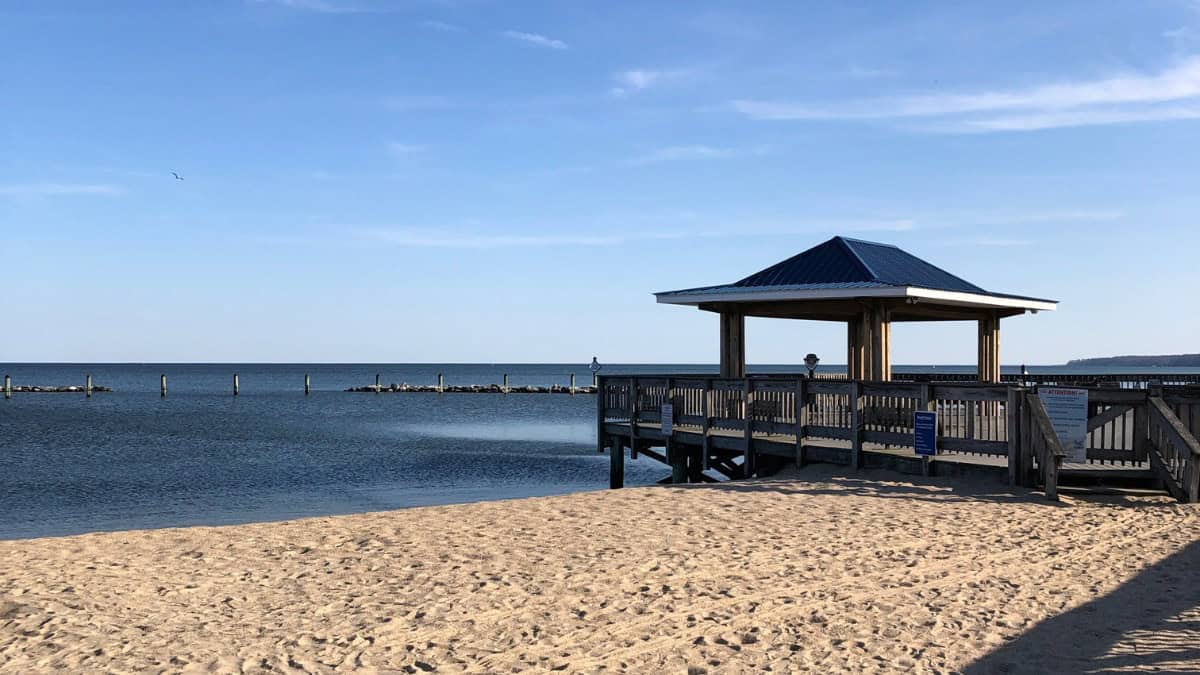
North Beach

North Beach

  • Location: North Beach, MD
  • Amenities: Boardwalk, fishing pier, shops
  • Activities: Swimming, fishing, shopping

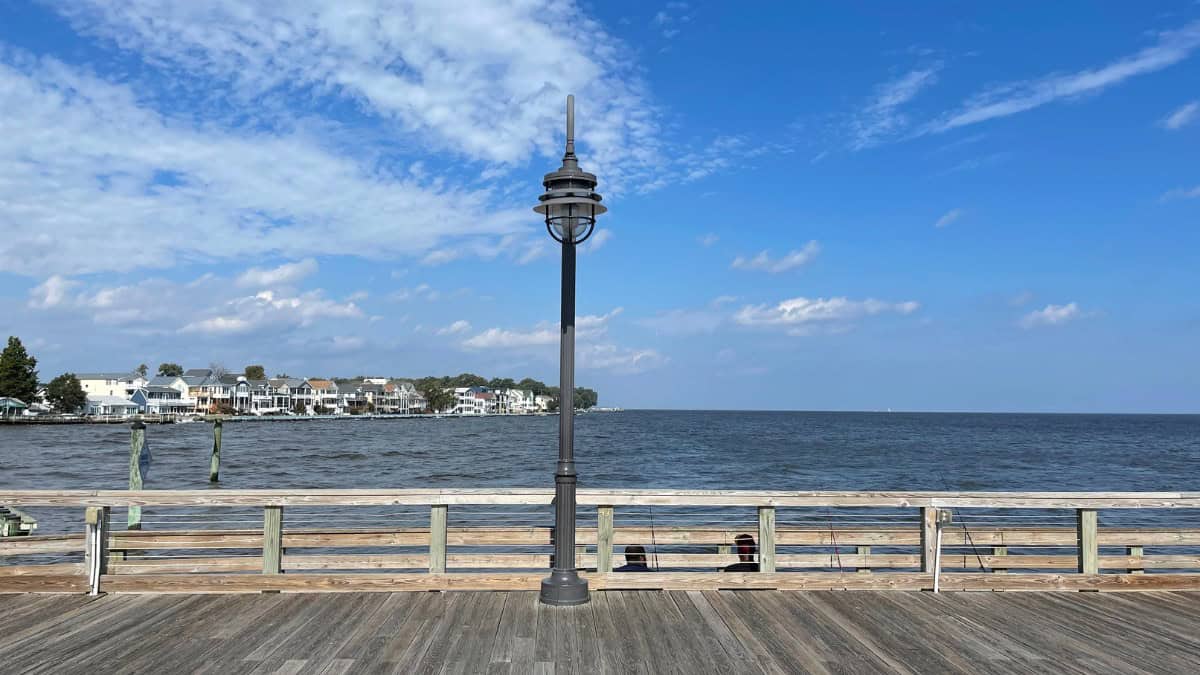
North Beach feels like stepping into an old postcard. Kids still fish off the pier with dollar-store nets, hoping to catch blue crabs. The Friday night farmers market turns into an impromptu community party in summer, with local bands playing as the sun sets over the bay.

Last week, I met Bill at Nice and Fleazy Antiques. He’s been collecting beach glass here for 40 years and knows every story behind every Victorian house on the strip. “This town’s got more stories than shells,” he told me, showing me a piece of cobalt blue glass smoothed by decades in the Chesapeake.

Sandy Point State Park

Sandy Point State Park

  • Location: Annapolis, MD
  • Amenities: Picnic areas, boat rentals, playgrounds
  • Activities: Swimming, picnicking, boating

Everyone photographs the Bay Bridge from Sandy Point – it’s impossible not to. But the real magic happens in the park’s quieter corners. Follow the trail past the main beach to where locals fish for striped bass, and you might find yourself sharing space with great blue herons hunting in the shallows.

The east beach gets crazy on summer weekends, but the south beach is usually empty. Bring water shoes – the bottom’s rocky – and watch for ospreys diving for fish. They’re better entertainment than any phone screen.

Calvert Cliffs State Park

Calvert Cliffs State Park

  • Location: Lusby, MD
  • Amenities: Hiking trails, picnic areas, playground
  • Activities: Fossil hunting, hiking, picnicking

Nobody tells you about the hike to Calvert Cliffs beach. It’s two miles through woods and marsh, and yes, you’ll sweat. But then you round that last bend and see the cliffs rising from the bay like ancient walls, and suddenly the walk seems worth it.

Bring a kitchen sieve for fossil hunting – it works better than the fancy tools they sell at the visitor center. I learned this from Sarah, a retired science teacher who’s been finding shark teeth here since the ’70s. “Every rainstorm changes what you might find,” she told me while showing me how to spot the telltale black shine of a Megalodon tooth in the sand.

Chesapeake Beach

Chesapeake Beach

  • Location: Chesapeake Beach, MD
  • Amenities: Water park, restaurants, marinas
  • Activities: Swimming, boating, dining

The railway brought Victorian tourists to Chesapeake Beach over a century ago. The trains are gone, but something of that old resort spirit lingers. Skip the water park and head to the railway trail instead – it follows the old train route, with signs telling the story of the town’s heyday. At Abner’s Crab House, they still spread brown paper on the tables and serve beer in plastic cups.

South Point Beach

South Point Beach

  • Location: Near Berlin, MD
  • Amenities: Limited facilities
  • Activities: Swimming, sunbathing, nature walks

You won’t find South Point in many guidebooks, and that’s exactly why it’s special. No facilities means no crowds – just dunes, waves, and the kind of quiet that’s getting harder to find on the Eastern Shore. Bring everything you need, including water, and prepare to climb over some downed trees to reach the beach. The reward? Having a stretch of Atlantic shoreline practically to yourself.

Elk Neck State Park

Elk Neck State Park

  • Location: North East, MD
  • Amenities: Campgrounds, hiking trails, boat launch
  • Activities: Hiking, camping, boating

Where forest-clad cliffs meet the mighty Chesapeake, this park presents a masterclass in Maryland’s natural diversity. Standing sentinel above it all, the historic Turkey Point Lighthouse commands sweeping views across waters that have guided mariners for generations.

My trek through dense woodland canopy ended at this lofty perch, where the convergence of bay and sky stretches endlessly toward the horizon. Here, amid the mingling of maritime and woodland worlds, outdoor adventurers find their own path – whether by trail, shore, or rolling waves.

Fenwick Island State Park

Fenwick Island State Park

  • Location: Fenwick Island, DE (near the Maryland border)
  • Amenities: Restrooms, showers, lifeguards
  • Activities: Surfing, fishing, beachcombing

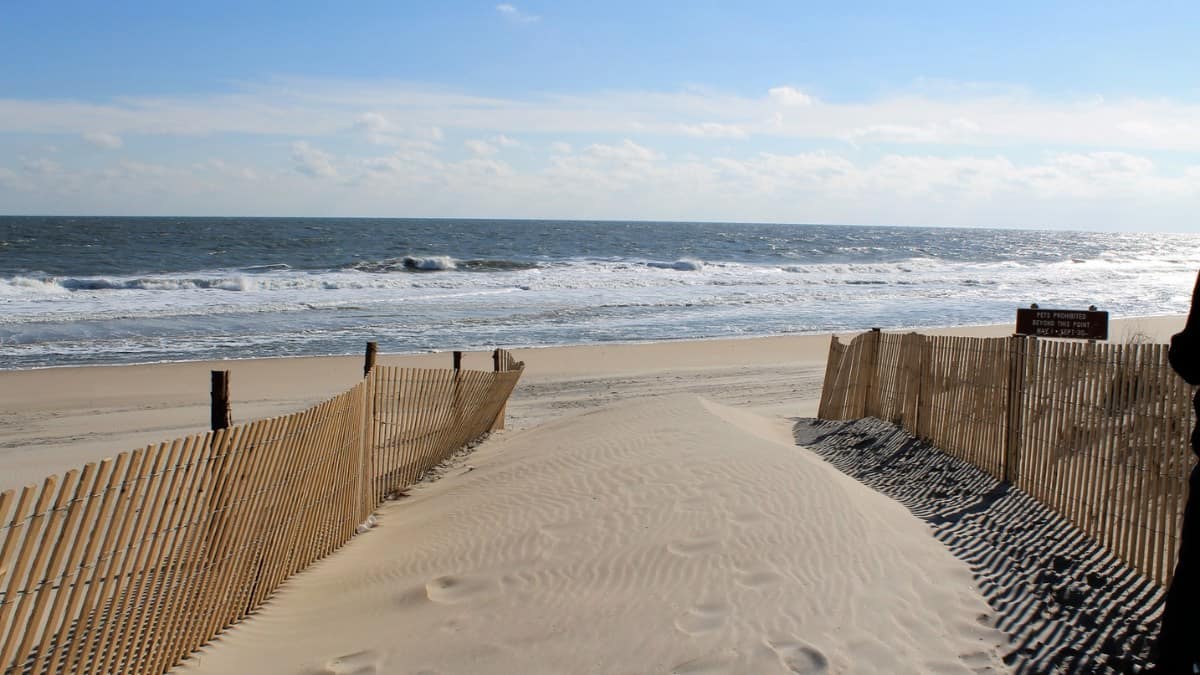
Between the more frequented shores of Ocean City and Bethany Beach lies this coastal sanctuary, where nature still writes its own rules. After years chronicling America’s beaches, I’ve found few stretches of Atlantic shoreline that maintain such pristine isolation while remaining accessible.

Here, my solitary footprints marked the morning sand, disappearing with each gentle wave. Seabirds wheeled overhead, their calls the only interruption to the rhythmic surf. While most visitors seek the energy of neighboring beaches, those in search of both solitude and sport find their reward – from the designated surfing zones to fishing spots where patient anglers cast their lines into the rolling Atlantic.

What to Pack for Maryland’s Beaches

Years traversing Maryland’s diverse shoreline have taught me the delicate art of coastal preparation. Here’s a list of things you need:

  • Cash: Even in 2025, the sweetest boardwalk discoveries – those legendary fries or artisanal ice cream – often come from vendors who favor paper over plastic. Keep small bills handy.
  • Beach Shoes: Maryland’s coast isn’t just postcard-perfect sand. The fossil-rich shores of Calvert Cliffs and the shell-strewn beaches demand more than flimsy flip-flops. Pack sturdy water shoes.
  • Sunscreen and Bug Spray: Especially crucial for Assateague Island, where the wild ponies may roam free but the mosquitoes rule the dawn and dusk. Double up on protection.
  • Layers: Morning fog at South Point gives way to blazing afternoon sun. I’ve learned to pack like a coastal chameleon – from warm layers at sunrise to swimsuits by noon.

The Best Time to Visit

Timing is everything when exploring Maryland’s beaches. During my trip, I realized how much the experience changes based on the time of year.

  • Summer: Perfect for families and vibrant boardwalks. Ocean City was buzzing with energy, and the water was warm for swimming.
  • Fall: Less crowded and more peaceful. Assateague Island was stunning with its autumn hues, and the wild ponies were easier to spot.
  • Weekdays: Avoid weekends if you want to skip the crowds, especially at popular spots like Sandy Point State Park.

What to Expect When You Arrive

Each beach offers a unique vibe, so knowing what to expect can enhance your visit:

  • Ocean City: Expect a lively atmosphere with constant activity. Parking can be tricky, so arrive early.
  • Assateague Island: Be prepared for a more rugged experience. It’s ideal for nature lovers, but the amenities are minimal.
  • Calvert Cliffs: It’s more of a hike than a typical beach visit, but fossil hunting here is an adventure worth trying.

What I’d Do Again (and What I’d Skip)

Looking back, some experiences stood out while others could have been skipped.

  • Would Do Again:
    • Spend a sunset at North Beach—it was magical.
    • Explore Assateague’s trails and wildlife.
    • Enjoy a picnic at Sandy Point State Park.
  • Would Skip:
    • Visiting Ocean City in the middle of the day. The crowds were overwhelming, and parking was a hassle.

My Final Thoughts

From my weathered reporter’s notebook comes this truth: Maryland’s coastline defies simple categorization. Each beach writes its own story – from South Point’s whispered solitude to Ocean City’s exuberant boardwalk symphony.

For future chronicles, I’ll aim for early autumn, when summer crowds ebb but warmth lingers.

FAQs

Do I need to pay to access Maryland’s beaches?

While Ocean City’s sands remain free to all, state treasures like Sandy Point and Assateague maintain modest entrance fees that support their preservation.

Are Maryland’s beaches family-friendly?

From my observations, destinations like Ocean City and North Beach have mastered the art of family hospitality, offering extensive amenities and activities for all ages.

Can I see wild ponies at Assateague Island year-round?

These iconic residents grace their barrier island home throughout all seasons, though fall’s golden light provides nature’s perfect backdrop for photography.

Are Maryland’s beaches pet-friendly?

While Assateague and designated zones of Ocean City welcome leashed companions, always verify local ordinances before bringing your four-legged friends.

The $16.1 Billion Hudson Tunnel Project: Who Should Get the Credit, Biden or Trump?

If you’ve ever taken the train between New Jersey and Manhattan, you know the struggle—crowded platforms, endless delays, and aging tunnels that can’t keep up.

For years, commuters waited for a real solution.

Now, after delays and debates, a $16.1 billion project is finally happening.

A new tunnel under the Hudson River is being built, and the old, storm-damaged tunnel is getting repaired.

Naturally, people have questions—how long will it take, how will it affect travel, and will it solve the problem?

Officials recently held a public meeting in North Bergen to share updates covering construction plans, noise control, and expected benefits.

But while the tunnel is all about improving train service, another debate is happening in the background—who should get credit?

Some argue that President Biden deserves recognition since his 2021 infrastructure bill provided the funding.

Others believe that former President Donald Trump might try to claim credit once the project is completed.

So, who deserves it? Let’s break it down.

Key Takeaways
  • The Hudson Tunnel Project is a $16.1 billion plan to improve train travel between New Jersey and Manhattan by building a new tunnel and fixing the old one damaged by Superstorm Sandy.
  • At a public meeting in North Bergen, officials shared updates on construction, noise control, and how the project will connect to Penn Station to help commuters and residents understand what to expect.
  • Some argue the tunnel should be named after President Biden since his 2021 infrastructure bill funded it, while others believe former President Trump might try to take credit for it later.

Public Meeting Brings Updates on the Hudson Tunnel Project

The Hudson Tunnel Project, part of the $16.1 billion Gateway Program, is one of the country’s biggest infrastructure projects.

The Gateway Development Commission held a public information session in North Bergen to keep the community informed.

Mayor Nicholas Sacco hosted the event at the downtown Recreation Center and Library, joined by Commissioner Hugo Cabrera, Claudia Rodriguez, Anthony Vainieri, Township Administrator Janet Castro, and County Commissioner Robert Baselice.

At this session, residents learned about the project’s goals, construction timeline, and efforts to reduce noise and other disruptions.

Officials explained that the new tunnel would connect the Bergen Palisades in New Jersey to Manhattan and restore the North River Tunnel, which was damaged by Superstorm Sandy in 2012.

The discussion focused on how the project would improve travel between New Jersey and New York City.

Many commuters rely on the existing tunnels, which are aging and overused.

A new double-track tunnel will provide more capacity and make train service more reliable.

Another important part of the project is the construction of a concrete casing in Hudson Yards, which will allow the tunnel to connect to Penn Station.

Officials also explained how they plan to minimize construction noise and other inconveniences.

Since this is a long-term project, they assured the community that steps are being taken to reduce disruptions as much as possible.

The Debate Over Credit for the Project

While nearly everyone agrees that the Hudson Tunnel Project is a long-overdue improvement, the question of who should receive credit has become a political debate.

MSNBC host Lawrence O’Donnell has been especially vocal, arguing that the tunnel should be named the “Biden Tunnel” because President Joe Biden’s 2021 infrastructure bill provided the funds to finally get it built.

During an interview on The Last Word with outgoing Transportation Secretary Pete Buttigieg, O’Donnell called the Gateway Program the most complex infrastructure project funded by the Biden administration.

He pointed out that different politicians had pushed for a new tunnel for years, but nothing moved forward until Biden’s bill made it happen.

O’Donnell also raised an important point about just how outdated the region’s transportation system has become.

Despite population growth and increasing traffic over the past 50 years, no extra lanes have been added to major Hudson River crossings like the Holland Tunnel, Lincoln Tunnel, or George Washington Bridge.

In his view, the Hudson Tunnel Project is an absolute necessity.

His argument for naming the tunnel after Biden comes from a broader belief that major infrastructure projects rarely get the recognition they deserve.

He said that millions of people will travel through this tunnel in the future without ever knowing who made it possible.

At the same time, he predicted that former President Donald Trump might try to take credit for it, even though the funding came from Biden’s administration.

Buttigieg agreed, adding that large infrastructure projects take years to complete, and the leaders who push them forward often don’t get the recognition they deserve.

He compared the Hudson Tunnel Project to “cathedrals of our infrastructure,” saying that, like great buildings, these projects are built to last for generations.

The Future of the Hudson Tunnel Project

Now that the funding is secure, construction is finally moving forward.

It won’t be a quick fix—this is a massive project that will take years to complete—but once it’s done, it will change how people travel between New Jersey and Manhattan.

More trains will run, delays will shrink, and thousands of commuters who have spent years dealing with overcrowding and unreliable service will finally get some relief.

Beyond the daily grind of commuting, this project is also expected to give the economy a major boost.

A stronger transportation system means workers can get to their jobs more easily, businesses can operate more smoothly, and the entire region will benefit from improved infrastructure.

The project will create jobs during construction and improve the entire region’s infrastructure in the long run.

While the debate over who deserves credit—or what the tunnel should be called—will likely continue, the important thing is that it’s finally happening.

Residents can expect more updates as construction progresses, and officials have promised to keep the public informed.

Call it the “Biden Tunnel” or something else entirely, but one thing is certain—this project will change the way people travel for decades to come.

2022-23 West NY Students’ Grades Performance in ELA and Math

The latest results show both progress and setbacks as some schools made big improvements, while others struggled to keep up.

And though ELA scores dropped slightly, Math scores saw an improvement.

Thus, let’s take a closer look at the numbers and see which schools are doing well and which ones need more support.

Key Takeaways
  • West NY students’ grades in ELA dropped slightly, while Math scores improved, with Cattaraugus County seeing a 5.3% increase in proficiency.
  • Ellicottville Middle School High School had the best ELA scores in Cattaraugus (67% passing), while East View Elementary had the lowest (20%).
  • Chautauqua County’s overall performance was below the state average, with only 36.2% passing ELA and 39.4% passing Math.

Cattaraugus County ELA Performance

Let’s start by looking at how students in Cattaraugus County performed in English Language Arts (ELA) in the 2022-23 school year.

A total of 3,980 students took the ELA test, and according to the New York State Education Department, 30.3% met expectations, while another 12.3% exceeded expectations.

This brings the total proficiency rate to 42.6%, but unfortunately, this represents a small decline of 0.6% from the previous school year.

Now, if we take a closer look at school-by-school performance, Ellicottville Middle School High School stood out as the best performer, with an impressive 67% of students reaching proficiency.

On the other hand, East View Elementary School had the weakest results, with only 20% of students passing the ELA test.

Other schools showed mixed results.

Portville Junior-Senior High School had 45% of students meeting ELA expectations and another 20% exceeding them, while Randolph Senior High School followed closely with 44% meeting expectations and 17% exceeding them.

At Portville Elementary School, 37% of students met the ELA standards, and 22% exceeded them.

Meanwhile, Ellicottville Elementary School had 38% meeting expectations and 16% exceeding them.

At the lower end, some schools struggled significantly.

Cattaraugus-Little Valley Middle School had only 26% of students meeting expectations and just 5% exceeding them.

Olean Intermediate-Middle School recorded 21% meeting expectations and 5% exceeding them.

And East View Elementary School had the lowest scores, with only 15% meeting expectations and 5% exceeding them.

Cattaraugus County Math Performance

While ELA results showed a small decline, Mathematics scores in Cattaraugus County tell a different story.

A total of 7,177 students took the Math test, and 34.9% met expectations, while 13.4% did even better.

That means 48.3% of students reached proficiency, a strong 5.3% increase from the previous school year.

This improvement in Math is an encouraging sign for the county’s education system.

Looking at individual schools, Ellicottville Elementary School had the strongest Math results, with an impressive 77% of students considered proficient.

However, East View Elementary School had the lowest Math performance, just like in ELA, with only 20% of students passing.

There are also other schools that performed well.

Ellicottville Middle School High School had 48% of students meeting expectations and 24% exceeding them.

Allegany-Limestone Elementary School saw 50% meeting expectations and 20% exceeding them.

Portville Junior-Senior High School had 53% meeting expectations and 15% exceeding them.

However, on the lower end, some schools had difficulty.

Olean Senior High School had just 14% of students meeting expectations and 13% exceeding them.

East View Elementary School continued to struggle, with only 15% meeting expectations and 5% exceeding them.

Chautauqua County ELA Performance

Now, let’s shift our focus to Chautauqua County and examine how students performed in ELA.

A total of 6,819 students took the ELA test.

Of these, 26% met expectations, while 10.2% exceeded them.

This resulted in an overall proficiency rate of 36.2%, which unfortunately represents a 1.9% decline from the previous school year.

Among individual schools, Forestville Central High School was the highest performer in ELA, with 62% of students reaching proficiency.

However, Pine Valley Elementary School had the weakest results, with only 16% of students passing the test.

Other notable ELA performances included Southwestern Middle School, where 38% of students met expectations and 18% exceeded them.

Maple Grove Junior/Senior High School also performed well, with 41% meeting expectations and 15% exceeding them.

Panama High School’s results were interesting: 29% met expectations, and a strong 26% exceeded them.

Then you have the schools that struggled.

Cassadaga Valley Middle/High School had just 22% meeting expectations and 14% exceeding them.

Persell Middle School recorded 24% meeting expectations and 11% exceeding them.

Samuel G. Love Elementary School had only 19% meeting expectations and 9% exceeding them.

Milton J. Fletcher Elementary School had the lowest results, with just 15% meeting expectations and 3% exceeding them.

Chautauqua County Math Performance

When it comes to Math, Chautauqua County saw much better results.

A total of 13,434 students in the county took the Math test.

Among them, 29.6% met expectations, and 9.8% exceeded them, bringing the total proficiency rate to 39.4%.

This is a notable 7.1% increase from the previous school year, one of the strongest areas of improvement.

The top-performing school in Math was Chautauqua Lake Elementary School, where 75% of students reached proficiency.

And it was Pine Valley Elementary School that had the lowest Math results, with only 16% passing the test.

Other schools had a good year with math.

Panama K-6 School saw 46% of students meeting expectations and 16% exceeding them.

Bemus Point Elementary School had 50% meeting expectations and 11% exceeding them.

Forestville Central High School had 53% meeting expectations and 9% exceeding them.

But some schools had a harder time.

Brocton Middle High School had only 30% meeting expectations and just 1% exceeding them.

Sinclairville Elementary School had 25% meeting expectations and 5% exceeding them.

Pine Valley Elementary School had the weakest Math performance, with just 12% meeting expectations and 4% exceeding them.

How Do Cattaraugus and Chautauqua Counties Stack Up?

Now, if we zoom out and compare these two counties to the state average, how do they compare?

New York State as a whole had an ELA proficiency rate of 48% and a Math proficiency rate of 49.6%, meaning that Cattaraugus and Chautauqua counties fell below the state average.

Cattaraugus County was close to the state’s Math average of 48.3%, but its ELA score of 42.6% was lower than its 48%.

Chautauqua County had a tougher time, with a 36.2% proficiency rate in ELA and 39.4% in Math.

That being said, New York still ranks as one of the best states for education.

A recent study by Scholaroo ranked New York’s education system as the second-best in the nation for school quality.

The state also spends more per student than any other state, allocating $33,440 per student per year, totaling a massive $84.7 billion in education funding statewide.

What’s Next for Education in Western New York?

Now that we’ve reviewed all the numbers let’s take a step back and consider the following: Math scores are improving, which is great news, but ELA scores are slipping, and that’s a problem.

Students need strong reading and writing skills for lifelong success, so why is literacy falling behind while Math improves?

Schools like East View Elementary and Pine Valley Elementary are struggling in both subjects, meaning they need urgent attention.

New York spends more per student than any other state, but are those funds reaching the students who need them most?

If schools can take the lessons learned from the Math improvements and apply similar strategies to ELA, we might see scores climb in both subjects.

The bottom line is that there’s progress but also work to do. Math scores are headed in the right direction, but literacy needs serious attention.

Gunnison Beach: What to Know About New Jersey’s Nude Beach

Gunnison Beach FI

When you think of New Jersey beaches, you probably picture classic boardwalks, family-friendly spots, or surfers catching waves.

But Gunnison Beach, tucked away at Sandy Hook, offers something a bit more daring—it’s the state’s only legal nude beach.

And each summer, this unique stretch of sand draws thousands of visitors who come for the freedom, the views of the New York skyline, and the welcoming vibe.

However, there’s more to Gunnison Beach than just going bare.

With roots stretching back to its days as a military site, it’s a place that balances history with a free-spirited atmosphere.

Maybe you’re curious about what to expect on your first visit, or perhaps you’re a regular who appreciates its rare charm—either way, this guide has everything you need for a memorable day.

A Beach with History and a View

Long before it became a beach known for sunbathers seeking freedom, Gunnison Beach was part of the Fort Hancock military installation at Sandy Hook.

The area’s military roots stretch back to the 1800s when it served as a strategic defense point for New York Harbor.

And remnants of this past are still visible today—visitors walk by Battery Gunnison, a historic artillery fortification, on their way to the shore.

In the 1950s, servicemen stationed at Fort Hancock would often sneak down to this secluded spot for a quick skinny dip.

The public picked up the tradition when the base was decommissioned in the early 1970s and handed over to the National Park Service.

By the late 1970s and early 1980s, beachgoers had turned this corner of Sandy Hook into New Jersey’s unofficial clothing-optional beach.

That changed in 1999 when New Jersey outlawed nudity on state and local beaches.

However, because Gunnison Beach sits on federal land, it’s not subject to state law, making it the only legal nude beach in New Jersey today.

This unique status has earned it a loyal following and a reputation as one of the most relaxed, welcoming spots along the East Coast.

Today, Gunnison Beach stands out for more than its freedom-friendly policies.

On a clear day, the New York City skyline can be seen in the distance—a unique view that combines the city’s energy with the beach’s laid-back vibe.

This rare appeal is due to Gunnison Beach’s unique mix of history, natural beauty, and free-spirited atmosphere.

What to Expect at Gunnison Beach, New Jersey

A day at Gunnison Beach, New Jersey, isn’t like any other beach day.

As the state’s only legal nude beach, it’s where people come to kick back, soak up the sun, and just feel free.

If you’re new here, seeing beachgoers enjoying the freedom of a clothing-optional beach might feel different at first.

But the atmosphere at Gunnison quickly puts people at ease.

Everyone seems to follow an unspoken code: respect each other’s space, keep things friendly, and leave the cameras at home.

But amazingly, visitors tend to look out for each other, offering tips, sharing sunscreen, or simply making space so everyone feels comfortable.

It’s the little things—like a friendly smile or a casual conversation—that give Gunnison a real community feel.

The crowd at Gunnison is a mix of solo beachgoers, couples, and friends.

And there’s a sense of community here that’s hard to find anywhere else.

Tips for Your First Visit to New Jersey’s Nude Beach

If you’re planning a trip to Gunnison Beach, a little prep can make all the difference.

The walk from the parking lot to the sand is longer than most people expect, especially in the summer heat, so it helps to pack light.

Plus, a towel, plenty of water, and maybe a small umbrella for shade can go a long way on a sunny day.

Sunscreen is also a must.

With Gunnison’s clothing-optional vibe, you may be exposing parts of your skin that aren’t used to much sun, so go for a high SPF and remember to reapply often.

And don’t forget the unspoken code we mentioned earlier.

Gunnison’s laid-back, respectful atmosphere is what makes it so inviting, and part of that is giving people their space and keeping cameras away.

So, stick to these basics, and you’ll be all set for an easygoing day on the New Jersey coast.

Beyond Gunnison: More to Explore at Sandy Hook

Gunnison Beach is awesome, no doubt. But it’s just one part of what makes Sandy Hook so special.

This stretch of coastline has a lot to offer, so why not make a full day of it?

Here are a few ideas to get you started:

  • Beach Hopping: With seven miles of sand, you will surely find your perfect spot. Just a short stroll from Gunnison, you’ll find North Beach, a classic Jersey shore experience with lifeguards and a family-friendly vibe. Or, if you’re craving a bit more peace, head to Horseshoe Cove or Plum Island—you might even have the beach all to yourself!
  • Hit the Trails: Feeling energetic? Bring your hiking boots or bike and explore the trails that crisscross Sandy Hook. The Multi-Use Pathway gives you amazing views of the ocean and bay, and the trails around Fort Hancock are a cool way to see some history up close.
  • Discover Fort Hancock: Speaking of history, Fort Hancock is a must-see for anyone who loves a good story. This old military base has seen a lot, and you can explore the old batteries, check out the barracks, and even climb to the top of the Sandy Hook Lighthouse (it’s been guiding ships since the 1700s!).
  • Explore the Sandy Hook Museum: Want to learn more about the area’s unique ecosystem and maritime history? The Sandy Hook Museum is the place to be. You can get up close with local marine life, discover cool facts about the natural world, and even see some fascinating exhibits.
  • Time for a Treat: After all that exploring, you’ve earned a reward! Grab a bite to eat at one of Sandy Hook’s restaurants or concession stands. With fresh seafood, classic American dishes, and even ice cream, there’s something for everyone. And the best part? You can enjoy your meal with an amazing ocean view.

So, while Gunnison Beach is definitely a highlight, don’t miss out on the rest of what Sandy Hook has to offer.

With some exploration, you can find your own perfect slice of this coastal paradise.

Gunnison Beach is Sandy Hook’s Unexpected Oasis

Gunnison Beach defies expectations.

It’s where societal norms blur, and a unique sense of community thrives.

Beyond the initial curiosity, visitors discover a welcoming atmosphere, stunning views, and a refreshing sense of liberation.

It’s a reminder that sometimes, the most unexpected places can offer the most profound experiences.

So, the next time you’re exploring New Jersey beaches, venture off the beaten path and discover Gunnison Beach for yourself.

You might find that this “clothing-optional” haven offers something truly special—a chance to connect with nature, others, and a different side of yourself.

The Knicks’ Fragile Reality and the OG Anunoby Injury They Can’t Ignore

og anunoby injury

Success can be deceiving, lulling a team into confidence until a single moment shatters the illusion.

The Knicks, comfortably third in the East at 32-17, had built a formidable defensive identity, only to find out how quickly stability can vanish.

Their 128-112 loss to the Lakers should have been just another midseason test, but instead, it exposed their fragility.

OG Anunoby went down, and when a player like that gets injured, everything changes.

Key Takeaways
  • OG Anunoby has a foot sprain, not a broken bone, but he won’t play against the Houston Rockets, and it’s unclear how long he’ll be out.
  • Without Anunoby, the Knicks have a big problem with depth, and coach Tom Thibodeau will have to adjust the lineup, likely giving more minutes to Josh Hart, Precious Achiuwa, or Miles McBride.
  • The Knicks struggled last season when Anunoby was injured, so with their strong 32-17 record, they need to be careful and make sure he is fully healed before bringing him back.

An Injury That Felt Worse Than the Loss

It was the kind of injury that doesn’t make sense, doesn’t involve a dramatic fall, an awkward landing, or a violent collision, but rather happens out of nowhere.

It’s as if basketball itself had decided to intervene and remind the Knicks that nothing comes easy in this league.

There was no contact.

No warning.

Anunoby simply caught a pass from Jalen Brunson on the left wing, prepared to take a three, then suddenly let go of the ball, reached down for his foot, and hunched over in pain.

For a brief second, there was a pause, a collective hesitation, as if everyone on the court—Knicks players, Lakers players, fans in the arena—needed a moment to process what was happening.

Then LeBron James and Karl-Anthony Towns, two players who had nothing to do with the injury, instinctively moved toward him, checking in, recognizing the severity of what had just happened before anyone else did.

Anunoby walked off the court on his own, without assistance, but the limp was noticeable, the concern was real, and suddenly, whatever hope the Knicks had of mounting a comeback in that game evaporated into something far more unsettling.

Brunson, Hart, and the Weight of the Unknown

Inside the Knicks’ locker room, the usual postgame frustration was different this time, as it was about Anunoby and, more specifically, about what his absence could mean for everything they had built to this point.

Jalen Brunson, the team’s leader, wasn’t even trying to pretend he wasn’t concerned.

Obviously, praying for the best, but I know as much as you guys do right now,” Brunson said.

He’s huge for our team, so we’re going to pray. It’s always tough to see something like that, especially when it’s a teammate, someone who means a lot to you and to your team.”

Josh Hart, one of the Knicks’ most versatile players this season, was just as blunt, acknowledging that Anunoby’s presence on the floor, especially in recent games, had been one of the team’s greatest strengths.

We obviously hope he’s good,” Hart said.

It’s always tough losing one of your guys, the way he’s playing this whole season, especially these last 4-5 games.

Tom Thibodeau, a coach who rarely allows his emotions to seep into his postgame comments, did his best to remain composed, but even he couldn’t ignore the reality of the situation.

He confirmed that X-rays were negative, meaning there were no fractures in Anunoby’s right foot, but he also made it clear that a sprain can mean many different things, and until further tests are conducted, there’s simply no way to know how long Anunoby will be out.

The Knicks initially listed him as questionable for their upcoming game against the Houston Rockets, but by Monday morning, they made the inevitable decision—Anunoby is out.

A Roster Suddenly Thinner Than It Looked

And now, the Knicks have a problem, a significant one.

While they may have one of the most talented starting lineups in the league, they do not have the kind of depth that allows them to lose a player like Anunoby without serious consequences.

This team went all-in on consolidating talent, trading for Mikal Bridges, bringing in Karl-Anthony Towns, and prioritizing star power over depth, a strategy that works when everything goes right but becomes far more complicated when injuries start piling up.

So now, Thibodeau has to adjust, and none of the available solutions are perfect.

  • Josh Hart will probably shift to small forward.
  • Precious Achiuwa might move into the starting lineup.
  • Maybe Mikal Bridges slides over, forcing Landry Shamet into more minutes.
  • Miles McBride might get a bigger role.
  • Cameron Payne could be needed to stabilize the second unit.

It’s a mess, and it’s all happening while the Knicks are third in the Eastern Conference at 32-17.

The timing couldn’t be worse.

The Shadow of Last Season and the Reality of What’s at Stake

Knicks fans don’t have to go back far to remember what it’s like to lose Anunoby for an extended period.

Just last season, an elbow injury forced him to undergo surgery in February, and while the Knicks managed to keep their playoff hopes alive, they never quite recovered from his absence.

The team had to adjust quickly, reshuffle its identity, and ultimately enter the postseason without the same defensive edge that made them dangerous in the first place.

That, of course, can’t happen again.

This season, the Knicks are better positioned, currently sitting at third in the East, but that positioning means nothing if they can’t enter the playoffs at full strength.

There is no reason to rush Anunoby back.

No reason to risk a short-term gain at the expense of long-term stability.

The goal has never been about securing a high playoff seed—it has always been about being healthy when it matters.

And the Knicks will move forward without him, preparing for a Houston Rockets team that sits at 32-16, an opponent that will immediately test how much Anunoby’s absence changes things.

The hope for the Knicks and their fans is that this is just a brief setback, that the sprain is minor, and that Anunoby will return in a matter of days.

But if it isn’t—if this turns into something more significant—the Knicks will once again be forced to answer a question they didn’t want to face.

How do they survive without OG Anunoby?

And, more importantly, can they?

Latest News

Do Jersey City Children Have a Right to Local School?

Jersey City Preschoolers Bused 5 Miles—Do They Have the Right to...

In Downtown Jersey City, widely described as one of the most walkable neighborhoods in the United States, many daily errands can be done on...
New Jersey Bomb Cyclone Travel Ban and Snowfall

New Jersey Bomb Cyclone 2026: Travel Bans, Transit Shutdowns, and Record...

The February 2026 blizzard in New Jersey was officially classified as a “bomb cyclone.” The designation applies when a storm undergoes bombogenesis — a...
Vetoed Bird-Safe Ordinance 26-008 Back in Debate

Jersey City Council Reopens Fight Over Bird-Safe Building Costs

Ordinance 26-008, which regulates bird-safe materials for buildings, has been reintroduced to the Jersey City Council agenda. The measure is identical to the version...
Rob Menendez Slams Trump Over Hudson Tunnel Funding Freeze

Rob Menendez Urges End to Hudson Tunnel Funding Dispute After Court...

In Hoboken, after a press conference concerning an unrelated federal funding allocation, U.S. Rep. Rob Menendez (D-8) discussed the restoration of approximately $205 million...
Hudson County NAMI Caregiver Support Programs

Hudson County Caregivers Get February Mental Health Support

Hudson County residents caring for youth with mental health symptoms can participate in a six-session NAMI Basics course offered this February through NAMI Hudson...