

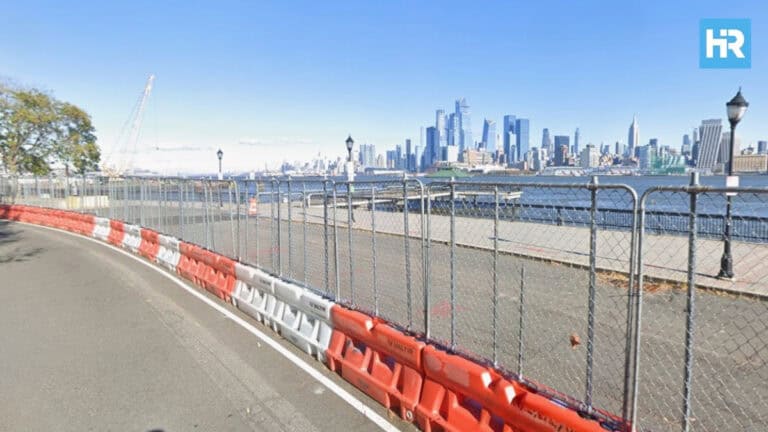
On December 10, the City of Hoboken began construction on Maritime Park, an 8.7-acre waterfront park located at the former Union Dry Dock site at 901 Sinatra Drive. The groundbreaking ceremony brought together city, county, and state officials to formally start the transformation of Hoboken’s final industrial waterfront parcel into a public park along the Hudson River.
Officials in attendance included Mayor Ravi S. Bhalla, Assemblyman John Allen, Hudson County Executive Craig Guy, Chairman of the Hudson County Board of Commissioners Anthony Romano, and Mayor-elect Emily Jabbour. The event followed decades of community organizing, negotiations, and planning aimed at completing a continuous public waterfront in Hoboken.
- Hoboken broke ground on Maritime Park on December 10 at the former Union Dry Dock site at 901 Sinatra Drive.
- The 8.7-acre project converts Hoboken’s last industrial waterfront parcel into fully public open space shaped through extensive community input.
- Phase One construction is scheduled to start this winter and continue into spring 2026, with major work beginning in the first quarter of 2026.
Union Dry Dock and the Effort to Secure Public Waterfront Space
For more than a century, Union Dry Dock operated as a ship repair facility along the Hudson River and remained one of the last active pieces of Hoboken’s industrial maritime infrastructure. When industrial operations declined, the future use of the site became the subject of long-running debate and public concern.
At multiple points, the property faced potential conversion into a permanent ferry refueling and maintenance facility. Nearly eight years ago, a NJ Transit meeting, held on Martin Luther King Jr. Day during the administration of then-Governor Chris Christie, included an agenda item related to a takeover of the site. The agenda item was later pulled.
In response to these proposals, residents organized marches, rallies, and waterfront demonstrations. Local advocacy groups worked alongside the City of Hoboken to oppose attempts by NJ Transit to acquire the property. The site also faced the possibility of becoming a ferry fueling station for New York Waterway.
Litigation and negotiations continued for several years. The City of Hoboken ultimately reached an amicable agreement with NY Waterway to acquire the property for public open space. State involvement later supported the project through funding secured during that process.
Planning and Design Based on Public Input
City officials say Maritime Park is intended to serve as a space for recreation, environmental restoration, and hands-on learning. The final layout reflects months of public feedback gathered through surveys, community meetings, and resident engagement sessions.
Planning began after the City of Hoboken acquired the site in 2023. A design team led by Dattner Architects developed concepts and gathered feedback from residents. The stated goal of the project is to create a contiguous waterfront park extending from Pier A near Hoboken Terminal north to Weehawken Cove.
The full park design includes an upgraded modern skatepark, an open-use lawn area, enlarged beach sections, and a children’s play area. Learning-focused components include a pier dedicated to marine education and a shoreline environment made up of tidal pools and marshland. The plan also includes a plaza influenced by the Castle Point bluffs, a community structure with indoor gathering areas and a rooftop viewing deck, and a continuation of the Hudson River Waterfront Walkway through the site.
Environmental performance and long-term durability are built into the design. Planned elements include native vegetation, rain-absorbing gardens, bioswales, and land shaping intended to handle future sea level rise. Along the water’s edge, the shoreline design incorporates rock sills, seawalls, and wave-reducing structures to limit erosion while creating transitional planted areas that support local wildlife and ecological health.
Phase One Construction Scope and Schedule
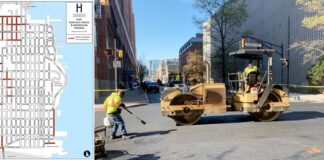
Project construction for Phase One will begin in earnest in the first quarter of 2026. Construction staging will include the installation of a temporary multi-use path for pedestrians and cyclists along Sinatra Drive following completion of the Waterfront Reconstruction Project.
Phase One includes the construction of a skatepark designed for all skill levels. Planned features include a six-foot half pipe pocket, a three- to four-foot flow bowl, a mini ramp, an additional three-foot mini ramp, beginner-friendly ledges, a Euro-gap, a flat rail, a four-stair with handrail, and a tech pad. These features were selected based on feedback from more than 150 skateboarders who participated in the public input process.
Additional Phase One components include lengthening the Hudson River Waterfront Walkway and building a public gathering space influenced by the nearby Castle Point bluffs. This area will feature stone and wood elements, places to sit, a drinking fountain, and clearly visible park signs. Phase One also provides for an educational plant nursery and a tree holding area that will be used to grow native vegetation for future stages of the park.
Funding, Labor, and Government Involvement
Hudson County invested $500,000 in Maritime Park through its Open Space Trust Fund. The fund was created under former Hudson County Executive Tom DeGise. The funding will help support project costs, including debt associated with the bond used to cover construction expenses.
The State of New Jersey provided $1 million in funding secured through the State Assembly. Construction of the project will use union labor, including members of the Laborers’ International Union of North America. Final project costs will be determined through the construction bidding process.