

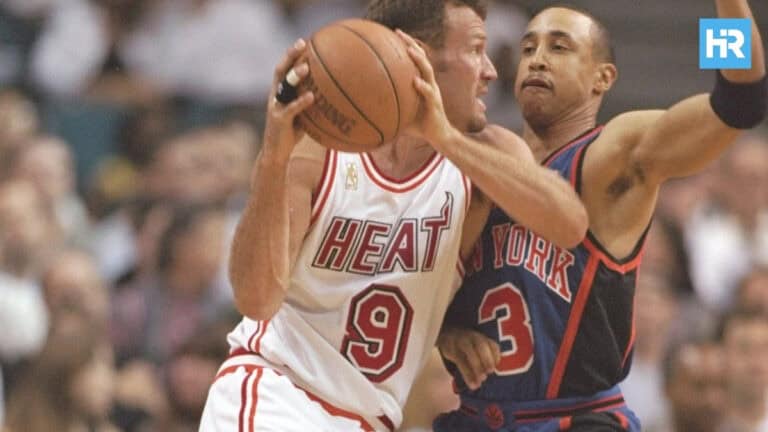
The Heat–Knicks rivalry is a long-running, physically intense NBA feud, driven by repeated playoff meetings, on-court fights, player suspensions, and decisive last-second shots. The rivalry reached its height in the late 1990s and early 2000s, then reemerged in the 2020s with postseason series in 2012 and 2023 and an ongoing regular-season history tracked through November 2025.
- On September 2, 1995, Pat Riley left the Knicks to become the Heat’s head coach and president, and Miami paid New York $1 million and a future first-round draft pick after a league investigation into tampering allegations.
- From 1997 to 2000, the Heat and Knicks faced each other in the playoffs four straight years, with a May 14, 1997, brawl at Miami Arena, multiple suspensions, and two series-ending shots with 0.8 seconds left (1999 and 2000).
- As of 2025, the teams have split six playoff series 3–3, with Miami ahead 19–16 in 35 playoff games, while New York leads the regular-season series 76–68 through 144 games as of November 2025.
Origins And Early Regular-Season Meetings
The New York Knicks were founded in 1946 as one of the original teams in the Basketball Association of America, which merged with the National Basketball League in 1949 to form the National Basketball Association. The Knicks played home games at Madison Square Garden and built an identity around tough, competitive basketball.
The Miami Heat entered the NBA as an expansion franchise in 1988 and began play in the 1988–89 season alongside the Charlotte Hornets. Miami was placed in the Western Conference’s Midwest Division before league realignment moved the team to the Eastern Conference’s Atlantic Division in 1989–90.
The first regular-season game between the teams took place on March 2, 1989, at Madison Square Garden, where the Knicks won 132–123. Over the early years, New York controlled the series, winning 10 of the first 14 regular-season meetings from 1989 through early 1992.
Pat Riley’s 1995 Exit And The Personnel Matchups
Pat Riley was hired by the Knicks on May 31, 1991. He coached New York to the 1994 NBA Finals and then left the organization to join a direct rival.
On September 2, 1995, Riley resigned from New York and became head coach and president of the Miami Heat. The move followed a league investigation into tampering allegations filed by the Knicks, and Miami provided New York $1 million and a future first-round draft pick as compensation.
Riley built a tough, defensive-minded Miami team featuring point guard Tim Hardaway and center Alonzo Mourning, directly challenging the Knicks’ physical identity led by center Patrick Ewing, forward Charles Oakley, and guard John Starks under coach Jeff Van Gundy.
Alonzo Mourning and Larry Johnson became a focal matchup in the rivalry after playing together in Charlotte. Mourning was traded to Miami from the Charlotte Hornets in November 1995, and Johnson was traded from Charlotte to the Knicks in July 1996.
Coaching connections remained a consistent thread. Van Gundy had been Riley’s longtime assistant and succeeded him as Knicks head coach in 1995. Erik Spoelstra later rose through Miami’s system under Riley and became the Heat head coach in 2008, continuing the team culture into later eras.
1997 Eastern Conference Semifinals
The rivalry’s first playoff meeting came in the 1997 Eastern Conference Semifinals, played from May 7 to May 18. The Knicks took a 3–1 lead with wins in Game 1 (88–79), Game 3 (77–73), and Game 4 (89–76). Miami came back to win the series 4–3, becoming only the sixth team in NBA history to overcome a 3–1 deficit in a best-of-seven series.
The turning point came in Game 5 on May 14 at Miami Arena. With the score tied late in the fourth quarter, Knicks guard Charlie Ward attempted to box out Heat forward P.J. Brown for a rebound. Brown lifted and body-slammed Ward to the floor, triggering a bench-clearing brawl. The incident produced 10 technical fouls. Brown, Ward, and Starks were ejected, and Oakley had been ejected earlier for fighting Mourning. Miami won Game 5, 96–81, cutting the series deficit to 3–2.
NBA commissioner David Stern issued suspensions that affected both teams. Brown missed Games 6 and 7. Five Knicks were suspended: Patrick Ewing, Allan Houston, and Charlie Ward were each suspended for one game for Game 6, while Larry Johnson and John Starks were each suspended for one game for Game 7. Miami won Game 6, 95–90, in New York and then won Game 7, 101–90.
The series included individual production. Patrick Ewing averaged 23.7 points and 11.5 rebounds per game, including 37 points and 17 rebounds in Game 7. Alonzo Mourning averaged 19.1 points, 9.1 rebounds, and 2.4 blocks per game, and he posted 28 points and 15 rebounds in Game 6. Allan Houston averaged 19.3 points over six games and scored 23 points in Game 7. Tim Hardaway scored 38 points in Game 7. The Knicks’ three wins came by an average margin of 8.7 points. The series scoring averages were at 86.9 points per game for Miami and 85.6 for New York.
1998 Eastern Conference First Round
The teams met again in the 1998 Eastern Conference First Round. The series was described as a gritty, low-scoring defensive struggle, and the Knicks won 3–2 after dropping the opener. Miami averaged 87.4 points per game across the five games.
Game 2 ended in a 96–86 Knicks win and included a throat-slashing gesture by guard Chris Childs toward the Heat bench. Miami won Game 3, 91–85. The series reached another major fight in Game 4 at Madison Square Garden, when Larry Johnson and Alonzo Mourning traded punches with 1.4 seconds left while contesting a rebound. Jeff Van Gundy latched onto Mourning’s leg as he attempted to intervene. Both Johnson and Mourning received two-game suspensions. New York still won Game 4, 90–85, to tie the series 2–2.
The series concluded with a 98–81 Knicks win in Game 5, where New York’s zone defense limited Miami to 81 points and generated 18 turnovers. Despite averaging 26.0 points per game, Tim Hardaway shot just 5-for-18 in the finale. John Starks posted a series average of 16.8 points, Larry Johnson averaged 20.8 points prior to his suspension, and Alonzo Mourning recorded averages of 19.3 points and 8.5 rebounds.
1999 Eastern Conference First Round
The third consecutive playoff series took place in the 1999 Eastern Conference First Round, the first postseason after the 1998–99 NBA lockout compressed the regular season to 50 games. Miami entered as the top seed at 33–17, and New York entered as the eighth seed at 27–23. The Knicks won 3–2.
New York opened with a 95–75 win in Game 1 behind Patrick Ewing’s 22 points and 15 rebounds. Miami responded in Game 2 with an 83–73 win led by Alonzo Mourning’s 23 points. New York won Game 3, 97–73, and the game included Tim Hardaway’s ejection late in the fourth quarter after he received two technical fouls for arguing with officials following an offensive foul call. In that game, Hardaway shot 4-of-19 and was later fined $5,000 for verbal abuse and delaying his exit from the court.
Miami forced Game 5 by winning Game 4, 87–72, behind Mourning’s 27 points and 10 rebounds. Game 5 in Miami ended with Allan Houston hitting a 17-foot jumper off a pass from Latrell Sprewell with 0.8 seconds left, giving the Knicks a 78–77 win. The shot banked in off the rim and backboard. Mourning had 21 points and 9 rebounds in the loss.
The series was described as drawing 18 technical fouls. The Knicks shot 47.1% from the field as a team, while Miami shot 44.1%, and the series averaged 162 combined points per game.
2000 Eastern Conference Semifinals
The fourth consecutive postseason meeting came in the 2000 Eastern Conference Semifinals. The Knicks were seeded third and the Heat second, and New York won the series 4–3. Each game was decided by fewer than 10 points, and the series averaged 161.4 total points per game.
Miami won Game 1, 87–83, and Game 3, 77–76 in overtime. New York won Game 2, 82–76, Game 4, 91–83, and Game 6, 72–70. Miami won Game 5, 87–81, to force a seventh game.
Game 6 at Madison Square Garden included a comeback from an 18-point deficit in the second quarter, and New York won 72–70 while holding Miami to 70 points, described as the Heat’s lowest in the postseason. Game 7 on May 21 in Miami ended 83–82 after Latrell Sprewell stole the ball from Tim Hardaway, setting up Allan Houston’s 19-foot jumper with 0.8 seconds remaining. Clarence Weatherspoon’s desperation heave at the buzzer missed.
Alonzo Mourning averaged 23.1 points and 10.6 rebounds per game and scored 29 points with 13 rebounds in Game 7. Patrick Ewing averaged 14.6 points and 10.9 rebounds per game in what was described as his final playoff appearance with the Knicks. Latrell Sprewell averaged 17.7 points per game, including 24 in Game 7. Allan Houston averaged 16.0 points per game.
Regular-Season Flashpoints From 1997 To 2000
One of the most notable regular-season games took place on February 1, 1998, at Madison Square Garden. The Knicks won 89–83 in a game that included a late scuffle between Alonzo Mourning and Larry Johnson. The game featured 55 combined personal fouls, with 26 for Miami and 29 for New York, along with two technical fouls per team and one flagrant foul each. The game was played before a sellout crowd of 19,763.
Another high-profile regular-season game occurred on April 9, 2000, at Miami Arena, where the Heat won 95–94 in overtime in front of 19,600 fans. Tim Hardaway ended the game with a one-handed 25-footer over Chris Childs with 0.1 seconds left. The win improved Miami’s record to 50–26 and solidified its hold on the No. 2 seed, while New York dropped to three games behind with four regular-season games remaining.
Across 12 regular-season games played between 1997–98 and 1999–2000, the teams split evenly at 6–6, with each season series ending 2–2.
Fan response was described as part of the rivalry’s atmosphere, especially at Madison Square Garden, where Knicks fans booed Pat Riley and displayed signs reading “Benedict Riley.” Riley was also described as being called “Pat the Rat.” After a 2000 loss to the Knicks, Riley described the matchup as “one big death grip that both teams have on the other.”
2000–2012: The Postseason Gap And Key Franchise Changes
After the four consecutive playoff meetings from 1997 to 2000, Miami and New York did not meet again in the playoffs until 2012, described as an 11-year absence from 2001 through 2011.
The Knicks’ decline was tied to the summer 2000 trade of Patrick Ewing to the Seattle SuperSonics in a four-team deal involving 12 players and five draft picks. New York made the playoffs three times during this period: in 2001, losing in five games to the Toronto Raptors in the first round; in 2004, being swept in four games by the New Jersey Nets; and in 2011, losing 4–0 to the Boston Celtics in the first round. The Knicks missed the postseason in eight seasons from 2002–2003 and 2005–2010 and had losing records in nine of those 11 seasons.
Miami remained more competitive and won the franchise’s first NBA championship in 2006 after acquiring Shaquille O’Neal in 2004 to pair with Dwyane Wade. Pat Riley resigned as head coach in October 2003 to focus on front-office duties. Dwyane Wade suffered a left shoulder dislocation in February 2007 against the Houston Rockets, and Miami later posted a 15–67 record in 2007–08, described as the franchise’s worst. The Heat followed with 43–39 in 2008–09 and 47–35 in 2009–10.
A specific regular-season example from this period occurred on February 26, 2007, when the Knicks beat a depleted Heat team 99–93 at Madison Square Garden, halting Miami’s three-game winning streak amid Wade’s absence.
During the same period, the Eastern Conference landscape changed with league expansion, including the addition of the Charlotte Bobcats in 2004, which brought the conference to 15 teams and intensified competition for the eight available playoff spots.
2010–2014: Big Three Spotlight And The 2012 Playoff Series
Miami’s Big Three era began in 2010 with LeBron James, Dwyane Wade, and Chris Bosh. The Knicks emerged as a brief contender led initially by coach Mike D’Antoni, who coached until March 2012, and the roster featured Amar’e Stoudemire and Carmelo Anthony after New York acquired Anthony in 2011. Across the 2010 to 2014 span, Miami held a 9–6 regular-season record against New York.
On January 27, 2012, Miami won 99–89, with Wade scoring 28 points in a return from injury and James scoring 31 points. On March 3, 2013, Miami won 99–93 at Madison Square Garden after coming back from a 16-point deficit, and James recorded 29 points, 11 rebounds, and seven assists. On April 2, 2013, Anthony scored a career-tying 50 points in a 102–90 Knicks win, and he shot 18-of-26.
The teams met in the playoffs again in the 2012 Eastern Conference First Round, played from April 28 to May 9. Miami, the second seed, won 4–1. Miami won Game 1, 100–67; Game 2, 104–94; Game 3, 87–70; and Game 5, 106–94. The Knicks won Game 4, 89–87.
Over the five games, Miami shot 45.6 percent from the field while New York shot 41.7 percent. Miami averaged 96.8 points per game, and New York averaged 82.8. LeBron James averaged 27.8 points, 6.2 rebounds, and 5.6 assists on 47.8% shooting. Game 4 included Carmelo Anthony’s 41 points on 16-of-29 shooting, and the series referenced Iman Shumpert’s ACL tear. In Game 5, Anthony scored 35 points while James recorded 29 points, seven rebounds, and five assists.
The series also featured heavy fouling. Game 1 included a flagrant-1 call on a Tyson Chandler screen, and New York committed 21 fouls in the first half alone, leading to a 28–5 free-throw attempt advantage for Miami early in the series.
2023 Eastern Conference Semifinals
The rivalry’s most recent postseason meeting was the 2023 Eastern Conference Semifinals, where the eighth-seeded Heat defeated the fifth-seeded Knicks 4–2. Jimmy Butler averaged 24.6 points per game and appeared in five games after missing Game 4 due to an ankle sprain. Jalen Brunson averaged 31.0 points per game. Caleb Martin contributed 19.3 points per game, and Bam Adebayo anchored Miami’s defense by limiting New York’s interior scoring and affecting Julius Randle.
The series opened on April 30 at Madison Square Garden with Miami winning Game 1, 108–101, behind Butler’s 30 points. New York tied the series on May 2 with a 111–105 Game 2 win, with Brunson scoring 30 points and the Knicks taking advantage of Miami’s 11 turnovers. Miami took Game 3 on May 6, 105–86, and held New York under 40% shooting. Miami won Game 4 on May 8, 109–101, without Butler, with Max Strus scoring 19 points and Adebayo recording 23 points and 13 rebounds. New York extended the series with a 112–103 win in Game 5 on May 10 at Kaseya Center behind Brunson’s 38 points. Miami closed the series in Game 6 on May 12 in New York, winning 96–92, and the game included disputed fouls and a late “tumble” incident involving Caleb Martin that drew attention for potential flopping.
Miami held New York to 29.9% from three-point range across the series, and the Knicks averaged about 12 turnovers per game in their losses.
The series included specific controversy markers: memes mocked Butler’s perceived “acting,” and Game 5 drew referee scrutiny because the Knicks were assessed nine fouls in the first quarter, including a flagrant foul on Josh Hart and three consecutive offensive fouls, with complaints focused on inconsistent officiating and uncalled moving screens by Adebayo.
After the series, Miami advanced to the Eastern Conference Finals, upset the top-seeded Boston Celtics in seven games, and then lost to the Denver Nuggets in the NBA Finals. The Knicks traded forward Obi Toppin to the Indiana Pacers and signed guard Donte DiVincenzo to a four-year, $50 million contract. The series averaged approximately 4.8 million viewers across ESPN and TNT, and the 2023 playoffs were described as the most-watched since 2018.
2014–2025 Developments And Recent Regular-Season Results
After LeBron James left Miami in 2014, the Heat reached the NBA Finals that year and lost to the San Antonio Spurs in five games. Miami later acquired Jimmy Butler in 2019 via sign-and-trade from the Philadelphia 76ers and reached the 2020 NBA Finals in the Orlando bubble as the sixth seed after defeating the Milwaukee Bucks and Boston Celtics before losing 2–4 to the Los Angeles Lakers, posting a 14–7 playoff record.
New York’s franchise path included controversies under owner James Dolan, including the 2017 ejection of Charles Oakley from Madison Square Garden. The Knicks hired Tom Thibodeau as head coach in July 2020 and built around Julius Randle, acquired in 2019, and RJ Barrett, the 2019 No. 3 overall pick. New York ended a seven-year playoff drought in 2021 and lost to the Atlanta Hawks.
From 2014 to 2022, Miami held an 18–7 record over New York across 25 regular-season games. A highlighted matchup occurred on January 12, 2020, when the Knicks produced a 40-point fourth quarter to beat the Heat 124–121 at Madison Square Garden, led by Julius Randle’s 26 points.
In the 2023–24 regular season, the teams played three times: the Knicks won 100–98 on November 24, 2023, and 125–109 on January 27, 2024, while the Heat won 109–99 on April 2, 2024.
The 2024 playoffs did not include a Heat–Knicks series. The eighth-seeded Heat lost 1–4 to the top-seeded Boston Celtics in the first round, including a 114–94 Game 1 loss and injuries involving Jimmy Butler. The second-seeded Knicks reached the Eastern Conference semifinals but lost 3–4 to the Indiana Pacers, ending with a 130–109 Game 7 loss in which Indiana set a playoff record field-goal percentage of 67.1%.
In the 2024–25 regular season, the Knicks swept all three meetings: 116–107 on October 30, 2024; 116–112 in overtime on March 2, 2025; and 116–95 on March 17, 2025, at Madison Square Garden. The March 17 win included Mikal Bridges scoring 28 points and Miami being held to 38.5% shooting, and it extended Miami’s skid to eight games.
The 2025–26 season opened with the teams splitting their first two games. Miami won 115–107 on October 26, 2025, in Miami, with Norman Powell scoring 29 points on 10-of-21 shooting and adding seven rebounds. The Knicks won 140–132 on November 14, 2025, in New York.
Head-To-Head Totals, Playoff Series Results, And Named Statistical Marks
The playoff history includes six series, with the teams tied 3–3 in series wins and Miami holding a 19–16 advantage across 35 playoff games as of 2025. All six series were in the Eastern Conference:
- 1997 Eastern Conference Semifinals: Miami Heat 4–3
- 1998 Eastern Conference First Round: New York Knicks 3–2
- 1999 Eastern Conference First Round: New York Knicks 3–2
- 2000 Eastern Conference Semifinals: New York Knicks 4–3
- 2012 Eastern Conference First Round: Miami Heat 4–1
- 2023 Eastern Conference Semifinals: Miami Heat 4–2
Through 144 regular-season games as of November 2025, the Knicks lead 76–68. The teams split their first two games of 2025–26, so the rivalry kept its even feel on a night-to-night basis, even when the all-time totals lean slightly toward New York.
Top single-game playoff scoring in Heat–Knicks series:
- Carmelo Anthony (Knicks): 41, Game 4 of the 2012 Eastern Conference First Round (May 6, 2012)
- Jalen Brunson (Knicks): 41, Game 6 of the 2023 Eastern Conference Semifinals (May 12, 2023)
- Tim Hardaway (Heat): 38, Game 7 of the 1997 Eastern Conference Semifinals (May 18, 1997)
- LeBron James (Heat): 32, Game 1 of the 2012 Eastern Conference First Round (April 28, 2012)
- Alonzo Mourning (Heat): 31, Game 5 of the 1997 Eastern Conference Semifinals (May 13, 1997)
Top single-game regular-season scoring:
- Dwyane Wade (Heat): 55, April 12, 2009
- Jamal Crawford (Knicks): 52, January 26, 2007
- Carmelo Anthony (Knicks): 50, April 2, 2013
- Jalen Brunson (Knicks): 37, October 26, 2025
Top playoff series scoring averages (minimum 10 playoff games vs the opponent):
- Patrick Ewing (Knicks): 21.0 PPG, 19 games
- Alonzo Mourning (Heat): 20.9 PPG, 22 games
- Allan Houston (Knicks): 19.3 PPG, 17 games
- Tim Hardaway (Heat): 18.9 PPG, 19 games
- John Starks (Knicks): 17.2 PPG, 15 games
Additional individual records and milestone stats:
- Alonzo Mourning recorded 64 rebounds in the 1997 series, averaging 9.1 rebounds per game.
- Julius Randle averaged 10.2 rebounds per game in the 2023 series and had 13 rebounds in Game 2.
- Tim Hardaway recorded 42 assists in the 1997 series, averaging 6.0 per game, with a peak of seven assists in Game 7.
- Jalen Brunson recorded 38 assists in 2023, averaging 6.3 per game, with a series-high nine assists in Game 5.
- Mourning recorded 20 blocks in the 1997 series, averaging 2.9 blocks per game.
- Hardaway recorded five steals in Game 7 of the 1997 series.
- Bam Adebayo recorded four blocks in the 2023 series, averaging 0.7 per game, and averaged 9.7 rebounds.
- Patrick Ewing scored 1,001 career points against the Heat across 45 regular-season games, averaging 22.2 points and 10.4 rebounds.
- LeBron James recorded a triple-double on December 17, 2010, with 32 points, 11 rebounds, and 10 assists in a 113–91 Heat win at Madison Square Garden.