

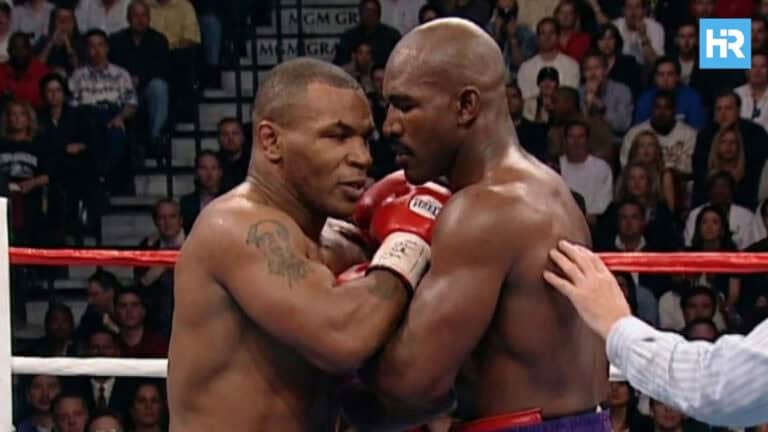
On June 28, 1997, a heavyweight boxing rematch in Las Vegas became one of the most shocking moments in sports history. Mike Tyson and Evander Holyfield met again at the MGM Grand Garden Arena, but the fight did not end because of a knockout or the distance. Instead, it ended when Tyson bit Holyfield’s ear during the third round. The incident stunned fans around the world, led to an immediate disqualification, and changed both fighters’ careers forever.
- Mike Tyson was disqualified in the third round of the June 28, 1997, rematch after biting Evander Holyfield’s ears twice, shocking the boxing world.
- The fight broke records, earning around $100 million in revenue, and remains one of the most talked-about events in boxing history.
- The incident changed Tyson’s career forever, while Holyfield went on to earn millions and later made peace with his former rival.
The Background That Made the Rematch a Global Event
Mike Tyson reached the peak of boxing at an unusually young age. In 1986, at just 19 years old, he defeated Trevor Berbick to become the youngest heavyweight champion in history. Within a few years, however, problems outside the ring began to dominate his life. By 1989, Tyson’s behavior had grown increasingly unstable. He married actress Robin Givens and later divorced her after she accused him of domestic violence. Around the same period, Tyson fired and sued his manager, broke his hand during a street altercation that took place early in the morning, and was involved in two separate car accidents, one of which was described as a suicide attempt. During this stretch, he also ended his working relationship with longtime trainer Kevin Rooney and moved forward under the guidance of promoter Don King.
Tyson’s dominance in the ring ended abruptly on February 11, 1990. In one of the most shocking results in boxing history, he lost the heavyweight championship after being knocked out by James “Buster” Douglas, a 42-to-1 underdog. Legal troubles followed soon after. In 1991, Tyson was accused of raping Desiree Washington, a beauty pageant contestant, in Indianapolis, Indiana. He was convicted on February 10, 1992, and sentenced to prison, where he served three years and one month in a state prison.
After being released, Tyson returned to professional boxing and regained the heavyweight titles. His comeback eventually led to a matchup with Evander Holyfield, a former heavyweight champion from Georgia known for his disciplined lifestyle and strong religious beliefs. Holyfield had stepped away from boxing in 1994, but the financial opportunity persuaded him to return. When the two fighters met on November 9, 1996, Holyfield entered the bout as the underdog and stunned observers by stopping Tyson in the 11th round to claim the WBA heavyweight title.
Even after the defeat, Tyson was installed as the betting favorite heading into their 1997 rematch. The second fight attracted massive worldwide attention and generated an estimated $100 million in revenue, setting a new benchmark at the time. Lennox Lewis, who held the WBC heavyweight championship then, later said the events surrounding Tyson led him to believe Tyson had crossed a mental line and made him doubt that a future fight between them would ever take place.
The Fight Night Atmosphere and Early Rounds Inside the Ring
The rematch took place at the MGM Grand Garden Arena in Las Vegas before a worldwide audience. Holyfield entered the second fight stronger and more confident than in the first fight. In the opening round, Holyfield landed hard body shots while Tyson flailed and abandoned the disciplined boxing approach his trainer had promised. By the end of the round, the crowd was chanting Holyfield’s name, turning against Tyson, who had long been the sport’s biggest fan favorite.
In the second round, a clash of heads occurred. Holyfield’s head collided with Tyson’s, opening a cut above Tyson’s right eye. Referee Mills Lane ruled the incident a clash of heads rather than an intentional foul. The decision did nothing to calm Tyson, who believed the headbutts were deliberate and felt no points were deducted to protect his career and livelihood.
The Third Round That Shocked the World
In the third round, Tyson lost control. He spat out his mouthpiece and leaned into Holyfield, biting off a piece of the top of Holyfield’s right ear. Holyfield recoiled in pain as Tyson spat the severed piece onto the canvas. Holyfield later described believing his ear had fallen off and expressed disbelief that such an act could happen within a sport governed by rules and regulations.
After a four-minute delay, during which blood streamed from Holyfield’s injured ear, the fight was allowed to continue. Mills Lane deducted two points from Tyson. The punishment failed to deter him. Before the end of the same round, Tyson bit Holyfield’s left ear. Tyson had left his stool with illegal intent and had removed his gumshield to prepare for the act, leaving Lane with no alternative.
At the end of the third round, Mills Lane disqualified Mike Tyson. Immediately after the decision, chaos began when Tyson attempted to get at Holyfield and his corner amid pushing and shoving, and also took a swing at a police officer.
Later that night, after the arena was empty, an MGM Grand employee discovered a portion of Holyfield’s bitten ear on the canvas and returned it to Holyfield’s team.
Medical Impact, Financial Stakes, and Official Consequences
Evander Holyfield required eight stitches for the injury to his ear. Despite the severity of the incident, he made clear that he held no lasting grudge and later said that seeing his ears in the mirror did not bother him, as it reminded him he earned $35 million in nine minutes.
Tyson’s $30 million purse was withheld while Nevada boxing officials reviewed the fight. He was ultimately fined $3 million and received an 18-month suspension from boxing. After being reinstated, he returned to the ring, where he continued to be one of the sport’s biggest financial draws.
Career Fallout and the Long Shadow of the Bite Fight
Mike Tyson was never the same fighter after the incident. His personal life continued to spiral, including further legal trouble and a prison sentence a year later for an assault charge. His financial problems eventually led to bankruptcy, reportedly worsened by spending $400,000 per year maintaining a flock of pet pigeons. The dark humor surrounding his suspension included jokes that his next opponent would be Hannibal Lecter.
Tyson eventually received one final opportunity at the heavyweight title when he fought Lennox Lewis in 2002 — a bout that ended in a punishing eighth-round knockout defeat. Tyson had also previously bitten Lewis on the thigh during a brawl at a press conference promoting their fight, reinforcing concerns about his control outside the ring.
Holyfield continued his career and later faced Lennox Lewis twice in 1999, losing on points after a controversial draw earlier that year. Although both Tyson and Holyfield ultimately lost much of the wealth they earned during their careers, their legacy among heavyweight greats remains intact. Lewis later stated that when boxing history is written, Tyson and Holyfield belong alongside Muhammad Ali, George Foreman, Joe Frazier, and Joe Louis, each remembered for distinct qualities that defined their greatness.
Reconciliation and the Fight’s Place in History
In later years, Tyson and Holyfield reconciled and became friends. They even appeared together in a humorous television advertisement referencing the Bite Fight, in which Tyson visits Holyfield and presents him with a piece of “ear” kept in a jar of formaldehyde.
“Whenever I see my ears in the mirror, it don’t bother me,” Holyfield said. “I just remember how I made $35 million in nine minutes.”