
Home Blog Page 105

Bayonne prepares $65 million in bonds to support film studio

A mock up of the what the entrance to 1888 Studios will look like from Avenue A. Renderings by architectural firm Gensler.

Bayonne is preparing to sell tens of millions of dollars in bonds to support the estimated $900 million construction cost of what redevelopers say will be the largest ground-up film studio in New Jersey, to be known as 1888 Studios, at the former Texaco site.

At the site at the terminus of Avenue A, surrounded by the Kill van Kull and Bayonne Bridge, Togus Urban Renewal, LLC is redeveloping the land into the film studio, which will be constructed using “100 percent union labor” through contractor Turner Construction.

At its November meeting, the City Council approved an application for the bonds to the Local Finance Board. According to its resolution, the city wants the approval from the Local Finance Board to issue up to $65 million of general obligation redevelopment area bonds. 

The resolution states the city believes the bond issue is in the public interest, that the improvements are for the betterment of the community, that the amount to be spent is not unreasonable or exorbitant, and that the proposal will provide services for residents and will not create a financial burden.

Before the resolution was approved, resident Gail Godesky asked if this was the right time for the bond: “Are we going too late to the dance?” 

This sparked some music-themed wordplay during the back-and-forth with Law Director Jay Coffey. He disagreed that the city was moving on this too late: “If they’re still playing music, it’s not too late. And they are still playing music.” 

Godesky said with film studios being built in Newark and even in Oceanport, where Coffey is the mayor, that Bayonne shouldn’t risk paying anything into the film studio when a recession could be lurking around the corner. 

Godesky asked, “Do we really want to take that chance now with the recession on the horizon, with inflation, and with people losing their jobs? Construction, development, and everything is going to start slowing down.”

Coffey said that it was a legitimate question, but that Bayonne was farther along than Newark and Oceanport. He said that in Oceanport, the municipality has not yet finalized a contract with Netflix. 

“It’s a risk-reward scenario,” Coffey said. “You’re asking why we should go through with this and put $65 million up on a $900 billion dollar project… The answer is… what’s securing our $65 million is not just the land itself.” 

Provision built in to assist city if need be

Coffey added the bonds are secured by the letter of credit provided by the redeveloper and the land itself. There is also a provision where the city can step in if the project falls through and take the land without going through the foreclosure process.

“There will be a letter of credit that underscores and secures the debt,” Coffey said. “It’s a letter of credit that provides cross collateralization, where you have equity and then you have actual real property. Then as the property gets developed, the letter of credit will be commensurately reduced because the value of the property is going up as the property is being built. If the property is not built, our total exposure is $65 million. I would dare say that having the land plus a $65 million letter of credit provides us with sufficient security. It even provides for any costs associated with taking over the property that would be borne by the developer. So that’s really a triple net zero to us.”  

Godesky questioned why the redevelopers, including Togus Urban Renewal, LLC, couldn’t get a construction loan. Coffey said they are already getting a construction loan “of an incredible proportion.” 

Godesky asked why they needed the bonds then and if they are short $65 million. Coffey said they are not short, and that this ensured construction was done how the city wanted it.

“This is a way to ensure that the development is done in a way that’s commensurate with what we want down there, how it’s going to be done, the type of labor that’s going to be used down there,” Coffey said. “This is a massive undertaking, and the city, by going after this financing, gets better rates than a private entity can… We get better rates. Are we involved in the risk? Yes. But this is a billion dollar project that brings thousands of jobs to the city of Bayonne.”

Coffey was confident in the nearly $1 billion investment by the redevelopers, which consists of $700 million in construction costs and $200 million in land costs and redevelopment fees. Godesky reiterated that now might not be the time amid a potential recession.

Coffey reiterated there is not a better time, noting that nothing was constructed in Bayonne between 2001 and 2014. However, after that, the market and the city’s outlook changed, with it being more willing to take risks to bring investors to Bayonne leading to a redevelopment boom in recent years.

“It was with great consternation we started opening up the spigot,” Coffey said. “These rooms were filled by people concerned about what happens if we do too much, what happens if we don’t do enough. I would say that now that the market has changed, you’re going to see a different approach to development on both the development side and our side.” 

A rendering of the main road through the film studio.

Content creation industry not subject to ‘market vagueries’

According to Coffey, the content creation industry continues strong regardless of the market. He said that a shift away from filming in Hollywood has prompted a need that 1888 Studios would seek to fill.

“In this case, this industry… creating content… for the foreseeable future, it’s not really something that’s subject to the vagueries of the market,” Coffey said. “Building this project is. But as far as content creation right now, I would say that for the next decade, there is a need to be able to create your own content and not having to deal with Hollywood and certain large corporations that would charge you for the services. These self-contained units where they make their own content and they don’t have to worry about another provider, that’s the business model that’s working.” 

Coffey said that spaces like a film studio for content creation are coming to the East Coast now for a variety of reasons. He said that there’s been a paradigm change and that Netflix and the studios in Newark and Brooklyn have a different outlook than Godesky as to how things are going to go in the future. 

Coffey conceded they could be wrong, to which Godesky conceded she may be wrong too. But she still felt it wasn’t the right time amid a possible recession. 

“They’re playing the last song,” Godesky said continuing the musical analogy. “The bottom line is, I don’t think it’s the right time. I liked their presentation …a lot of people in Bayonne did. But right now, the way things are turning in the global economy. I just don’t think it’s the right time.”

Coffey noted that it’s more the redeveloper’s risk as opposed to the city, as long as the city is secured through the land itself and the letter of credit. Godesky asked if the city would need to sell the property if everything fell through, to which Coffey noted it likely wouldn’t need to do that since it has $65 million bonds backing it up. 

Godesky still disagreed with the project, but Coffey remained adamant it would be a risk worth taking. The council then unanimously approved the resolution.

No working nights, weekends, and holidays

Also at the November meeting, the council voted on another resolution regarding 1888 Studios that would have authorized redeveloper Togus Urban Renewal, LLC to work on nights, weekends, and some holidays. Coffey said this is in conjunction with raising the elevation nearly 17 and a half feet.

“We have a restriction against performing work on national holidays,” Coffey said. “There is water-based work. Essentially, it involves barges coming in to build up the site. The request was, could they have an exemption from the no work ordinance on federal holidays.” 

Coffey said that through discussions, Mayor James Davis did not have a problem with it due to its isolated location at the tip of the Bergen Point neighborhood. However, the only holiday Davis was opposed to was Christmas.

La Pelusa said the resolution would allow construction for six federal holidays, except for Christmas Day. It would apply for the rest of this year and run until the end of February in 2023.

Second Ward City Councilwoman Jacqueline Weimmer noted she was concerned it would be a quality of life issue. La Pelusa agreed, but highlighted there was a measure that would allow the council to negate the resolution if there are issues. 

“I’m always against allowing work on holidays and after hours,” La Pelusa said. “But this has a provision here that the city reserves the right to declare this resolution null and void, without further action by the municipal council, if any justified complaints are lodged with the Bayonne Police Department, the Bayonne Law Department, or any other department within the city of Bayonne in connection with the noise disturbances arising out of said construction activity.”

La Pelusa said there were some residences in the area. But he noted the immediate surroundings were mostly non-residential uses.  

“That’s the reason why I would consider it,” La Pelusa said.

A rendering of the planned mill buildings on the site.

Raising the site elevation

Coffey added this wasn’t for construction yet but for filling in the land to raise the elevation. 

“It’s not so much construction as it is water-borne, like it’ll be coming up with barges on the west side of the property,” Coffey said. 

Weimmer asked the audience at the meeting if there were any residents who lived in the area. While there were none present, another resident Mike Ruscigno, addressed the issue, stating the work was more than just barges dropping off dirt. 

“What they’re doing now, they’re compacting property while they clear the contamination and dropping in new dirt and pounding it,” Ruscigno said. “That cannot go on. You hear it everywhere. People go to the park to enjoy it and do stuff. So they don’t want it going on during the holidays.” 

La Pelusa repeated that if there were any complaints, the council could void the resolution. Godesky said that the resolution wasn’t worth it and asked the council to vote against it. 

“It’s going to take years for them to build it anyway,” Godesky said. “Don’t allow it please. Quality of life is important. We’re losing our quality of life here in this city… with all the construction and everything else going on. It’s not worth it. They could do without the six days, we’re giving them $65 million.” 

La Pelusa reminded that another caveat of the resolution was that it could allow them to work at night from 6 p.m. to 6 a.m. Godesky called that ridiculous, and that it would affect people who live in the area. 

First Ward City Councilman Neil Carroll said he was more concerned about work going on during the nights and weekends than on holidays. Weimmer agreed, to which La Pelusa echoed them both, and suggested the council not do it.  

With that, the resolution was not approved. Meanwhile, also at the meeting an ordinance set to be introduced that would approve a financial agreement with Togus Urban Renewal, LLC was withdrawn. The city previously announced its intention to enter into a payments-in-lieu-of-taxes (PILOT) agreement with Togus Urban Renewal, LLC which will bring in $200 million to the city over a 30-year term.

While things are still being ironed out, the city and redevelopers are very much moving forward with the construction of 1888 Studios full steam ahead. Vertical construction of the studio is slated for the first quarter of 2023, and some industry insiders are already hyping the project.

For updates on this and other stories, check www.hudsonreporter.com and follow us on Twitter @hudson_reporter. Daniel Israel can be reached at [email protected].

Union City to hold annual Winter Coat Drive

Donate coats to students and families in need in Union City until the end of December. Image via Shutterstock.

Union City is set to hold its annual Winter Coat Drive from November 21 through December 30. The drive is hosted by the Union City Office of Community Relations by Director Mercedes Joaquin.

The past few years the Office of Community Relations has been conducting the Winter Coat Drive for needy students in the school district those families can’t afford to buy them a winter coat due to financial hardship.

For a child, a brand new coat can be more than a coat. According to the city, it not only helps to keep them warm, but also can change a child’s life and empower them with greater self-confidence, peer acceptance, and increase school attendance and overall wellness.

Drop off locations are Union City Public Schools. Collection boxes will be at the entrance of each school.

Items needed include: coats, gloves, scarves, socks, hats, and sweaters. All sizes are requested, from toddler, to children, to juniors, and adults.

According to the city, each gift will have the ability to transform a child’s life and relay the message “You are worth it.”

For updates on this and other stories, check www.hudsonreporter.com and follow us on Twitter @hudson_reporter. Daniel Israel can be reached at [email protected].

Bayonne police captain dies in line of duty

37-year veteran of the Bayonne Police Department Captain Paul Jamolawicz has passed away. Photo courtesy of the Bayonne Police Department.

Bayonne Police Captain Paul Jamolawicz has passed away while on duty, Mayor James Davis announced on Saturday, November 12.

“Bayonne is mourning today, as we have lost Bayonne Police Captain Paul Jamolawicz while on duty serving our community,” Davis said.

Jamolawicz, a graduate of New Jersey City University with a degree in Criminal Justice, began his career in 1985, with Davis following behind him in 1986. Davis said they remained friends throughout their careers.

In 1999, Jamolawicz was promoted to Sergeant, followed by another promotion in 2013 to Lieutenant. In 2018, he promoted to Captain.

During his career, Jamolawicz worked in the Patrol Division, Detective Bureau, Narcotics Unit, and Internal Affairs Unit. He has received three commendations and seven Excellent Police Service Awards for his service.

According to Davis, Jamolawicz was not only an outstanding police officer, but a devoted family man to his wife Jeanne, daughter Lori Anne and son Paul Jr. He has also been a longtime businessman in town, serving residents as the owner and operator of the First Street Laundromat and past owner of Manny’s Liquors.

“Paul’s love of family and this city was evident every day of his life and his friendship will be sorely missed,” Davis said. “Please keep Paul’s family in your thoughts and prayers, as well as our great Police Department… Rest in Peace Paul.”

This is the first line of duty death for the Bayonne Police Department in 52 years. Police Chief Robert Geisler also released a statement following Jamolawicz’s death.

“It is with a heavy heart that I must announce the death of Bayonne Police Department Captain Paul Jamolawicz,” Geisler said on November 11. “Captain Jamolawicz died unexpectedly tonight while on-duty serving our community. On behalf of the City of Bayonne and the Bayonne Police Department, I would like to express our condolences to the Jamolawicz Family.”

Additionally, Fire Chief Keith Weaver sent his condolences from the Bayonne Fire Department.

“The Bayonne Fire Department mourns with our brothers and sisters of the Bayonne Police Department, as they suffered the loss of Captain Paul Jamolawicz,” Weaver said. “Our agencies are intricately tied together as their loss is our loss, and this is especially true as Captain Jomolawicz is also the brother-in-law of Bayonne Fire Department Battalion Chief Thomas Obiedzinski. On behalf of our entire department, I would like to extend our deepest condolences to the entire Jamolawicz and Obiedzinski families.”

The manner of death has not been announced.

For updates on this and other stories, check www.hudsonreporter.com and follow us on Twitter @hudson_reporter. Daniel Israel can be reached at [email protected].

Ban approved on vehicle coverings in public streets and parking lots

Vehicles with coverings on them are no longer permitted on public roads. Image via Google Maps.

North Bergen has banned covering vehicles on public streets and in public parking lots because the covers interfere with enforcing parking regulations.

Mayor Nicholas Sacco and the Board of Commissioners adopted an ordinance at the November 9 meeting after it was introduced in October.

The Parking Authority utilizes automated license plate reading technology to enforce its parking requirements.

The ordinance states that when a person covers their vehicle when it is parked on the public street or highway, or in public parking lots, the license plate becomes obstructed and inhibits the Parking Authority’s ability to enforce parking requirements.

The inability to effectively enforce parking regulations results in parking space being lost to those who follow the parking rules and regulations. According to the ordinance, the lack of ability to enforce parking regulations also inhibits effective and efficient street sweeping.

The ordinance states that when a vehicle is covered, the Parking Authority is limited in its ability to issue a summons. The ordinance says no vehicle parked on a public street, highway, or public parking lot within the township can be covered, partially or totally, with a car cover, motorcycle cover, or other similar protective cover.

Owners and leases of vehicles violating the ordinances now face a fine of $75 for each offense. For each summons written by Parking Authority enforcement officers where a fine would be collected by the township for a violation of the ordinance, the Parking Authority will collect 40 percent of the fine.

The ordinance will be enforced by the Parking Authority or Police Department.

For updates on this and other stories, check www.hudsonreporter.com and follow us on Twitter @hudson_reporter. Daniel Israel can be reached at [email protected].
North Bergen considers new commercial zone west of River Road

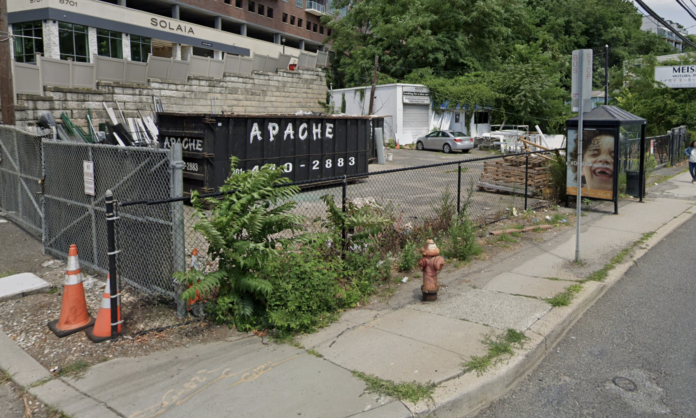
A few empty lots on the west side of River Road would be included in the new zoning district. Image via Google Maps.

North Bergen is contemplating a new zoning district in the township.

Mayor Nicholas Sacco and the Board of Commissioners introduced an ordinance at their November 9 meeting to implement a Master Plan amendment creating a new zoning district, known as the RRC-2 River Road Commercial 2, to permit commercial use along a portion of the west side of River Road.

The Planning Board adopted a “Periodic Reexamination and Report of the Master Plan and Land Use Plan Element Amendment” at its November 1 meeting. It recognized the character of certain properties on the west side of River Road between Bulls Ferry Road and the border with Edgewater as predominately nonresidential.

The commercial nature of that portion of the street has occurred despite being residentially zoned.

In addition, a number of lots don’t conform to existing zoning bulk standards. Those factors, coupled with significant residential growth in the vicinity, warrant an amendment to the current zoning for these lots in terms of uses and bulk standards.

The Board of Commissioners is responsible for implementing recommendations of the Master Plan to create the new commercial zone district. The new zone permits retail and commercial uses on that side of River Road.

Permitted uses in new commercial zone

Permitted uses in the district would include retail sales, personal services, professional offices, banks, and eating and drinking establishments without drive-thru or walk-up service.

Cannabis retailers and medical cannabis dispensaries with the proper permits would be allowed, so as long as there is only one within the district and it does not exceed the township’s limit of two dispensaries.

According to the ordinance, the bulk standards would now require a minimum lot area of 2,500 square feet, a minimum lot width of 25 feet, a minimum lot depth of 27 feet, no minimum setback from the street or side yard setback or 5 feet if provided, a minimum rear yard setback of 10 feet, a maximum building coverage of 50 percent, a minimum landscaped area of 10 percent, maximum impervious coverage of 90 percent, and a maximum building height of three stories or 40 feet.

Buildings with expansive blank walls facing the public right of way are prohibited. Large horizontal buildings would be broken into segments having vertical orientation.

Architectural elements and design variation, including building offsets, would be integrated to preclude a continuous uninterrupted facade. Side and rear building elevations would receive architectural treatments comparable to front facades when visible from a public right-of-way.

A significant landscape feature would be provided. Total landscaped are must not be less than 10 percent of the site area. Street trees would be provided around parking areas. Parking rows longer than 20 spaces would have a six foot wide landscaped island. There would be particular focus on landscaping the River Road frontage in a “creative and aesthetically-pleasing manner.”

Residents support new zone, but question certain bulk standards

During the public comment portion of the meeting, resident Kathy Krickovic applauded the proposed creation of the new zoning district.

“We are in favor of and we’re here to support the creation of the new zone,” Krickovic said. “The uses are similar to the existing RC zone with the exception of hotels.” 

Krickovic took issue, however, with the bulk standards for the front yard setback being zero. The existing front yard setback in area is 15 feet. She said Planning Board officials determined that 15 foot front yard setbacks were not feasible due to the short lot depth, but that setbacks would be necessary for pedestrians to safely traverse. 

Krickovic brought a packet of pictures with her to explain her point. She showed empty lots of the west side of River Road at the corner of Churchill Road, followed by Lolita’s Mexican Cantina, Hasan’s Rug, and Beethoven’s Veranda, and some other stores, as well as townhouses, as well as the sidewalks nearby at issue.

“So it’s all developed as commercial properties and we agree that it should stay commercial,” Krickovic said. “The existing sidewalk in front of 8400 River Road, which has a light pole in the middle of the sidewalk… we have only 13 inches on one side and 19 inches on the other side. A person walking with a stroller, they actually have to walk on River Road because they cannot pass through on either side. Zepter has the fence directly on the property line. There’s zero setback.” 

Residents ask for 5 foot front yard setback

Since the township is rezoning the area, Krickovic asked for a 5 foot set back at minimum. She said it is currently not defined by the ordinance. 

Krickovic said the Board of Commissioners can set the bulk standards in the zoning district. She echoed that the existing zoning district for the area has a 15 foot setback. 

Township Attorney Tom Kobin said that the street setback would be zero. He said that the board can set the standard higher for the front yard setback before the public hearing on the ordinance, since it first goes back to the Planning Board before final approval from the Board of Commissioners. 

“We can intro it, and then raise these comments, see what the Planning Board says,” Kobin said. “I don’t know what the logic was from them to have that, although I think it was to make it more buildable, you need to zero setback. So we can raise that concern after it’s introduced.” 

Krickovic again rasied the issue that the poles and a fire hydrant were blocking the sidewalk. Kobin agreed the pictures she showed the board supported her argument. 

“Clearly, you can’t walk by on these things,” Kobin said. “I’ll raise the concerns with the Planning Board and see what the logic was and then we’ll talk about dealing with it.”

Issues to be addressed before ordinance adoption, officials say

“We’re not voting on anything other than an introduction right now,” Sacco said. 

Krickovic also asked what the lot depth requirements were, to which Kobin said it was 75 feet. She said this was shorter in comparison to the existing district of 150 feet. 

“You have to take into account… with 84 units nearby, we have a lot more people walking,” Krickovic said. “We want to make the town walkable. So it has to be safe. That’s the point.” 

Krickovic also took issue with the trees that would be planted, noting that the ordinance does not denote they would be native trees. She said it was important to plant native trees to “preserve biodiversity, support wildlife, create a health ecosystem, brings clean water, purifies the air, maintains healthy soil, regulates the climate.” 

Castro noted the township has a new policy of only planting native trees. She said that requirement would extend to this new zoning district. 

“We are already moving in that direction,” Castro said. “We have a Green Environmental Advisory Committee that has already recommended to the Mayor and the Commissioners that. So anything moving forward that the township engages in will all be native.”  

Nenad Krickovic also asked about the height and rear yard setbacks, which officials confirmed were three stories or 40 feet maximum and 10 feet minimum. He then thanked the board for creating the new district. 

“I really appreciate you guys having this zoning to the RRC 2 Zone so we can have some services like professional services, personal services, some sales close to our neighborhood, he said. “There’s so much residential redevelopment so that’s going to help us a lot.” 

For updates on this and other stories, check www.hudsonreporter.com and follow us on Twitter @hudson_reporter. Daniel Israel can be reached at [email protected].

Bayonne concludes absorption study, residential redevelopment likely to resume

Bayonne has finished its study on existing residential redevelopment following a pause on new redevelopment, although the results pave the way for the halt to be lifted. Photos by Daniel Israel.

Bayonne officials have concluded the study on the status of redevelopments in the city, and the data clears the way for residential redevelopment to resume.

Most major residential redevelopment was paused by Mayor James Davis amid the 2022 May non-partisan municipal election until a study could be completed to determine if new redevelopments were being occupied or not.

Despite the pause, a number of residential redevelopment received planning approvals anyway, including the 18-story Silk Lofts tower that seemingly prompted the halt. City officials said this was an exception because the developers had already gotten planning approval and were midway through the process and could not be stopped.

However, new residential redevelopment without prior approval was halted.

The newly sworn-in City Council passed a resolution in July authorizing the study. According to the resolution, the absorption study would look at the total number of new residential dwelling units and multiple dwelling developments built in the city of Bayonne after January 1, 2015, the number of units occupied and unoccupied, new units expected in multi-unit developments over the next 24 months, the amount of tax and other revenue realized by the city as a result of multi-unit residential development completed after January 1, 2015, and the amount of tax and or other revenue the city would have realized if these properties were not developed.

Absorption study completed and preliminary data collected

Now, as of the November 9 council meeting, the study has concluded. City Council President Gary La Pelusa read the data obtained from the study aloud prior to the public comment portion of the meeting. Before that, he noted that before the residential and even commercial redevelopment ushered in by the Davis Administration, the city was losing population as job opportunities shrunk in the city.

“Since 2009, the city of Bayonne has been through a renaissance of growth after many decades of decreasing population, loss of jobs, and the lack of local opportunities,” La Pelusa said. “This change slowly occurred over time, such as the closure of the Texaco plant in the 1980s, the closure of the MOTBY in the late 1990s, and the closure of Best Foods in the early 2000s.”

As a lifelong resident and small business owner who raised his family here, La Pelusa said he has seen the ups and downs the city and community have faced. He said most people know someone who grew up here but decided to leave.

According to La Pelusa, the declining population and job opportunities have in part been remedied by the Davis Administration through residential and commercial redevelopment. He said this has been a boon for Bayonne, without which the city may not have recovered.

“There has been some fear that the values of the town will be lost as redevelopment occurs throughout the city and our community and that community itself will be a thing of the past,” La Pelusa said. “Bayonne has had a population growth over the past decade to over 70,000 people. This growth in population is a direct result of the redevelopment occurring all over our beloved city.”

Assessing a city on the rise over nearly a decade

Hearing residents’ concerns over redevelopment, he said that the administration and council agreed to a pause. Following that, one of the first things the new council sworn in after the May election did was set out to conduct the study of redevelopment impact.

La Pelusa said, “The council specifically asked for an absorption study to find out if the units built were being filled and if more units can be maintained without jeopardizing the stability of our community. We can ponder the future of Bayonne, and I feel the future is promising. The residential development impact on Bayonne needed to be studied, and this council made the study our first priority.”

Law Director Jay Coffey (left) and City Council President Gary La Pelusa (right) discuss the study on residential redevelopment at the November council meeting.

La Pelusa said according to preliminary data, things look promising for Bayonne’s future.

“After looking at the numbers, the future of the city’s well-being is encouraging,” La Pelusa said.

La Pelusa defined the absorption rate as the amount of housing stock a community has available to sell or lease, and how quickly it is being sold or rented. Absorption rates provide information on the leasing rates of a rental market or an individual property over a time period known as an absorption period, he said.

An occupancy rate is the number of units being occupied over the total amount of units available. La Pelusa said that high occupancy rates show the demand for people wanting to live in that area.

“These rates are important to understand the health of the community, buildings, and what impact it will have on the city’s revenue,” La Pelusa said.

Preliminary data shows high absorption and occupancy rates

Since 2009, there have been 20 residential redevelopments constructed featuring 2,978 units. He said these buildings were 92.6 percent occupied.

This number includes buildings that are currently in their lease up phase, La Pelusa said. The average stabilization for buildings that have been leased up is about 94.6 percent occupied. According to La Pelusa, the lease up period is an indicator of the absorption.

The buildings currently in their lease up period are being leased “at a breakneck pace” of five to six months, La Pelusa said. Meanwhile, the industry standard is up to 12 months. He noted that in one example, a building was fully leased up within 2 to 3 months.

“To put this in perspective, for a building to be considered stabilized according to Fannie Mae, a federal government created corporation tasked with lending money to mortgage lenders, the minimum occupancy rate for Fannie Mae to issue a multi-family loan is 75 percent occupancy,” La Pelusa said. “With that stated, the city occupancy rate for new construction is will in excess of this standard.”

According to La Pelusa, the minimum occupancy rate per federal standards is 75 percent. Given the data, the city’s occupancy rate is way above that.

La Pelusa said the current occupancy rate is even higher than its 10-year historical average of 91.372 percent, according to data from Rutgers University. He added that a full presentation from city professionals will follow his announcement to detail their findings.

According to La Pelusa, the pause will likely end soon after more conversations with administration officials.

“The preliminary findings are extremely promising for the pause on development to end after more discussion with the administration and my council colleagues,” La Pelusa said.

Residents have mixed reactions to the announcement

During the public comment, former city employee and outspoken resident Gail Godesky said residential redevelopment had not stopped. This was a reference to the planning approvals for projects that were allowed to go forward even amid the halt, in part due to prior approvals.

A rendering of the planned 18-story Silk Lofts residential redevelopment that prompted the pause but was approved during it anyway due to prior planning approvals. Rendering courtesy of Marchetto Higgins Stieve Architects.

“There was never a pause on redevelopment,” she said. “So that needs to be corrected.”

Meanwhile, resident Mike Morris was happy with the results of the study. He said it showed his property value had increased.

“I’m happy with the absorption rate study and the numbers that make my property more valuable. I know how valuable it is, because right now, I’ve had several offers on my particular home. I turned one down today. I had a near contract… I’m glad I didn’t accept it, because that study proves that my home is very valuable. And I’m very happy with it. So thank you.”

Now it appears that Bayonne is getting ready to march full steam ahead with plans to again allow residential redevelopment in the city.

Davis told the Bayonne Community News: “I would like to thank everyone who was involved with this important analysis of Bayonne’s housing units and population growth. The overwhelming majority of new apartments in Bayonne are occupied. The study demonstrates clearly that people looking for a place to live find Bayonne to be an attractive community. We will keep a close eye on housing and population trends as we continue to plan for the future.”

For updates on this and other stories, check www.hudsonreporter.com and follow us on Twitter @hudson_reporter. Daniel Israel can be reached at [email protected].

‘Together We Can’ wins three out of four seats in Bayonne school board election

The "Together We Can" slate from left to right: Trustee Hector Gonzalez, Miriam Bechay, Mary Jane Desmond, and William "Bill" Young. Photo courtesy of the ticket.

Once upon a time in Bayonne, an endorsement from the mayor used to help a ticket for the Board of Education go far in an election, but now it appears it didn’t mean as much in the Tuesday, November 8 election.

Mayor James Davis and the current City Council members among other administration officials endorsed and supported the “Voices for Progress” slate, as well as the Bayonne Education Association, Assemblyman William Sampson, and outgoing Trustee Denis Wilbeck, among others.

Meanwhile, former City Council President Sharon Ashe-Nadrowski, who failed to unseat Davis in last May’s municipal election, her former council slate running mate Executive Director of the Bayonne Police Athletic League “KT” Kim Torello, and most of the current Board of Education including Trustee Jodi Casais, Board President Maria Valado, Vice President Christopher Munoz, Trustee Melissa Godesky-Rodriguez, and others supported the “Together We Can” slate, resulting in something of a proxy war between the two forces.

Running as “Together We Can” with teacher and incumbent Trustee Hector Gonzalez were: former Trustee and former City Councilwoman Mary Jane Desmond; Financial Services and Registered Representative with the New York Life Insurance Company William “Bill” Young; and New Jersey Institute of Technology Biomedical Engineering student Miriam Bechay.

They faced off against the “Voices for Progress” slate featuring: President of the Board of Trustees at the Bayonne Community Day Nursery and the Bayonne School Employees Credit Union, and a retired public school teacher Saverio “Sam” Maggio; businesswoman, community activist, and President of the Bayonne Youth Center Angelique Jackson-Belle; previous candidate and teacher at Jersey City’s P.S. 17 Gina Irizarry; and businessman in the financial sector and major proponent of the mosque in Bayonne, Ali Hassan.

Running as an independent was Jahnbaz Almas, a Trustee of the Bayonne Education Foundation and former educator at Saint Peter’s University, Saint Peter’s Preparatory School, and New Jersey City University, under the banner “Education is Freedom.”

From left to right: Trustee Hector Gonzalez, Mary Jane Desmond, Miriam Bechay, and William “Bill” Young.

Winner, winner, chicken dinner

The “Together We Can” slate won three out of four seats up for grabs on the Board of Education. Gonzalez, Desmond, and Bechay were elected, while Maggio was the only candidate from the Davis-backed “Voices for Progress” ticket to be elected.

According to unofficial election results on Wednesday from the Hudson County Clerk, the top three highest vote getters for the three seats with three-year terms were Desmond with 4,043 votes, Gonzalez with 3,822 votes, and Maggio with 3,812 votes.

In a close fourth place was Irizarry with 3,568 votes followed by Jackson-Belle in fifth with 3,524 votes. Trailing in sixth was Young with 3,420 votes.

Almas came in a distant seventh with 551 votes, and there were 61 write-in votes. In total, 22,807 votes were cast by voters from 10,544 ballots.

For the seat with the one-year unexpired term previously held by Gonzalez, Bechay beat out Hassan with 2,745 votes to his 2,452 votes. There were 14 write-in votes with 1,457 votes cast by voters from those 10,544 ballots.

Bechay won a seat despite being the only candidate to not attend the candidate forum as well as the only candidate who was unavailable for a feature interview with the Bayonne Community News.

The “Voices for Progress” slate and the Mayor from left to right: Gina Irizarry, Saverio “Sam” Maggio, Mayor James Davis, Ali Hassan, and Angelique Jackson-Belle.

Did Davis endorsement matter?

The “Voices for Progress” ticket issued a joint statement after the polls closed: “Thank you Bayonne! Polls are closed and now we wait for the final results. We are so grateful for the love, support and hard work everyone gave this campaign! Together we are Bayonne Voices for Progress!”

Also before the results came in, the “Together We Can” slate issued a similar message thanking voters for their support this election cycle. Neither slate has issued any statements since the most recent official results have been posted.

“Thank you to every supporter, family member, friend, and neighbor that came out to vote for us,” the ticket wrote in a joint statement on social media. “No matter the outcome, it has been an amazing journey. Nothing would have been possible without YOU. Thank you from the bottom of our hearts.”

The election was largely sleepy this cycle. In typical fashion, candidates knocked on doors, appeared at community events like the Bergen Point Fall Festival, and held meet-and-greets all in attempts to convince voters to pick their side. One interesting development, however, was who ended up backing who, and ultimately how much the endorsements mattered to the outcome.

Despite Davis not endorsing anyone in 2021 and the “Voices for Progress” slate in 2022, the results show the “Together We Can” slate continues to largely dominate Bayonne school board elections as it did when it had his endorsement in 2018 and 2019. While voters chose Maggio over Young, “Together We Can” is still 9 for 10 in successfully electing candidates in the past three elections.

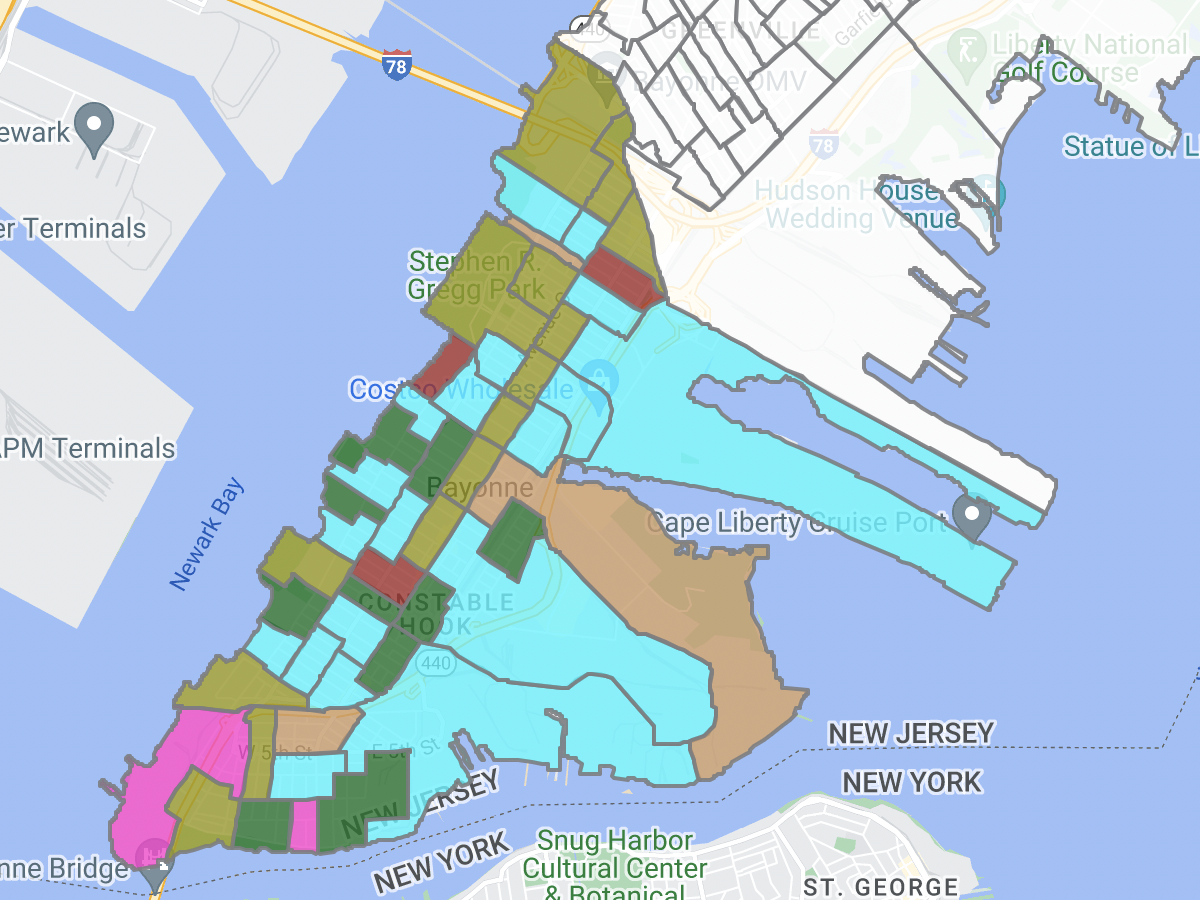
Districts colored in: green were won by Hector Gonzalez, blue by Mary Jane Desmond, Purple by William Young, dark yellow by Saverio “Sam” Maggio, red by Angelique Jackson-Belle, and pink by Irizarry.

Candidates clash at forum, followed by online drama

In addition to the endorsements, the candidates and their slates did clash somewhat at the candidate forum, largely over tax abatements for redevelopers. While “Together We Can” members like Gonzalez said that they were against those financial agreements that don’t produce tax revenue for the school district, members of the “Voices for Progress” slate like Jackson-Belle argued that the agreements ultimately benefited the community.

The candidate forum also sparked some online chatter about Irizarry regarding her stance on inclusivity and social justice in the curriculum, which many applied to the topic of sex education in the health curriculum. She said that while parents should be involved in their children’s education, the curriculum standards are determined by experts and should remain that way, drawing ire from parents who have sought to remove sex education from the curriculum entirely.

When it comes to turnout, this election appears to have had higher turnout than the May municipal election. With 42,626 registered voters, there were 10,544 ballots cast in this compared to the then-42,374 registered voters and 10,023 ballots cast in the municipal election.

Those numbers equate to an approximately 24.7 percent turnout for this election compared to the approximately 23.6 percent turnout overall for the municipal election. When looking at the mayoral contest alone, there was an approximately 23.4 percent turnout with only 9,909 votes cast despite 42,374 registered voters at the time.

For updates on this and other stories, check www.hudsonreporter.com and follow us on Twitter @hudson_reporter. Daniel Israel can be reached at [email protected].

North Bergen officially opens new Downtown Recreation Center and Library

North Bergen officials cut the ribbon officially opening the recreation center on Saturday, November 5. Photos courtesy of the township.

North Bergen’s new, highly anticipated Downtown Recreation Center and Library is now officially open.

Mayor Nick Sacco, Parks and Public Property Commissioner Hugo Cabrera, Commissioner Frank Gargiulo, Commissioner Allen Pascual, Commissioner Julio Marenco, County Commission Chair Anthony Vainieri, Assembly members Angelica Jimenez and Pedro Mejia, Sheriff Frank Schillari, Library Director Sai Rao, NJ State Librarian Jennifer Nelson, and many other officials held a ribbon cutting for the grand opening on Saturday, November 5.

Hundreds of local residents and business owners attended the event. Offerings included tours of the new site, music, food, carnival games, bounce houses and much more.

“Residents will be delighted when they see the abundance of new technology, athletic equipment, and other learning facilities at their disposal,” said Sacco. “I am very proud to see this happen for the community and residents of downtown North Bergen, whose children and families will be utilizing this center for decades to come.”

The site was formerly home to a furniture store until a massive fire destroyed the building in 2016. The township bought the property and utilized a combination of municipal ordinance bonds, Green Acres funding, as well as federal, state, and county grants to fund the new $19.5 million, state-of-the-art facility.

Many residents came out to enjoy the official opening of the new facility.

“When a devastating fire destroyed this building we didn’t cry over spilled milk, we viewed it as a catalyst and tremendous opportunity for positive change,” said Cabrera. “I want to thank Mayor Sacco for being the driving force behind this project and keeping a promise of academic, athletic, and social equity to our downtown residents and their children.”

The new Downtown Recreation Center and Library consists of five floors including a full library space with study rooms and the latest available technology, an indoor basketball court with six hoops and running track, outdoor fitness area, a rooftop turf practice field, and more. It evolved from being purely a recreation and community center to also include a library as well.

The library is fully staffed, with many books and other information ready to be read.

The new library will offer reading materials and other support. It also provides more space for community events and programs such as citizenship classes and other helpful initiatives.

“Our progressive leaders know that libraries are the hub of the community, which is why North Bergen has three!” said Rao. “Thank you to all the people who made this possible including the Mayor, Commissioners, and many others behind the scenes, who worked tirelessly to construct a beautiful facility that will empower our youth to advance confidently in their dreams.”

The basketball court and track above and around it are now open for residents to play and walk.

The North Bergen Downtown Recreation Center and Library is another step forward in Sacco’s vision of revitalizing Downtown North Bergen. It will offer downtown families excellent access to township services without needing to travel a long distance.

The facility comes on the heels of other major advances in the area. This has included the new downtown park on Paterson Plank Road, significant improvements to 10th Street Park, the former Downtown Library Branch, major residential developments, the new Wyndham Hotel, and more.

Many children enjoyed the inflatable rides and other offerings at the opening ceremony.

For updates on this and other stories, check www.hudsonreporter.com and follow us on Twitter @hudson_reporter. Daniel Israel can be reached at [email protected].

Weehawken residents rally against ferry pollution and maintenance facility

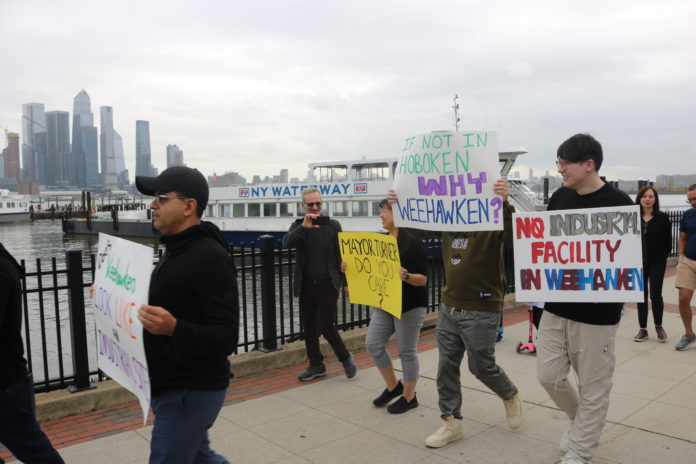
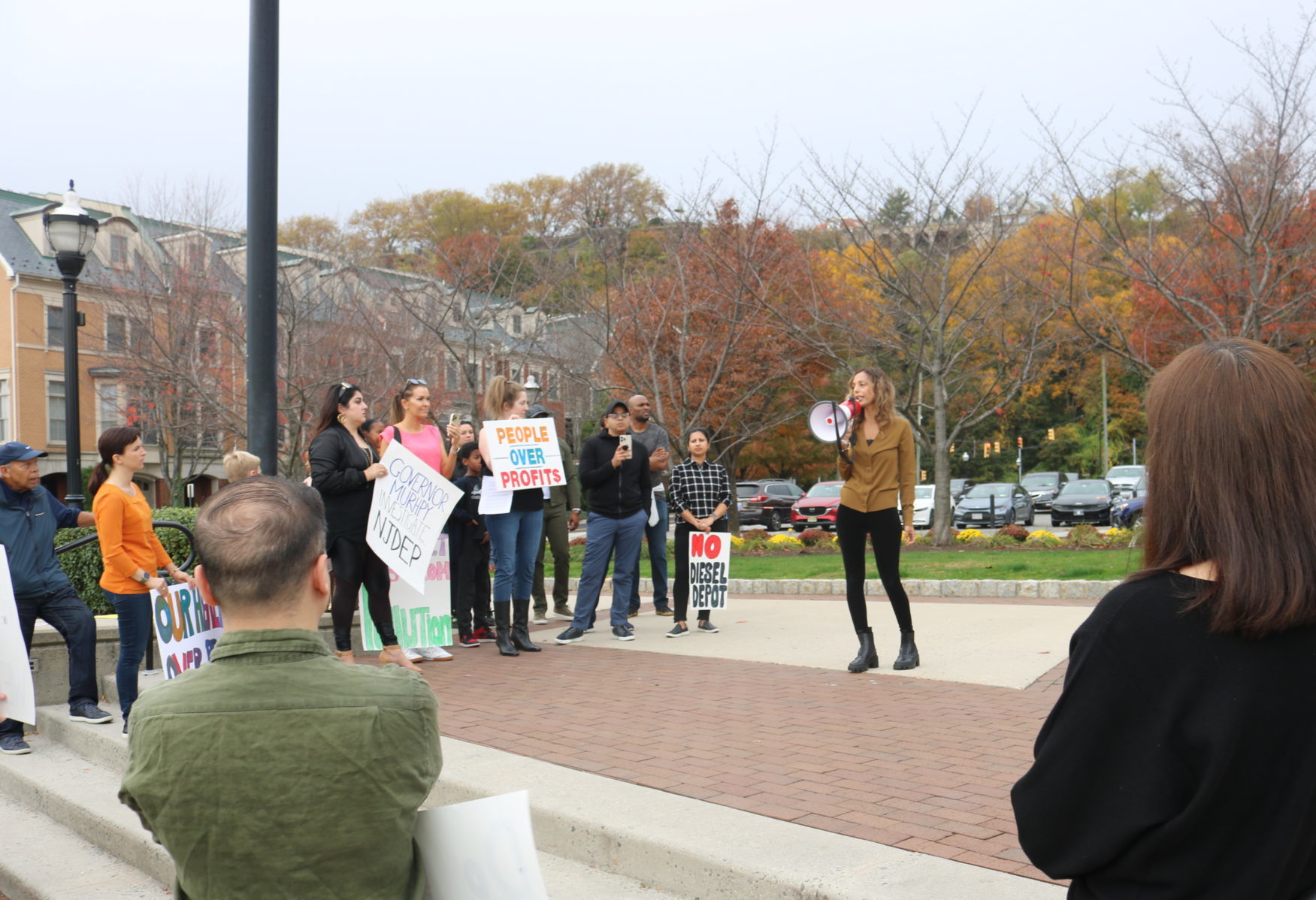
Weehawken residents marched along the Hudson River waterfront to protest New York Waterway's facility in the township and their alleged malpractices. Photos by Daniel Israel.

Weehawken residents are rallying against New York Waterway over ferry pollution and its maintenance and re-fueling facility in the township.

On Sunday, November 6, residents gathered at the waterfront near the facility to make a statement. The protest was led by Cassandra Porsch of the local group Weehawken Residents Against Ferry Pollution.

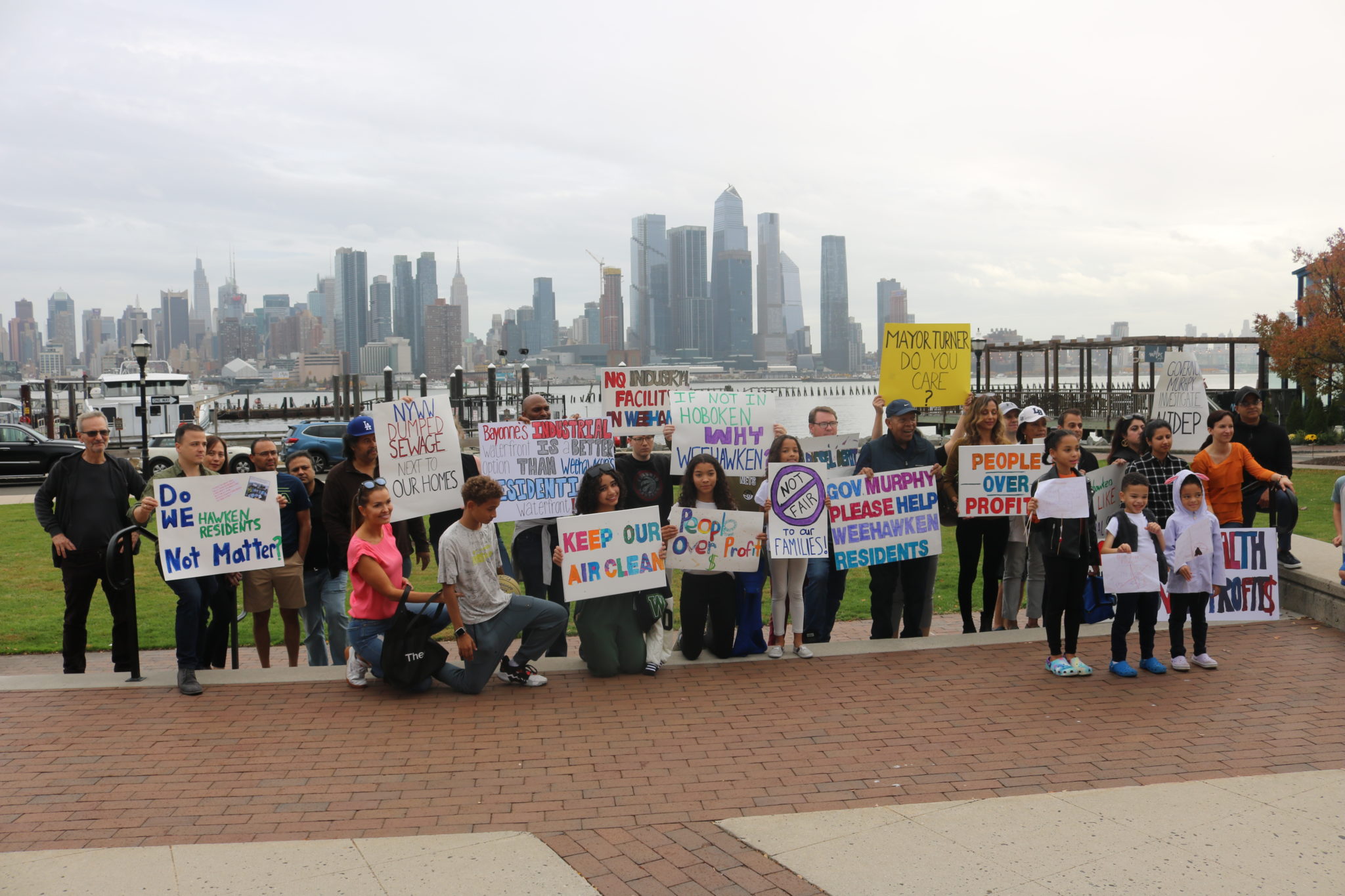
Around 35 people were in attendance at a rally held at the Pershing Park, many donning signs against New York Waterway’s actions and calling for further action.

Doctor highlights ferry pollution problem

Dr. Harold Davis, a longstanding member of the community who lives in The Brownstones at Port Imperial,  said the protest was against the lack of action by the local government. He said that residents have been trying to meet with Mayor Richard Turner, State Senator Brian Stack, and Governor Phil Murphy to discuss the matter, but have not been successful.

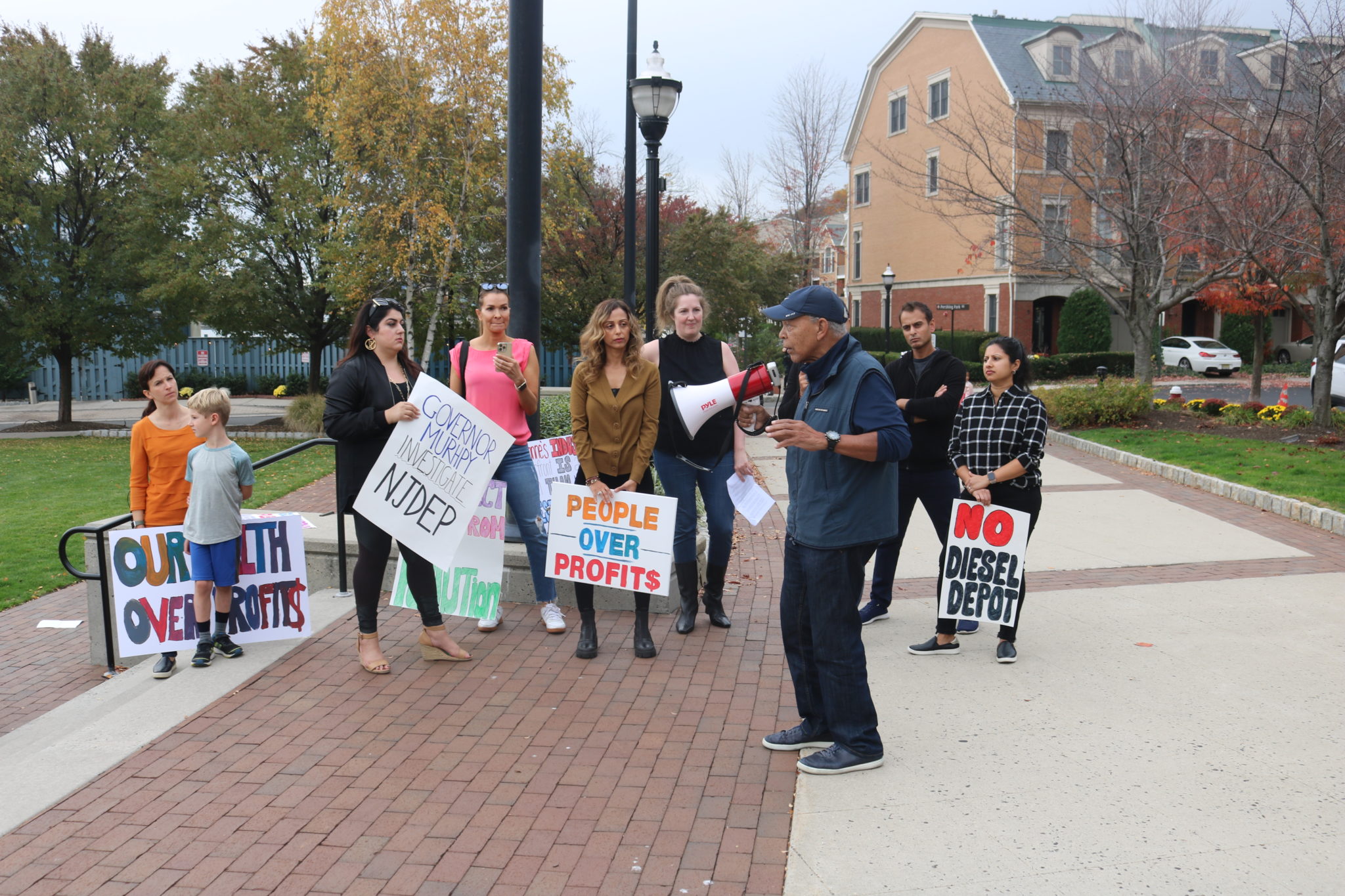
“Welcome to our toxic dump site,” Davis said. “Unfortunately, they haven’t put a dome over it, so we’re all exposed.” 

Davis said Weehawken residents on the waterfront are exposed to the air and noise pollution of the New York Waterway facility located in Port Imperial, just yards away from luxury residential buildings such as the RiversEdge and RiverParc.

“Those engines produce gases and soot,” Davis said, “which is particulate matter, and it has been demonstrated that they cause cancer. I’ll tell you this, as a physician, there is no safe level of exposure.” 

Davis said Weehawken residents are being treated unfairly. Hoboken residents rallied and blocked the facility from their city, he said, but the local government has not done the same. 

“A deal was made and accommodation was made,” Davis said. “The Governor was involved. They pushed this project from Hoboken up to Weehawken. The Hoboken mayor basically said not in my backyard. He said not in my backyard, and he told New York Waterway: ‘You’re not going to do this. You’re not going to expose our children to these poisions.’ And it came up here, and we haven’t heard a peep from the Weehawken Mayor’s Office.”

Davis said this will not be the last demonstration against  New York Waterway.

Weehawken residents gathered on the waterfront to protest New York Waterway on November 6.

Temporary facility is now permanent fixture

Megna Deva said, “We all care about our Weehawken community and we are not okay with having the New York Waterway maintenance facility right under our noses.”

Deva said the township was not told the facility would be permanent. When the now-thwarted plans for an expansion of the facility were leaked last year and sparked community activism, then the township passed a resolution halting further construction.

I just think we’ve been sold out by our government,” Deva said.

Some residents think the facility is better suited on Bayonne’s industrial waterfront.

“If you see the location of the Union Dry-Dock [in Hoboken], it’s actually pretty far away from the residents,” Deva said.

Deva claimed the facility is not just for re-fueling. She alleges it is also used a maintenance facility for many ferries, and that the number of ferries at the facility has been constantly increasing.

Deva said, “They are doing it under the cover. We have to stop it. We have to have a united front and say it’s not okay for us. We are not okay with an industrial facility.”

Deva pointed out that Bayonne has an industrial waterfront along its east side. Ferry service is about to open in the city soon, although under SeaStreak. She said the NY Waterway facility would not necessarily be out of place in the city. Deva claimed the location was not feasible for New York Waterway due to the cost.

Cassandra Porsch of Weehawken Residents Against Ferry Pollution led the rally and march.

Protestors say lawsuit highlights how NYWW is a ‘bad neighbor’

Porsch added that alleged malpractice of New York Waterway has been brought to light by a recent lawsuit. The suit alleges the ferry operator company instructed employees to illegally dump raw sewage into the Hudson River since 2015.

“We learned that they improperly dispose of oil, fuel, coolant, batteries, and aluminum shavings in addition to the raw sewage,” Porsch said. “The employees were asked to use pumps, that were jokingly referred to as Mafioso pumps, to empty the restroom holding tanks into the river rather than properly dispose of them through pumps into the municipal sewer system. According to the complaint, the employees had to stand over these pumps to clear clogs because there were frequent clogs from tampons and other debris thrown into the restroom holding tanks. One employee actually got a staph infection from having contact with the sewage. This also created the risk of exposure to hepatitis and E. coli.”

Porsch said New York Waterway was allegedly dumping raw sewage into the Hudson River. She noted that adjacent to the facility is the waterfront walk, parks, and residential buildings: “What kind of a company allows this to happen?”

Porsch said New York Waterway is not denying the allegations, but is trying to have the lawsuit dismissed on a technicality. She said they are arguing they did not have 60 days notice, as well as asking for dismissal on jurisdictional grounds.

Dr. Harold Davis, a local physician, said that the ferry pollution was harmful to residents, especially children.

Porsch said she and others want Gov. Phil Murphy to look into why the New Jersey Department of Environmental Protection was unaware of the alleged raw sewage dumping for so long. 

“At the last Township Council meeting, we asked Mayor Turner to call on Governor Murphy’s Office to investigate the New Jersey DEP and why this went on for years and nothing was done. I hope that people will go to future town hall meetings to follow up on this request.”

After the rally the crowd marched along the waterfront walkway, chanting “Hey hey, ho ho, the maintenance site has got to go!,” among other chants. The march concluded back at the plaza, where the rally ended.

Megna Deva said that Weehawken residents were not accommodated the way Hoboken residents were.

Township says to learn to live with facility

The outrage from residents has been a theme in recent weeks, last coming to a head at the October 12 Township Council meeting. The protest echoed much of what was said at the meeting, in addition to some other points as well as comments from Mayor Richard Turner.

Porsch said at the meeting New York Waterway had a contract stating that the was to be temporary. That contract was signed in 2016 as new residential redevelopment was being constructed and occupied nearby and stated tthe company would leave by 2019.

“In 2016, New York Waterway was contractually obligated to move the facility because new development was going up there,” Porsch said. “They instinctually understood that nobody was going to buy a place in front of these boats, especially when they were giving off all types of pollution they were dumping in the water… Since Hoboken didn’t want them there, they never left Weehawken.”

Porsch argued that Weehawken residents have been given the short end of the stick while Hoboken residents got preferential treatment. Porsch has been trying to procure a meeting with Stack and Murphy like Hoboken got, but efforts have been unsuccessful because Stack wants to have Turner present.

At the meeting Turner said he had previously met with residents in the past months on preventing the expansion. He reiterated that the expansion is not happening since the council passed a resolution opposing, but then made a major revelation regarding the facility, that it would likely be permanent in the township.

Residents marched along the Weehawken waterfront in protest of New York Waterway’s facility in the township and alleged malpractices.

“I think we have a good handle on preventing the expansion,” Turner said. “I’m almost pretty sure that the maintenance facility is staying. We’ve tried everything. [Township Manager] Gio [Ahmad] and myself had visited numerous sites. We’ve tried to convince everybody… In reality, it’s not going any place.”

“Is it fair? Probably not,” Turner said. “The council’s always said, ‘It’s temporary until we find another location.’ Over the last five years, we probably visited half a dozen potential locations. They are all not suitable for one reason or another. So I think we have to have a serious discussion on how to live with it.”

According to Turner, the township does not have the authority to shut the facility down as residents wish. He said they even contemplated condemning the property through eminent domain as Hoboken is doing with the Union Dry-Dock, but it proved unfeasible.

“It’s water, and it’s very hard to condemn,” Turner said. “We looked at everything.”

Of the dozens of people in attendance, there were a number of children.

All alternatives already explored, officials say

The issue with the suggested Bayonne location was expense, and the lack of “proper facilities” to dock them, Turner said. He noted all alternatives were explored including that, but none were viable.

Turner said New York Waterway agreed in 2016 that the facility was temporary so as long as they could find another suitable location that all stakeholders agree with. And with Hoboken’s Union Dry-Dock off the table, he said the facility was not required to move per the contract.

When asked why the township isn’t fighting like Hoboken, he added: “Our approach now is trying to share. If they want to an expansion, do it someplace else… Not my problem. My problem is when you have an existing facility and are trying to find a new location. Hoboken doesn’t have an existing facility, so it becomes a little more problematic… Now I think as a community we deal with it.”

In regards to the alleged illegal dumping of raw sewage into the river, Turner said it was wrong and something that can be addressed. In addition to fines and punishments, he said that measures such as monitoring systems can be put in place to avoid a repeat in the future.

Turner said that about the pollution that local municipalities do the same through sewer outfalls that empty in the Hudson River. That plays into New York Waterway’s argument he said, adding that there is little the township can do to help it on their end, although it has added catch basins to outfalls in Weehawken as well as other measures.

Cassandra Porsch led the protestors during the march on the waterfront walkway and on the Avenue at Port Imperial.

According to Turner, there is a lot of pollution already in the air and in the river from ferries and other boat traffic, as well as vehicle traffic on the nearby Lincoln Tunnel. He said that nothing can be done about either, but that the township is “stuck trying to make this facility as clean as possible,” such as encouraging the conversion of more ferries to be hybrid or electric.

Turner also expressed skepticism that anything would come of the lawsuit against New York Waterway. He said the company may be fined and reprimanded if found guilty, but won’t be shut down.

Turner echoed calls to monitor New York Waterway regarding the alleged dumping of raw sewage, and also learn to deal with the noise and lights at night. Turner said now New York Waterway needs to work with residents and the township to be a “responsible neighbor” and improve, not expand, the facility, which he said is “small enough” that it can be made “bearable.”

Turner said the township can’t do anything in court in regards to the lawsuit, but confirmed they would follow up to see if Weehawken was a third-party beneficiary from the 2016 contract. He also said he would inquire from the NJDEP about the dumping of raw sewage and other issues, but did not speak on the proposal to pass a resolution calling on Murphy to investigate the NJDEP.

“I don’t know why the DEP has not responded,” Turner said.

The march passed a number of luxury residential buildings at Port Imperial, raising awareness of their cause to passersby.

More protests and activism planned for the future

At the meeting, Porsch asked the township to keep residents inform and incorporate them into the process. Turner said he would, and had already been reached out to by Davis and would get back to him. 

“I think we need to sit down and take some of the ideas they wanted for the expansion, and see if that will work to make it a more acceptable facility and deal with our state partners,” Turner said. He noted this has been a problem for 30 years since it’s inception, and now is the time to make the best out of it instead of arguing for another 30 years. “So my the first goal we’re going to do is sit down the representatives from the condo buildings and The Brownstones… This is not going to go away. We take this very serious.”

Turner said he wanted to set up a meeting with every resident committee and condominium association involved. However, it appears that did not occur considering the protest.

While there was no discussion on the topic at the October 24 council meeting, protest organizers said there would likely be more residents speaking out at the next meeting. The Township Council will meet again on November 9 at 5 p.m. at Town Hall at 400 Park Avenue, with more information at weehawken-nj.us.

For updates on this and other stories, check www.hudsonreporter.com and follow us on Twitter @hudson_reporter. Daniel Israel can be reached at [email protected].

Navy rear admiral inspects USNS Pomeroy at Bayonne Dry-Dock

RADM Michael Wettlauder, Bayonne Dry-Dock President Michael Cranston, inspect the USNS Pomeroy. Photos by Ari Mintz.

Rear Admiral Michael Wettlaufer visited the Bayonne Dry-Dock on Friday, October 28, inspecting the USNS Pomeroy.

The Pomeroy is part of the U.S. Navy’s Military Sealift Command, which is nearing completion of a $27 Million overhaul before returning to sea duty.

Rear Admiral Wettlaufer, who has led the Military Sealift Command since 2019, was escorted by Bayonne Dry-Dock President Michael Cranston as he toured the ship and visited with both the ship’s crew and dockworkers.

Rear Admiral Wettlaufer also took time to facilitate a small-group discussion with the leadership teams from Bayonne Dry-Dock and the Port Authority of New York and New Jersey.

Throughout his visit, Wettlaufer stressed the importance of the facility’s work to National Defense and the U.S. Navy’s overall mission. Bayonne Dry-Dock has completed twenty similar overhauls for the Navy since 2015.

“We were honored to host Rear Admiral Wettlaufer to inspect the USNS Pomeroy, which is now ready to return to its active-duty status serving the U.S. military in its combat and humanitarian missions,” said Cranston in a statement on Monday, November 1. “We are proud of our employees, our work and our service to the United States military.”

The Bayonne Dry-Dock facility is New York harbor’s largest dry-dock facility, serving both the military and the commercial shipping industry with a full range of services.

The 951-foot-long Pomeroy, part of the Watson Class Large Medium-Speed Roll-on/Roll-off Ships (LMSRs), is designed to carry an entire U.S. Army Task Force including 58 tanks, 48 other tracked vehicles, including more than 900 trucks and other wheeled vehicles.

With a cargo-carrying capacity of 380,000 square feet (the equivalent of almost eight football fields), the USNS Pomeroy can accommodate up to 45 civilians, and up to 50 active-duty personnel.

Rear Admiral Michael Wettlaufer and Bayonne Dry Dock President Michael Cranston pose with dock workers conducting the repairs to the USNS Pomeroy.

Bayonne Dry-Dock’s personnel and subcontractors performed a wide array of upgrades and maintenance to the ship, including cargo gear and fan venting system overhauls, saltwater piping system replacement, tail shaft and main strut bearing service, and blasting and repainting the hull and topside weather decks, freeboard and superstructure.

There were approximately 225 employees that are contributing to the project’s completion, including both direct employees of Bayonne Dry-Dock and 30 subcontractors.

The Pomeroy was brought to Bayonne Dry-Dock on August 16, 2022, and the project is scheduled for an on-time delivery in mid-February of 2023.

For updates on this and other stories, check www.hudsonreporter.com and follow us on Twitter @hudson_reporter. Daniel Israel can be reached at [email protected].

Latest News

Rob Menendez Slams Trump Over Hudson Tunnel Funding Freeze

Rob Menendez Urges End to Hudson Tunnel Funding Dispute After Court...

In Hoboken, after a press conference concerning an unrelated federal funding allocation, U.S. Rep. Rob Menendez (D-8) discussed the restoration of approximately $205 million...
Hudson County NAMI Caregiver Support Programs

Hudson County Caregivers Get February Mental Health Support

Hudson County residents caring for youth with mental health symptoms can participate in a six-session NAMI Basics course offered this February through NAMI Hudson...
Portal Bridge Cutover Reduces NJ Transit Service

Portal Bridge Cutover Slashes 53% of NJ Transit Service

Beginning Feb. 15, Amtrak will start a month-long “cutover” project to transfer train traffic from the existing Portal Bridge to the new Portal North...
NJ Teacher in “Baby Rapist” Chat Pleads Guilty

Former NJ Teacher in ‘Baby Rapist’ Chat Pleads Guilty to Child...

On Wednesday, February 11, 2026, Senior Counsel Philip Lamparello announced that Matthew Ozol, 40, of Jersey City, pleaded guilty before U.S. District Court Judge...
Jersey City Faces $250M Deficit, Mayor Takes $1 Salary

Jersey City Releases Report Showing $250 Million Budget Deficit

On February 4, 2026, Mayor James Solomon released a document titled A Report to the People of Jersey City, outlining what it calls a...